
In controlled agriculture like Hydroponics, most growers monitor temperature and Relative Humidity. But plants don’t respond to humidity alone, they respond to how strongly the air pulls water from their leaves. That force is called Vapor Pressure Deficit (VPD).
VPD gives you more control over growth rate, nutrient uptake, and disease prevention than temperature or humidity alone.
What is VPD and Why Does It Matter?
Every leaf and surrounding air contains moisture. When the air is dry compared to the leaf, water evaporates faster from the leaf surface. When the air is already humid, evaporation slows down. VPD measures this moisture difference.
- Low VPD → Air is nearly saturated → Slow transpiration
- High VPD → Air is dry → Rapid transpiration
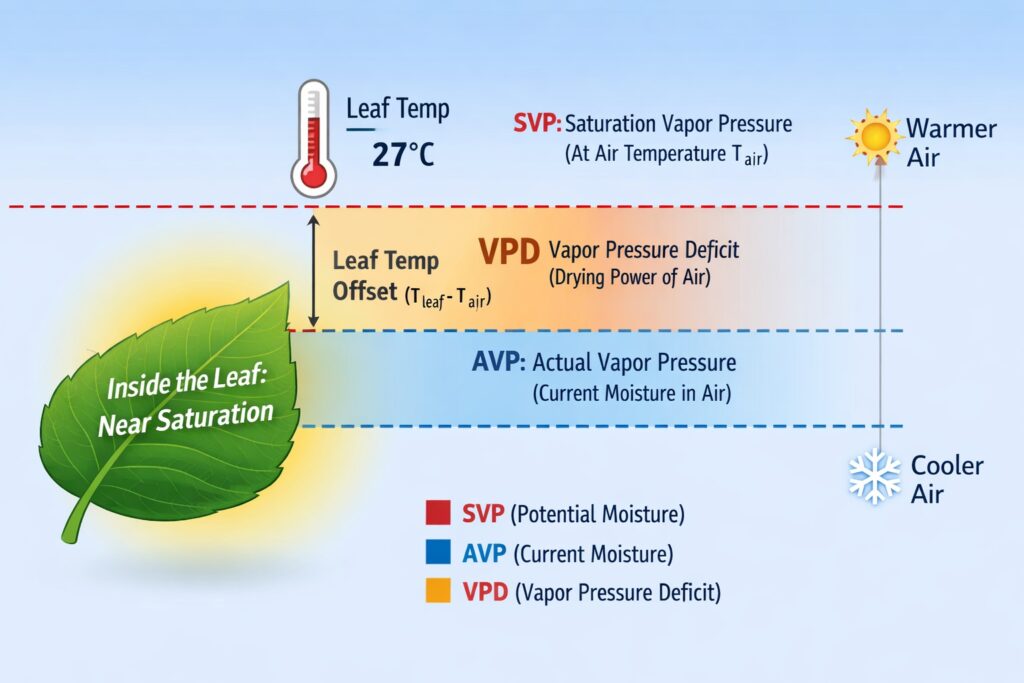
Think of VPD as the evaporation pressure acting on your plant. Vapor Pressure Deficit (VPD) depends on Air Temperature (°C) and Relative Humidity (%). To calculate Vapor Pressure Deficit you need to calculate “Saturation Vapor Pressure”, “Actual Vapor Pressure”, and “Leaf Temperature Offset”.
1. What is Saturation Vapor Pressure (SVP)?
SVP represents the maximum moisture the air could hold at a given temperature.
SVP Calculation Formula
You can calculate the saturation vapor pressure from Air Temperature.
SVP = 0.6108 × e(17.27 × T) / (T + 237.3)
Where T is the Temperature in °C and Saturation vapor pressure (SVP) in kPa
2. What is Actual Vapor Pressure (AVP)?
Actual Vapor Pressure (AVP) is the amount of water vapor that is actually present in the air at a given temperature. It represents the moisture in the air in pressure terms (kPa). Air can hold a maximum amount of water vapor depending on temperature. But most of the time, it holds less than that maximum.
- The maximum possible moisture = Saturation Vapor Pressure (SVP)
- The current moisture in air = Actual Vapor Pressure (AVP)
How to Calculate AVP
You can calculate the Actual Vapor Pressure (AVP) from Saturation Vapor Pressure (SVP) and Relative Humidity (RH).
AVP = SVP × RH/100
Where RH is Relative Humidity in %.
The Leaf Temperature Offset is the difference between the ambient air temperature and the actual temperature of the plant’s leaves.
- Calculation Formula: Offset = TAir – TLeaf
- Healthy Range: In a well-functioning indoor farm, the offset is usually between -1°C to -3°.
The VPD Sweet Spot: Ideal Ranges for Every Growth Stage
A common mistake is picking one VPD value and sticking to it from seed to harvest. In nature, the environment shifts as seasons progress, and your indoor “season” should do the same. By adjusting your VPD targets, you are essentially telling the plant what to prioritize: root development, leaf mass, or resin production.
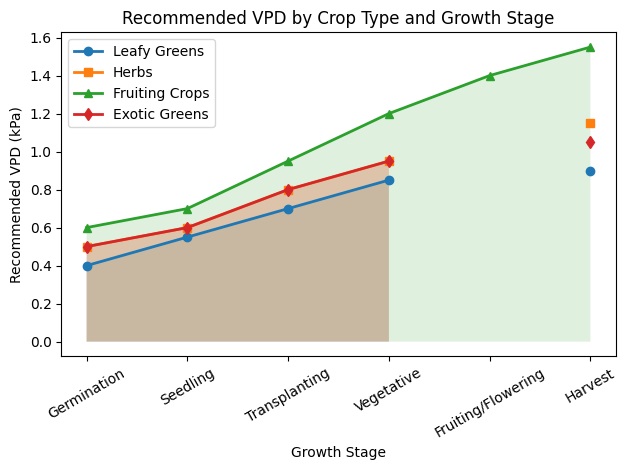
Recommended VPD Ranges by Crop Type and Growth Stage (kPa)
| Crop Type | Germination | Seedling | Transplanting | Vegetative | Fruiting / Flowering |
Harvest |
|---|---|---|---|---|---|---|
| Leafy Greens | 0.3 – 0.5 | 0.4 – 0.7 | 0.6 – 0.8 | 0.7 – 1.0 | Not Applicable | 0.8 – 1.0 |
| Herbs | 0.4 – 0.6 | 0.5 – 0.7 | 0.7 – 0.9 | 0.8 – 1.1 | Not Applicable | 1.0 – 1.3 |
| Fruiting Crops | 0.5 – 0.7 | 0.6 – 0.8 | 0.8 – 1.1 | 1.0 – 1.4 | 1.2 – 1.6 | 1.3 – 1.7 |
| Exotic Greens | 0.4 – 0.6 | 0.5 – 0.7 | 0.7 – 0.9 | 0.8 – 1.1 | Not Applicable | 0.9 – 1.2 |
Note: These VPD values are general guidelines. Optimal VPD can vary depending on light intensity, airflow, plant density, and leaf temperature offset.
How VPD Drives Plant Health
Most growers think of humidity as a “comfort level” for plants, but in reality, Vapor Pressure Deficit (VPD) is the engine that drives a plant’s entire circulatory system.
High VPD: The Danger of "Redlining"
When the air is too dry and hot, the VPD is high. The “pull” becomes so aggressive that the plant can’t keep up.
- Nutrient Burn: The plant is forced to drink water at a rapid rate to avoid wilting. As it drinks, it pulls in more salts and minerals than it can process, leading to “burnt” leaf tips even if your soil mix is perfect.
- Stomatal Closure: To prevent dehydration, the plant goes into “survival mode” and closes its stomata. While this saves water, it also stops CO₂ intake. No CO₂ means no photosynthesis, which means zero growth.
- Tacoing: You may notice leaves curling upward into a “taco” shape. This is a physical defense mechanism to reduce the surface area exposed to the dry air.
Low VPD: The "Stalled" Engine
When the air is too humid, the VPD is low. The air is already so full of moisture that it won’t accept any more from the leaf.
- Mineral Deficiencies: Because there is no “pull” from the air, the water stays stagnant in the plant. Even if your soil is rich in nutrients, they never reach the top of the plant. This often shows up as Calcium deficiency (tip burn or spotting) because Calcium is an immobile element that relies entirely on transpiration to move.
- Fungal Invitations: Stagnant, moisture-heavy air is the primary breeding ground for Botrytis (Bud Rot) and Powdery Mildew.
- Guttation: In extreme low-VPD environments, you might see water droplets forming on the edges of leaves. This is the plant literally “leaking” under internal pressure because it cannot transpire naturally.
How to Calculate VPD (Vapor Pressure Deficit)
Air Has a Moisture Capacity Limit. At any temperature, air can only hold a certain maximum amount of water vapor.
- Warmer air → higher moisture capacity
- Cooler air → lower moisture capacity
Air Is Usually Not Fully Saturated. Most of the time, air holds less water than its maximum capacity. The current amount of water vapor present is AVP.
Plants Lose Water Because of a Difference between maximum moisture air can hold and the moisture air is currently holding. And VPD represents this drying power of air. To calculate VPD, we subtract SVP from AVP.
- Water moves from areas of higher vapor pressure to lower vapor pressure.
- Inside a leaf Air spaces are nearly saturated (almost 100% humidity); Vapor pressure ≈ SVP at leaf temperature.
- Outside the leaf: Vapor pressure = AVP; So the driving force for water loss is = Leaf Vapor Pressure − Air Vapor Pressure
Steps in Calculating the VPD
You can calculate Vapor Pressure Deficit (VPD) using three main steps. However, for more accurate plant climate control, it is important to consider leaf temperature instead of only air temperature.
Plants transpire from the leaf surface, so the vapor pressure at the leaf is determined by leaf temperature, not air temperature. The difference between these temperatures is called the Leaf Temperature Offset.
For example, if air temperature is 25°C and the leaf is 2°C warmer, then Leaf temperature will be 27°C.
Step 1: Calculate Saturation Vapor Pressure (SVP)
SVPAir = 0.6108 × e(17.27 × T) / (T + 237.3)
SVPLeaf = 0.6108 × e(17.27 × TLeaf) / (TLeaf + 237.3)
Where T is the Air Temperature & TLeaf is Leaf Surface Temperature in °C and Saturation vapor pressure (SVP) in kPa. Consider SVPLeaf instead of SVP for more accurate results.Step 2: Calculate Actual Vapor Pressure (AVP)
AVP = SVP Air × RH/100
Where RH is Relative Humidity in %.Step 3: Calculate Vapor Pressure Deficit (VPD)
Next step is to calculate the Vapor Pressure Deficit (VPD)
Since leaf vapor pressure ≈ SVP
VPD = SVPLeaf – AVP
How Air Temperature and RH impact VPD
As temperatures rise, notice how you must aggressively increase humidity to stay within the healthy green “Sweet Spot.”
Universal VPD Growth Chart
Full Range: 5°C to 45°C | -2.0°C Leaf Offset
| Temp \ RH | 10% | 20% | 30% | 40% | 50% | 60% | 70% | 80% | 90% | 100% |
|---|---|---|---|---|---|---|---|---|---|---|
| 5°C | 0.67 | 0.58 | 0.50 | 0.41 | 0.32 | 0.23 | 0.15 | 0.06 | -0.03 | -0.11 |
| 10°C | 0.95 | 0.83 | 0.70 | 0.58 | 0.46 | 0.34 | 0.21 | 0.09 | -0.03 | -0.16 |
| 15°C | 1.33 | 1.16 | 0.99 | 0.82 | 0.65 | 0.47 | 0.30 | 0.13 | -0.04 | -0.21 |
| 20°C | 1.83 | 1.60 | 1.36 | 1.13 | 0.89 | 0.66 | 0.43 | 0.19 | -0.04 | -0.27 |
| 25°C | 2.49 | 2.18 | 1.86 | 1.54 | 1.23 | 0.91 | 0.59 | 0.28 | -0.04 | -0.36 |
| 30°C | 3.36 | 2.93 | 2.51 | 2.08 | 1.66 | 1.23 | 0.81 | 0.39 | -0.04 | -0.46 |
| 35°C | 4.47 | 3.91 | 3.34 | 2.78 | 2.22 | 1.66 | 1.09 | 0.53 | -0.03 | -0.59 |
| 40°C | 5.89 | 5.15 | 4.41 | 3.67 | 2.94 | 2.20 | 1.46 | 0.72 | -0.01 | -0.75 |
| 45°C | 7.68 | 6.72 | 5.76 | 4.81 | 3.85 | 2.89 | 1.93 | 0.97 | 0.02 | -0.94 |
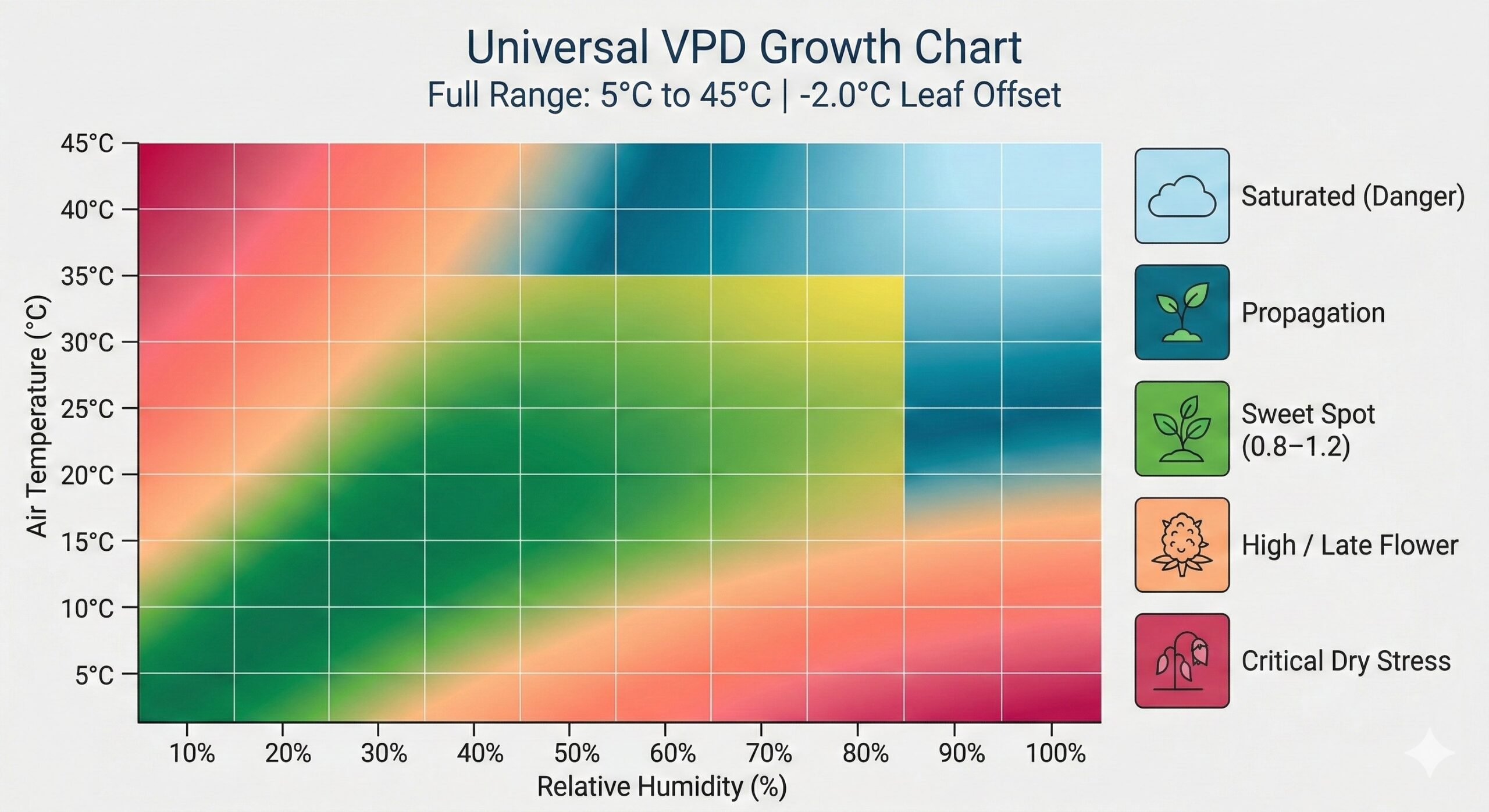
- Cold Temperatures (5°C): At low temperatures, the air has almost no capacity to hold water. Notice that even at 50% RH, you are already in the “Danger” zone for microgreens or young plants.
- The Summer Shift (45°C): In the extreme heat of the Indian plains, a plant will stay in the Sweet Spot only if the humidity is extremely high (80%). In a typical dry summer (10%–20%RH), the VPD climbs to over 7.0 kPa, which is physically impossible for most crops to survive without intensive misting or cooling.
- The Dew Point Floor: Values shown in negative numbers (Red) represent conditions where water will condense on leaves, making it impossible for the plant to transpire.
Practical Ways to control VPD
Knowing your VPD is one thing; controlling it is where the real artistry of growing happens. Because VPD is a “moving target” influenced by both heat and moisture, your strategy must change depending on your plant’s life cycle.
Scenario A: Your VPD is Too High (The "Desert" Effect)
When VPD is too high , your plants are under constant stress. They lose water faster than they can drink it, leading to nutrient burn and “tacoing” leaves.
- The “Micro-Mist” Strategy: If your room is too dry, an ultrasonic humidifier is your best friend. Unlike standard humidifiers, these create a fine cool mist that lowers the ambient temperature while raising humidity.
- The Dimmer Switch Secret: If your VPD is spiking due to heat from your lights, don’t just blast the AC. Try dimming your LEDs by 10-15%. You’ll lose a tiny bit of light intensity, but the drop in leaf surface temperature will drastically improve the plant’s metabolic health.
- Seal the Room: High VPD is often caused by over-ventilation. If you are pulling in too much dry outside air, your humidifier can’t keep up. Try slowing down your intake fans to let the moisture from the plants’ own transpiration build up naturally.
Scenario B: Your VPD is Too Low (The "Swamp" Effect)
A low VPD creates a stagnant environment where plants “stop breathing. This is the danger zone for Bud Rot (Botrytis) and White Powdery Mildew.
- Active Dehumidification (The Gold Standard): You cannot rely on exhaust fans alone during the dark cycle or late flower. A dedicated refrigerant dehumidifier is essential. It pulls moisture out of the air and adds a small amount of “latent heat,” which helps nudge a low VPD back into the healthy range.
- The “Air Scrub” Method: Sometimes the room’s VPD looks fine on the sensor, but the air inside the plant canopy is a stagnant swamp. Use “under-canopy” fans to blow air upward. This breaks the boundary layer—the thin film of moisture sitting on the leaf—allowing the plant to transpire even in humid conditions.
- The “Defoliation Reset”: If your humidity is stubbornly high, your plants might be their own worst enemy. Strategic pruning of large fan leaves reduces the total “sweat” (transpiration) entering the air, naturally raising the VPD.
The "Set It and Forget It" Solution: Environmental Automation
Manually chasing VPD with a thermometer and a spray bottle is a recipe for burnout. The modern solution is a VPD-Integrated Controller.
Instead of setting your equipment to trigger at “60% Humidity,” a smart controller calculates the VPD in real-time. It will speed up your fans if the air gets too stagnant or kick on the humidifier if the VPD climbs. This creates a “flat line” on your environment charts, which is the secret to explosive, stress-free growth.
Critical Points to Understand on VPD
What This Difference Physically Means
- If AVP is close to SVP → air is moist → small difference → low VPD
- If AVP is far below SVP → air is dry → big difference → high VPD
The difference between SVP and AVP creates a pressure gradient. That gradient pulls water out of leaves.
- No difference between SVP and AVP leads to no evaporation.
- Whereas, a Large difference between SVP and AVP leads to rapid evaporation.
Simple Analogy to understand VPD
You can think of:
- SVP as a fully filled water tank
- AVP as the current water level
The empty space between them is the “deficit.” That empty space is what allows more water to evaporate.
Why We Don’t Add SVP+AVP to calculate VPD?
If we added: SVP+AVP
- That would represent total moisture potential —
- But it would not tell us the evaporation driving force.
Plants respond to the difference, not the total.
What Vapor Pressure Difference (VPD = SVP − AVP) actually Controls
Because evaporation depends on how far the air is from saturation. That gap is what controls:
- Transpiration
- Nutrient uptake
- Disease risk
- Growth rate