Critical Parameters in a Hydroponics for Maximum Yield

Hydroponics works on a simple promise: Remove Soil, Control Everything Else.

But you must continuously monitor the right parameters for optimum plant growth in hydroponics. Unlike soil farming, hydroponics offers no forgiveness window. A small deviation can silently stress plants long before visible symptoms appear. 

This article covers non-negotiable parameters every hydroponic grower must monitor, explains why they matter biologically, and highlights what usually goes wrong when they are ignored.

Why These Critical Parameters Determine Your Success

Many beginners believe hydroponics success depends on choosing the right nutrient brand. In reality, crops fail because:

  • Nutrients are present but unavailable
  • Roots are submerged but oxygen-starved
  • Water exists but temperature is lethal
  • Plants receive light but cannot transpire

Critical Parameters you need to Monitor in Hydroponics

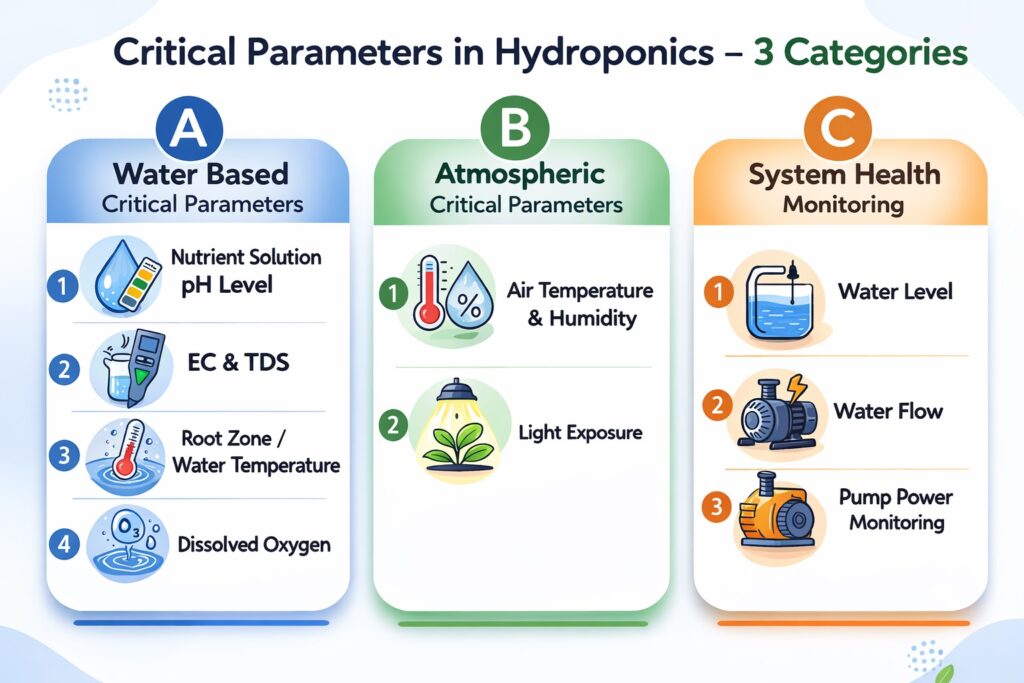
We can divide Critical Parameters in Hydroponics into following three Categories:

  1. Water Based Critical Parameters
    1. Nutrient Solution pH Level
    2. Electrical Conductivity and TDS
    3. Root Zone / Water Temperature
    4. Dissolved Oxygen
  2. Atmospheric Critical Parameters
    1. Air Temperature Around and Relative Humidity
    2. Light Exposure
  3. System Health Monitoring Monitoring
    1. Water Level
    2. Water Flow
    3. Pump Power Monitoring
Hydroponic critical parameters chart showing pH, EC, dissolved oxygen, temperature, humidity, light exposure, water level, and pump monitoring.

Critical Parameters: What it Controls and Future Outcome

Parameter What It Controls Failure Outcome
pH Nutrient availability Hidden deficiencies
EC Nutrient strength Burn or starvation
Water Temp Oxygen & root health Root collapse
DO (Dissolved Oxygen) Root respiration Sudden wilting
Air Temp Metabolism Growth distortion
Humidity Transpiration Weak nutrient flow
Water Level System integrity Pump failure
Light Photosynthesis Low yield

Water-Based Critical Parameters (pH, EC, DO)

The nutrient solution serves as the circulatory system of your plants, where pH, EC, and Dissolved Oxygen (DO) dictate nutrient solubility and uptake efficiency. Mastering these three variables ensures that your roots remain healthy and capable of absorbing the elements required for rapid growth.

Typical working range for hydroponic system is 5.5–6.5. pH determines which nutrients are chemically accessible to plant roots. The eaxt value of pH you need to control depends on crop type. 

Outside the ideal range, nutrients remain in the water but become biologically useless. We suggest you to read this article on How to control pH in a hydroponic system.

Nutrient Solution pH Sensor Options & Cost (₹)

Sensor Type Typical Price (₹) Implementation Notes
Basic Analog Lab Probe ₹750 – ₹2,000 Best for manual testing. If used for automation, requires a PH-4502C amplifier board.
Industrial "Online" pH Sensor ₹4,500 – ₹8,000 Recommended for Automation. Designed for 24/7 immersion with low drift. Often uses RS485/Modbus.
Atlas Scientific EZO-pH Kit ₹12,000 – ₹18,000 Top-tier DIY choice. Digital (I2C) output; extremely accurate and handles electrical isolation well.
LABART 7-in-1 Sensor ~₹11,999 All-in-one probe (pH/EC/Temp/NPK). Best for centralized data logging via RS485.
Hanna GroLine Monitor ~₹24,940 Commercial-grade wall-mount display. Includes high-quality probe + calibration solutions.

2. Electrical Conductivity (EC) & TDS

EC represents the total dissolved salts in the nutrient solution. It does not measure nutrient balance—only strength.

  • Low EC → underfeeding or dilution
  • High EC → salt stress and restricted water uptake

EC does NOT tell you which nutrient is deficient, or Whether plants are absorbing nutrients correctly.

Electrical Conductivity (EC) Sensor Options & Cost (₹)

Sensor Type Typical Price (₹) Implementation Notes
Consumer Handheld Meter ₹470 – ₹1,000 Manual spot-checks only. Cannot be easily integrated into a microcontroller.
Analog EC Kit (V2) ₹6,500 – ₹8,500 Best for DIY Automation. DFRobot/Gravity style. Includes BNC probe and signal board for Arduino.
Industrial RS485 Sensor ₹10,500 – ₹15,000 Modbus RTU protocol. IP68 rated for permanent immersion. Very high noise resistance.
Atlas Scientific EZO-EC ₹16,000 – ₹22,000 Lab-grade accuracy. Digital (I2C/UART) output. Requires separate circuit + probe.
LABART 7-in-1 Sensor ~₹11,999 Multi-parameter (pH+EC+NPK). Uses RS485. Best for all-in-one root zone monitoring.
Hanna GroLine Monitor ~₹24,940 Professional standalone wall-mount monitor. High reliability, low maintenance.

3. Root Zone (Water) Temperature

Optimal range for water termerature is different for different crops. Its value varies from 18°C to 24°C.  Root temperature directly affects Oxygen solubility, Root respiration, Microbial activity.

When water temperature rises Dissolved oxygen drops, Pathogens multiply faster,  and Roots suffocate even in flowing water.

Water Temperature Measurement Sensors

Sensor Type Typical Price (₹) Implementation Notes
Digital Probe (DS18B20) ₹100 – ₹350 Stainless steel waterproof probe. Digital "One-Wire" interface is easy to code.
NTC Thermistor (10K) ₹50 – ₹150 Analog output. Needs a 10k resistor and Steinhart-Hart equation in code.
RTD PT100 / PT1000 ₹450 – ₹1,500 High precision. Requires an interface board (MAX31865) for microcontrollers.
Industrial Transmitter ₹1,500 – ₹5,500 Best for large-scale systems. Uses 4-20mA or Modbus for long cable runs.
Contactless IR Sensor ₹700 – ₹1,200 Measures surface temp without touching the water. Uses I2C communication.

4. Dissolved Oxygen (DO)

Roots consume oxygen continuously. Without enough dissolved oxygen, nutrient uptake slows before plants show stress.

Low DO often occurs due to High water temperature, Low flow in NFT channels, and Poor aeration in DWC systems.

Dissolved Oxygen (DO) Sensor Comparison

Sensor Type Typical Price (₹) Implementation Notes
DIY Hobbyist (Galvanic) ₹4,500 – ₹6,500 Best for Arduino/ESP32; includes BNC signal converter board.
Lab Grade Membrane ₹20,000 – ₹30,000 Higher accuracy; requires electrolyte refilling and membrane care.
Industrial (Polarographic) ₹35,000 – ₹55,000 Standard for STP/ETP plants; needs 10-minute warm-up time.
Optical (LDO/Fluorescence) ₹80,000 – ₹1,50,000 Zero maintenance; no electrolyte needed. High-end automation.
Handheld / Pen Type ₹2,500 – ₹12,000 Manual spot-checking only; probe not designed for constant submersion.

Atmospheric Critical Parameters

Mastering the climate around your crop is just as vital as managing the water within the reservoir. Parameters like Temperature, Relative Humidity, and Light are the primary architects of plant metabolism, determining how fast your crop grows and how well it can resist heat stress or fungal pathogens in a high-density hydroponic setup.

1. Vapor Pressure Deficit : Air Temperature and RH

Many growers monitor temperature and humidity separately. But plants don’t respond to them separately. They respond to Vapor Pressure Deficit (VPD).

VPD measures the difference between the moisture the air can hold and the moisture it currently holds. In other words VPD tells you how strongly the air is pulling water out of the plant. It directly controls Transpiration rate, Nutrient movement, Calcium uptake, Plant stress levels.

VPD combines temperature + humidity into one meaningful value.

  • Low VPD (High Humidity) leads to Poor transpiration, Weak calcium movement, Risk of fungal disease and slow growth.
  • High VPD (Low Humidity / High Temp) leads to Excessive water loss, Leaf edge burn, Stomata close, and slow growth.

Air Temperature Around the Plant

Plants regulate growth through air temperature, not water temperature. Air temperature affect plants transpiration rate, nutrient demand, growth speed and morphology.

Ignoring air temperature leads to misinterpreting nutrient problems that are actually climate problems.

Relative Humidity (RH)

Humidity controls how efficiently plants move water from roots to leaves.

  • Low humidity causes excessive transpiration, calcium issues
  • High humidity results in poor nutrient movement, disease risk

Air Temperature & Relative Humidity (RH) Sensors

Sensor Type Typical Price (₹) Implementation Notes
Entry-Level (DHT11) ₹70 – ₹150 Cheap; low accuracy (±5% RH). Prone to failure in 80%+ humidity.
Standard (DHT22/AM2302) ₹250 – ₹450 Moderate accuracy; digital signal. Very popular for ESP32/Arduino.
Pro Hobbyist (SHT31-D) ₹600 – ₹1,200 Best for Grow Tents. High precision; uses I2C interface.
3-in-1 (BME280) ₹280 – ₹600 Includes Barometric Pressure. Crucial for calculating VPD accurately.
Industrial Transmitter ₹2,500 – ₹9,500 RS485/Modbus. Long-range wiring; moisture-resistant casing.

 Light drives photosynthesis, which drives everything else. Monitoring light matters even with natural sunlight, Open terraces, Greenhouses.

Seasonal changes alter both intensity and duration, affecting nutrient demand and growth cycles.

Quick Comparison Table: Light Measurement Tools

Method Accuracy Estimated Cost (INR) Best For
PAR Meter High (PPFD) ₹5,000 – ₹45,000+ Commercial & Professional Growers
Lux Meter Medium ₹800 – ₹3,500 Leafy Greens & Budget Hobbyists
Smartphone App Low / Medium Free / ₹399 (Pro) Beginners & Quick DIY Checks

System Health Monitoring Parameters

In a high-performance hydroponic setup, the life-support machinery must be as reliable as the chemistry. System health parameters including water flow, reservoir levels, and pump power consumption—act as an early-warning system that safeguards your investment against mechanical fatigue or plumbing obstructions.

1. Water Level Monitoring

Hydroponic systems fail mechanically more often than biologically. Common causes for the mechanical failure are empty reservoirs, dry-running pumps, blocked channels, Uneven flow distribution.

Water Level & Depth Sensors

Sensor Type Typical Price (₹) Implementation Notes
Mechanical Float Switch ₹70 – ₹250 Magnetic reed switch. Best for "Dry-Run" protection for pumps.
Contactless (XKC-Y26) ₹550 – ₹950 Sticks to outside of plastic tanks. Zero corrosion risk. Digital output.
Waterproof Ultrasonic ₹350 – ₹600 JSN-SR04T model. Measures exact % of water remaining in the tank.
Optical Point Sensor ₹700 – ₹1,800 Uses infrared light. No moving parts; immune to salt/nutrient buildup.
Pressure Transducer ₹4,500 – ₹15,000 Industrial standard (4-20mA). Measures height via water pressure.

2. Water Flow Monitoring (A Simple Proxy for Circulation Health)

Water flow sensors are vital for ensuring that your pumps are actually moving water through the pipes (e.g., in an NFT or Drip system). Measuring flow helps identify clogged lines, pump degradation, or even catastrophic leaks before they kill your plants.

A water flow sensor does not measure nutrient quality or dissolved oxygen directly, but it confirms if water actually moving through the system?

Proper water circulation ensures Continuous nutrient delivery, Oxygen replenishment in the root zone, Prevention of stagnant zones and Uniform temperature distribution.

Water Flow Monitoring Sensors

Sensor Type Typical Price (₹) Implementation Notes
Hobbyist Turbine (YF-S201) ₹185 – ₹450 Simple pulse output (Hz). Requires calibration to convert pulses to Liters/min.
Micro Flow (YF-S401) ₹220 – ₹550 High sensitivity for low-flow drip systems. 1/8" or 1/4" fittings.
Heavy Duty Brass Sensor ₹1,500 – ₹3,500 Corrosion-resistant metal body. Better for permanent, high-pressure plumbing.
Industrial Paddle Wheel ₹4,500 – ₹7,500 Low maintenance; open-flow design is less prone to "jamming" from salt buildup.
Electromagnetic Meter ₹15,000 – ₹25,000 Maintenance Free. Measures flow via magnetic fields. No moving parts to wear out.

 3. Pump Power Monitoring

Most growers monitor pH, EC, and temperature. Very few monitor the heart of the system the pump. Your circulation pump ensures Nutrient delivery, Oxygen replenishment, Temperature uniformity to your plants. If the pump fails, everything else becomes irrelevant.

A pump power monitoring sensor tracks how much electrical power your pump is consuming in real time. Instead of measuring dissolved oxygen directly (which requires expensive probes), you monitor proxy for the oxygen levels.

Pump Power & Current Monitoring Sensors

Sensor Type Typical Price (₹) Implementation Notes
Hall Effect (ACS712) ₹80 – ₹250 In-line sensor (requires cutting wire). Works for both AC and DC pumps.
Non-Invasive (SCT-013) ₹350 – ₹950 Best for AC. Clamp-on design; no direct contact with high voltage.
Digital Power (INA219) ₹100 – ₹450 High precision for DC pumps. Provides Voltage, Current, and Wattage via I2C.
Smart Monitoring Plug ₹600 – ₹1,500 Plug-and-play WiFi option. Useful for simple alerts via smartphone apps.
Industrial Energy Meter ₹2,500 – ₹6,500 RS485/Modbus. Best for commercial setups needing total energy (kWh) tracking.

Cost for Hydroponic Sensors Kit

Investing in the right sensor kit is a balance between precision and budget. While entry-level kits are excellent for learning the basics of water chemistry, professional-grade sensors offer the long-term stability required for fully automated, ‘set-and-forget’ hydroponic systems. Below is a breakdown of the estimated costs for sensor kits based on their accuracy and durability.

Estimated Cost for Hydroponic Sensor Kits

Kit Tier Typical Price (₹) Key Components
Basic DIY ₹2,500 – ₹4,500 DHT22, DS18B20, Basic pH Probe, Basic EC Probe, Ultrasonic Level.
Automation Ready ₹8,000 – ₹15,000 SHT31 (Temp & RH), Analog EC Kit, Industrial pH Probe, Ultrasonic Level.
Professional IoT ₹35,000 – ₹65,000 Atlas Scientific EZO Kits, RS485 Industrial Sensors.
7-in-1 Integrated ₹12,000 – ₹25,000 Multi-parameter Industrial Probes (RS485/Modbus).

Which Sensor Kit is Right for You?

Selection of the best kit depends on your skill level and requirements:

The Basic DIY Kit (₹2,500 – ₹4,500)

This is perfect if you are a student or a beginner building your first small Kratky or DWC bucket. It’s a low-risk way to learn the basics of data logging, but be prepared to calibrate your pH probe frequently (at least once a week) as these entry-level sensors can drift.

The Automation-Ready Kit (₹8,000 – ₹15,000)

This is the “Sweet Spot” for serious home growers. If you are building a balcony NFT system or a small grow tent, this kit provides the reliability needed to trust your sensors with 24/7 monitoring. The upgraded SHT31 and Industrial pH probes offer much better stability in high-humidity environments.

The 7-in-1 Integrated Sensor (₹12,000 – ₹25,000)

Choose this if you value simplicity and clean wiring. Instead of having five different cables tangling in your reservoir, this single RS485 probe handles almost everything. It is the best choice for rapid deployment in mid-sized greenhouses.

The Professional IoT Kit (₹35,000 – ₹65,000)

This is an investment for commercial success. If you are growing high-value crops (like exotic greens or medicinal plants) where a 0.5 pH error could cost you thousands in lost yield, the lab-grade accuracy of Atlas Scientific or industrial Modbus sensors is essential.

Don’t Forget the "Hidden" Costs of Monitoring

When budgeting for your sensor kit, it is important to set aside an additional ₹1,000 to ₹2,500 for essential accessories. These items aren’t just “extras”—they are required to keep your critical parameters accurate and your electronics safe:

Calibration Buffers (pH 4.0, 7.0, & 10.0)

Digital pH probes drift over time. To ensure your “critical” readings are actually correct, you must calibrate them at least once a month using standard buffer solutions.

KCL Storage Solution

High-quality pH probes must never dry out. A small bottle of Potassium Chloride (KCL) solution is necessary to keep the probe tip hydrated and functional.

Leave a Comment

Your email address will not be published. Required fields are marked *

Scroll to Top