
Light is the engine of any hydroponic system. Since plants are grown without soil, they rely even more on light to produce energy and grow properly. If nutrients are the food, light is the fuel that helps plants use that food.
This article explains how much light hydroponic plants need, what type of light works best, and how to manage lighting efficiently for different crops and systems.
Why Light Matters in Hydroponics
Plants use light for photosynthesis: Process where light energy is converted into sugars that drive growth.
- Too little light means → Slow growth, weak stems, pale leaves
- Too much light means → Leaf burn, stress, wasted electricity
- Optimum light means → Fast growth, healthy color, better yield
Understanding Key Light Parameters
Here is the list of three parameters that defines the plant growth:
1. Light Spectrum (Blue Red and Full Spectrum)
Plants do not See light like humans. Brightness to human eyes does not matter much to plants. They respond mainly to color (wavelength).
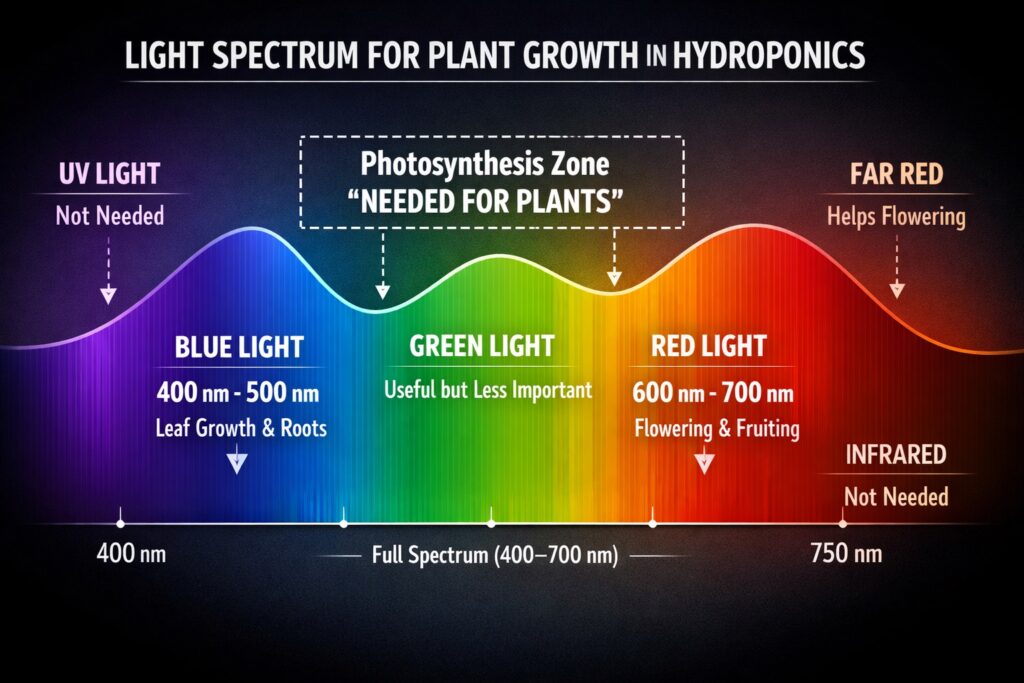
Blue Light (around 450 nm)
- Encourages compact growth
- Strong stems
- Better leaf development
- Very important for nursery and leafy greens
Red Light (around 660 nm)
- Drives photosynthesis
- Boosts biomass
- Essential for flowering and fruiting
White / Full Spectrum Light
White or full spectrum light is a combination of blue, green, red that is Closest to natural sunlight.
- Easier to manage for beginners
- Works across multiple crops and stages
2. Light Intensity (PPFD)
This measures the “density” of light hitting your leaves. In high-heat areas like North India, you want high PPFD LEDs that don’t require hanging the light too close to the water, which prevents your reservoir from overheating.
PPFD is like “Gallons per minute.” It tells you the pressure or volume of the water hitting the ground.
3. PAR (Photosynthetic Active Radiation)
PAR (Photosynthetic Active Radiation) refers to the spectral range of light (400 to 700 nanometers) that plants actually use for photosynthesis. While PPFD measures the intensity of that light at a specific point, PAR is often discussed in terms of the overall light “quality” or total output.
4. PPF (Photosynthetic Photon Flux)
While PPFD tells you what the plant is receiving, PPF (Photosynthetic Photon Flux) tells you what the light fixture is actually capable of producing.
Understanding PPF (The Source)
| Metric | What it Measures | Unit of Measurement |
|---|---|---|
| PPF | Total light output per second from the lamp | µmol/s (Micromoles per second) |
| PPFD | Light intensity arriving at the plant canopy | µmol/m²/s (Micromoles per sq. meter per second) |
PPF is the total amount of food the kitchen cooks. Even if the kitchen is incredibly productive (High PPF), if the waiters (distance/reflectivity) are bad, very little food will actually reach the tables (PPFD).
Why PPF Matters for Your Setup
During grow lights selection, PPF is your “horsepower” rating. It tells us the total capacity of the light, regardless of how and where you use it.
- Fixture Efficiency: If a light has a high PPF but uses very little power (watts), it is a highly efficient light that will save you money on your electricity bill.
- Coverage Planning: PPF helps you decide how many lights you need for your space. A light with a low PPF will only be able to cover a small “Leafy Green” setup, whereas a high PPF light can penetrate deep canopies of “High-Light Crops.”
- Distance Independent: Unlike PPFD, which changes the moment you move the light higher or lower, PPF is constant. A 500 µmol/s light is always a 500 µmol/s light.
5. PPE (Photosynthetic Photon Efficacy)
While PPF is the total volume of light, PPE (Photosynthetic Photon Efficacy) is the efficiency of the conversion.
If PPF is the total food cooked, PPE is how much food you get per dollar spent on ingredients.
Grow Light Efficiency (PPE) Guide
| Efficiency Category | PPE Rating (µmol/j) | Performance Impact |
|---|---|---|
| Entry Level / Legacy | 1.0 – 1.8 µmol/j | High heat output; expensive to run long-term. |
| Mid-Range LED | 1.9 – 2.5 µmol/j | Good balance of cost and performance for hobbyists. |
| High-Efficiency LED | 2.6 – 3.2 µmol/j | Minimal heat; significantly lower electricity bills. |
| Cutting Edge | 3.3+ µmol/j | Current industry maximum; coolest operation. |
Why PPE is the Most Important Metric for Your Wallet
- Heat vs. Light: Every watt of electricity that doesn’t turn into a photon turns into heat. A light with a low PPE (like 1.5) will make your grow room much hotter than a light with a high PPE (like 3.0), even if they have the same brightness. A Low PPE will Lead to increased temperature.
- Operating Costs: PPE tells you how much “growth power” you get for every penny. Switching from a 1.5 PPE light to a 3.0 PPE light literally cuts your lighting bill in half for the exact same amount of plant growth.
- Calculation Formula: Total Output (PPF) / Power Used (Watts).
6. Light Duration (Photoperiod)
In hydroponics, the “Photoperiod” is the total number of hours your lights are on during a 24-hour cycle. Along with Light, plants actually require a period of darkness to complete essential biological processes.
The Importance of the Dark Period
During the day, plants focus on Photosynthesis (creating energy). During the night, they switch to Respiration, where they break down that energy to grow tissues and develop roots.
Without darkness plants can become stressed, develop yellow spots, or fail to produce flowers/fruit.
Most hydroponic plants need at least 6–8 hours of total darkness.
Managing Power Cuts
- Short outages: Don’t worry. 2–4 hours of missed light won’t harm your plants.
- The “Sleep” Rule: If power goes out during the dark period, keep the room dark.
- Manual Reset: After power returns, always reset your mechanical timers; they will be “lagging” by the duration of the cut.
Automating Your Setup (The "Grower’s Best Friend")
Don’t rely on your memory to flip the switch every day. Inconsistent light cycles can confuse your plants and lead to hermaphroditism or stunted growth.
- Mechanical Timers: Simple, “plug-and-play” devices (starting at ₹400) that use pins to set the schedule.
- Smart Plugs: Use a WiFi-enabled smart plug (like TP-Link or Wipro) to control your lights via your smartphone and set precise schedules down to the minute.
7. DLI (Daily Light Integral)
This is the most important “pro-level” metric in indoor farming. If PPFD is the intensity of the “rainfall,” DLI (Daily Light Integral) is the total amount of “rain” that collected in the bucket by the end of the day.
Plants don’t just care how bright the light is right now; they care about the total energy they received over the entire 24-hour period.
Calculation Formula
DLI = PPFD x (Light Hours x 3600) / 1,000,000
DLI = PPFD x Light Hours x 0.0036
Why DLI Values are more important than any other Parameter
- Energy Savings: If you reach your DLI target in 14 hours, running your lights for 18 hours is just wasting electricity. The “bucket” is already full; the plant can’t use the extra “overflow.”
- Consistent Harvests: In winter, when natural light is low, pro growers use DLI to decide exactly how many hours of supplemental LED light they need to add to keep production consistent.
- Avoiding Stress: If your PPFD is very high, you must shorten the hours to ensure the DLI doesn’t exceed the plant’s limit, which causes “light toxicity.”
Optimal Light Requirements for Common Hydroponic Plants
Different plants have different “appetites” for light. While leafy greens are content with moderate intensity, fruiting plants are “light hungry” and require much higher PPFD levels to produce a harvest.
Recommended PAR Values (PPFD) by Stage
| Crop Type | Seedling Stage (µmol/m²/s) |
Vegetative Stage (µmol/m²/s) |
Flowering/Fruiting (µmol/m²/s) |
|---|---|---|---|
| Leafy Greens (Lettuce, Spinach) |
100–150 | 150–300 | N/A |
| Herbs (Basil, Mint, Cilantro) |
100–150 | 200–400 | 300–450 |
| Fruiting Crops (Tomato, Pepper) |
150–250 | 400–600 | 600–900 |
| High-Light Crops (Cucumber, Strawberry) |
150–250 | 500–700 | 700–1000+ |
Recommended Light Duration
| Crop Type | Seedling Stage (Daily Hours) |
Vegetative Stage (Daily Hours) |
Flowering/Fruiting (Daily Hours) |
|---|---|---|---|
| Leafy Greens (Lettuce, Spinach) |
16–18 hours | 12–16 hours | N/A (Harvested before bolting) |
| Herbs (Basil, Mint, Cilantro) |
16–18 hours | 14–18 hours | 12–14 hours (Optional for seeds) |
| Fruiting Crops (Tomato, Pepper) |
18–20 hours | 16–18 hours | 12–14 hours |
| High-Light Crops (Cucumber, Strawberry) |
18–20 hours | 16–18 hours | 12–16 hours |
Recommended DLI (mol/m²/day) by Growth Stage
| Crop Type | Seedling Stage | Vegetative Stage | Flowering/Fruiting |
|---|---|---|---|
| Leafy Greens | 6–10 | 12–17 | N/A |
| Herbs | 6–10 | 12–18 | 15–20 |
| Fruiting Crops | 8–12 | 15–25 | 25–35+ |
| High-Light Crops | 8–12 | 20–30 | 30–45+ |
Natural Sunlight vs Grow Light in Hydroponics
Choosing between the sun and artificial lights depends on your location, budget, and the specific plants you are growing. While sunlight is free, it isn’t always reliable for high-yield hydroponics.
Natural Sunlight
The best choice for a hydroponic system is to use Sunlight because its free and powerfull, works well for balconies, terraces, and green houses.
- Pros: Zero electricity cost, full-spectrum light, and environmentally friendly.
- Cons: Unpredictable intensity, heat buildup in reservoirs, and limited “light hours” during winter or monsoon.
- Best For: Leafy greens (Palak, Lettuce) and herbs on south-facing balconies.
- The Risk: Direct sunlight can heat up your nutrient solution above 25°C, leading to Root Rot and algae growth.
Grow Light
Artificial lights gives you a better control over the yield quality and quantity because they are consistent year round. You can precisely control the light intensity and the duration.
- Pros: Total control over the Photoperiod (hours of light), consistent intensity, and optimized spectrums for growth vs. flowering.
- Cons: High Initial investment cost (₹2,000–₹15,000+) and recurring electricity bills.
- Best For: High-value crops like Strawberries, Tomatoes, and Peppers that require 12–16 hours of intense light.
We suggest you to read this article on best Grow Lights for your system.
How to Measure Light Intensity in Your Hydroponic Setup?
Knowing the target PPFD for your plants is only half the battle. Because light intensity drops off significantly as you move away from the bulb—and because every grow light brand performs differently—you cannot rely on guesswork.
Instruments Used for Light Measurement
To ensure your plants are actually receiving the 200 to 900+ PPFD mentioned in the table above, you need to measure the light at the canopy level (the very top leaves of your plants).
Fortunately, you don’t need laboratory-grade equipment to get started. Here are the three most common ways to measure light in a home setup:Quick Comparison Table: Light Measurement Tools
| Method | Accuracy | Estimated Cost (INR) | Best For |
|---|---|---|---|
| PAR Meter | High (PPFD) | ₹5,000 – ₹45,000+ | Commercial & Professional Growers |
| Lux Meter | Medium | ₹800 – ₹3,500 | Leafy Greens & Budget Hobbyists |
| Smartphone App | Low / Medium | Free / ₹399 (Pro) | Beginners & Quick DIY Checks |
1. PAR Meter for PPFD Measurement: The Gold Standard
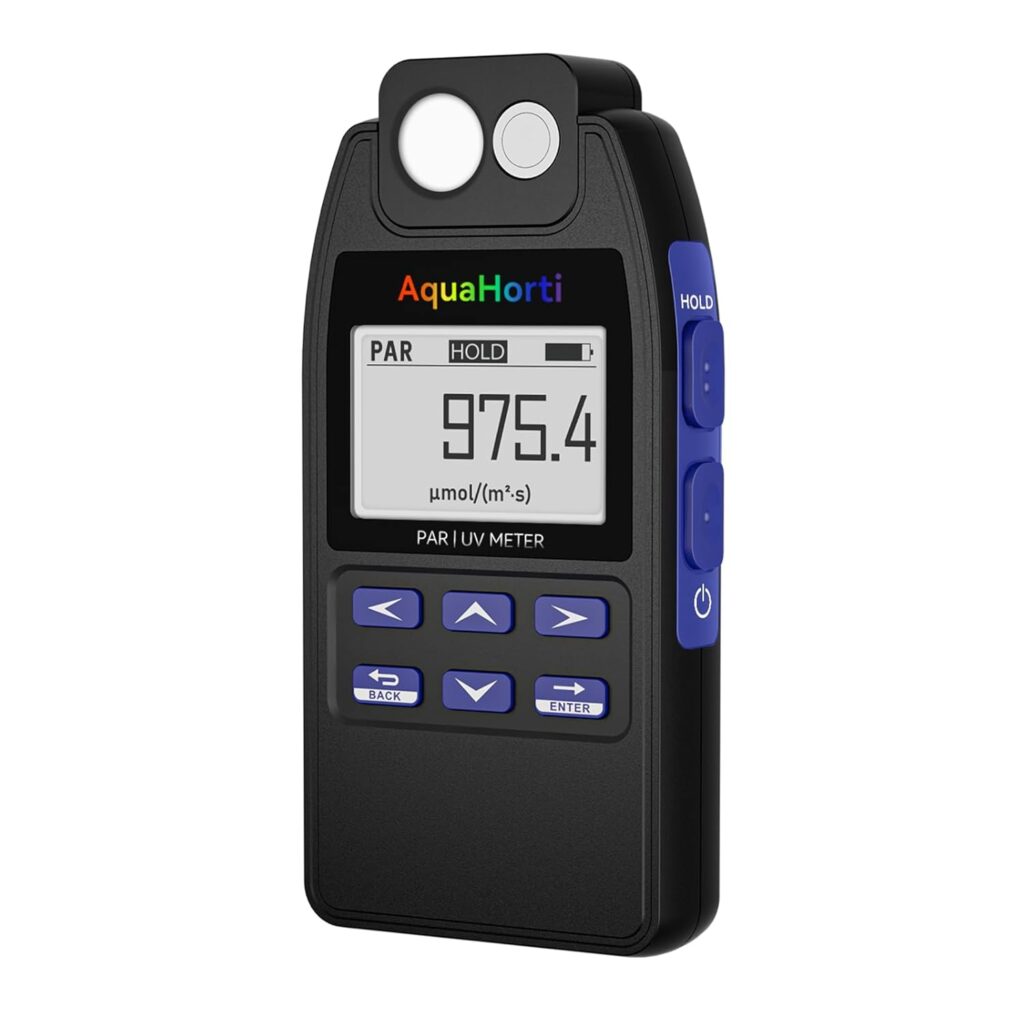
PAR meter measures PPFD (Photosynthetic Photon Flux Density), Light intensity in wavelength range (400nm to 700nm range) that plant need for photosynthesis. Best place to measure the PPFD values is at the top leaves. Measure the values at multiple locations to detect the hot spots.
2. Lux Meters and Conversion to PPFD
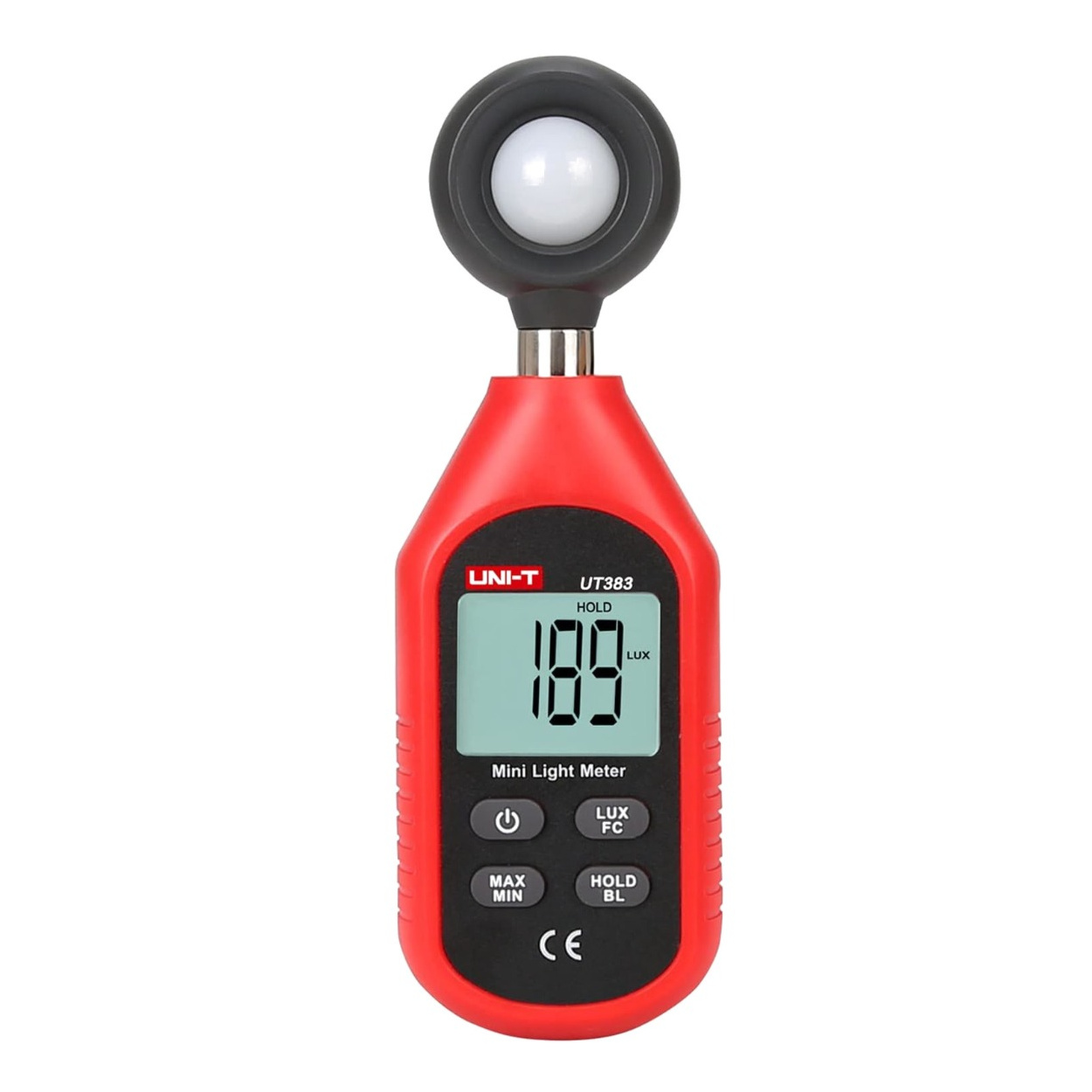
A Lux meter measures “lumens per square meter”. This is not but light intensity in complete wavelent range. This is not the right matrix to measure light for hydroponic system. But we can still use this as proxy for hydroponic growers on a budget.
To get a rough estimate of your PAR from a Lux reading, you can use a conversion factor.
PPFD = LUX Value / 70
This is an approximation. If you are using blurple (pink/purple) lights, Lux meters are highly inaccurate and should be avoided.
3. The Entry-Level Hack: Smartphone Apps
Modern smartphone cameras are sophisticated enough to act as basic light sensors when paired with the right software. You can use Apps like Photone or Korona to measure light PPFD.
Best way to Measure Light: Establishing Your Measurement Grid
Don’t just take one reading in the center of your tent and call it a day. Light intensity follows the Inverse Square Law, meaning it drops off significantly as you move away from the source.
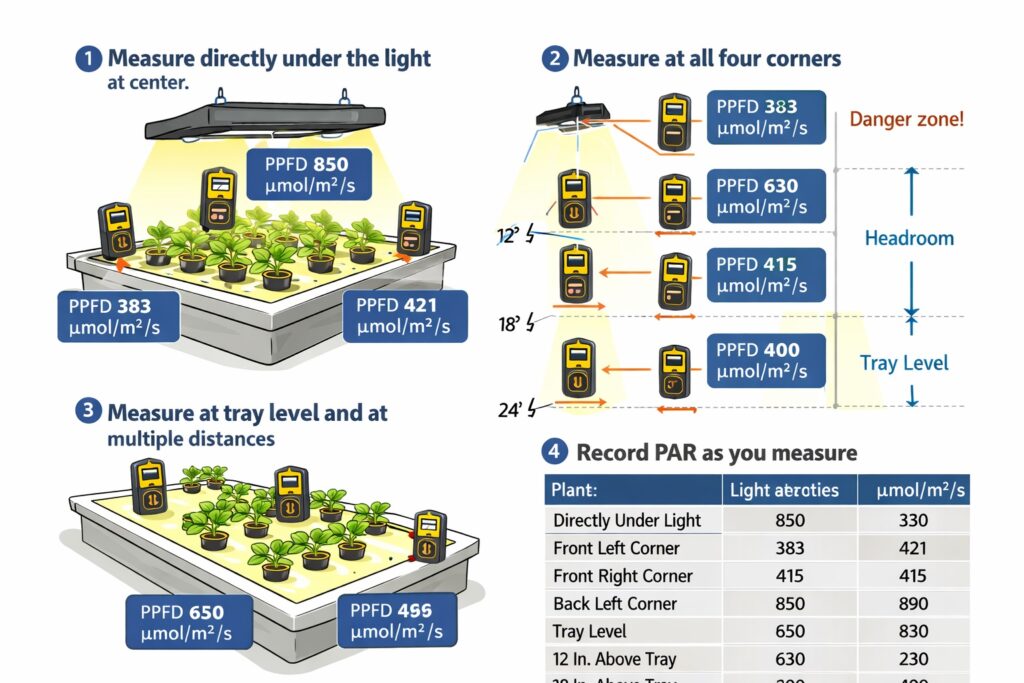
- Step 1: Record the reading directly under the light.
- Step 2: Measure the light readings at four corners of your hydroponic tray.
- Step 3: Measure the light at the tray level and at multiple distances. This gives ou “headroom” you have before your plants grow into a “danger zone” of light intensity.
- Step 4: Record the Data
5 Common Lighting Mistakes in Hydroponics
Avoid these pitfalls to ensure your indoor garden stays healthy and productive.
| The Mistake | Symptom | Impact | The Fix |
|---|---|---|---|
| Lights Too Far Away | Thin, "leggy" or stretchy stems. | Weak plants that cannot support their own weight. | Lower the light source. Aim for 12–24 inches for LEDs, depending on the wattage. |
| No "Dark Period" | Brittle leaves or failure to flower. | Plant stress; plants cannot complete essential respiration cycles. | Use a timer. Provide at least 6–8 hours of complete darkness every 24 hours. |
| Spectrum Mismatch | Lush leaves but no fruit, or stunted leaf growth. | Energy is wasted on the wrong growth stage. | Use Blue (6500K) for greens/veg and Red (2700K) for flowering, or switch to Full Spectrum. |
| Dirty Fixtures | General slow growth despite correct settings. | Dust and grime can block up to 20% of light intensity. | Wipe down LED diodes or bulbs with a dry microfiber cloth once a month. |
| Crowding & Shading | Uneven growth; edge plants leaning toward the center. | Lower yields and increased risk of pests in "shadow" zones. | Increase plant spacing and use reflective Mylar walls to bounce light back to the edges. |
Troubleshooting Guide: Is Your Light the Problem?
| Symptom | Likely Cause | Immediate Action / Fix |
|---|---|---|
| Thin, "Stretchy" Stems | Light is too far or too weak | Lower the light height or increase intensity |
| Brown/Crispy Leaf Tips | Light Burn (Heat or Intensity) | Raise the light by 4–6 inches (10–15 cm) |
| Very Slow Growth | Insufficient Light Hours | Increase photoperiod to 14–16 hours daily |
| Plants Leaning to One Side | Uneven Light Distribution | Rotate plants or add reflective Mylar walls |
| Yellowing/Stunted Growth | No "Dark Period" (Stress) | Ensure at least 6–8 hours of total darkness |
Frequently Asked Questions
How PAR values are different from Lumens
We can’t use a standard “Lumen” meter (designed for human eyes) to measure light for your hydroponics. Lumens prioritize green/yellow light which humans see well, but plants need the Blue and Red ends of the PAR spectrum to build mass and fruit.
How PAR is different from PPFD
PAR is not a measurement of intensity; it is the definition of the range. It specifically refers to the 400–700 nm wavelengths. When we talk about “PAR light,” we are simply saying “the light that plants can actually use for photosynthesis.” It is like saying “potable water”—it defines the quality/type, not the amount.
PPFD is the measurement of how many photons from that PAR range are hitting your plant per second. So, when you see a number like 600 µmol/m²/s, that is the intensity of the light within the 400–700 nm range.
Understanding Light: The Food Analogy
| Term | What it is | Unit of Measurement | The "Food" Analogy |
|---|---|---|---|
| PAR | The "Type" of light (400–700 nm) for plant growth. | This is a Category | The "Menu" of food a plant can eat. |
| PPF | Total light Output from the fixture | &mumol/m2/s | The total amount of food a Kitchen cooks. |
| PPFD | Light Intensity at the leaf surface | &mumol/m2/s | The amount of food actually put on your Plate. |
How PPF is different from PPFD and PPE
- PPF: It tells us does the light have enough total power for my space?
- PPFD: It tells us is the intensity high enough for my specific crop ?
- PPE: Is light we are using is efficient enough that I won’t go broke paying the electric bill?
How PAR PPF and PPFD are Different?
- PAR (The Menu): Just because a light is bright doesn’t mean it’s on the menu. A “green” light might look bright to you, but it’s like a menu item the plant doesn’t want to order.
- PPF (The Kitchen): A light might have a huge PPF (it’s a big kitchen), but if you hang it 10 feet above the plants, very little “food” actually reaches them.
- PPFD (The Plate): This is the only number that dictates how fast your plant grows. If the “plate” is too full (PPFD too high), the plant gets “indigestion” (light stress/bleaching).
Final Thoughts on Hydroponic Lighting
Mastering light is the single biggest step you can take toward hydroponic success. By understanding PPFD, setting a consistent photoperiod, and avoiding the common mistakes we’ve discussed, you are well on your way to a bountiful harvest.
🌱 What’s Your Lighting Setup?
Are you using a balcony with natural sunlight or a high-tech LED grow light? Every setup is unique! Drop a comment below with your setup details or any questions: we respond to every grower.
Enjoyed this guide? Don't forget to share it with your fellow hydroponic enthusiasts!