
Hydroponic farming allows precise control over nutrients, water, and growing conditions—but ventilation is often the most underestimated factor. Without proper airflow and air exchange, even a perfectly balanced hydroponic system can suffer from slow growth, disease, and reduced yields.
This guide explains what hydroponic ventilation is, why it matters, how to design it, and best practices for Indian conditions.
What Is Ventilation in Hydroponics?
Hydroponic ventilation is the controlled movement and exchange of air within a grow area to maintain optimal:
- Temperature
- Humidity
- CO₂ levels
- Oxygen availability
- Disease prevention
Ventilation includes air intake, air circulation, and air exhaust—working together to create a stable growing environment.
Why Ventilation Is Critical in Hydroponic Systems

Temperature Control
Plants grown hydroponically are highly sensitive to heat.
- Poor ventilation → heat buildup
- Excess heat → root stress, nutrient lockout, bolting in leafy greens
Ideal air temperature (most crops):
- Day: 18–26°C
- Night: 16–22°C
💧 Humidity Management: The Balance of Breath
Plants “exhale” water vapor through tiny pores called stomata. If your grow room’s air is already full of moisture, the plant cannot breathe, which brings its growth to a standstill.
- In states of high moisture (High Humidity), plants stop absorbing nutrients. This leads to “calcium lockout,” causing the edges of young leaves to turn brown and wither.
- In Low Humidity (Common during the North Indian) plants dry out, shut their pores, which stops them from taking in the CO₂ they need to grow.
| Humidity Status | Impact on Plants | Required Ventilation Action |
|---|---|---|
| Too High (>75%) | Risk of Rot, Mildew, and Calcium Deficiency. | Increase Exhaust Fan speed to pull out saturated air. |
| Optimal (50-70%) | Maximum CO₂ intake and nutrient transport. | Maintain consistent Air Exchange every 1-3 minutes. |
| Too Low (<40%) | Dehydration, leaf tip burn, and stunted growth. | Lower exhaust speed; use Evaporative Cooling or misting. |
PRO TIP: BEWARE THE NIGHT DROP
Humidity usually spikes at night when lights go off and temperatures drop. To prevent "Dew Point" condensation (which causes rot), keep your internal circulation fans running 24/7, even if your main exhaust is on a timer.
CO₂ Supply: Fueling the Photosynthesis Engine
Carbon Dioxide is the primary raw material plants use to create glucose. While the earth’s atmosphere naturally contains about 400–450 ppm (parts per million) of CO₂, plants in a closed hydroponic room can quickly deplete these levels, causing growth to stall.
Plants consume CO₂ only during the light cycle (daytime). Without proper air exchange if CO₂ levels drop below 200 ppm, photosynthesis virtually stops, regardless of how much light or nutrients you provide.
How Ventilation Solves the Carbon Gap
Fresh Air Injection: Your intake and exhaust fans act as a “lung,” constantly replacing used, low CO₂ air with fresh, mineral-rich air from outside.
PRO TIP: MANAGE THE LIGHT CYCLE
Plants only "inhale" CO₂ when the lights are ON. During the night, they actually release a small amount of CO₂ and consume Oxygen (Respiration). Ensure your exhaust fans are most active during the day to provide maximum fuel for photosynthesis.
| Growth Feature | Stagnant Air (Low CO₂) | Active Airflow (Fresh CO₂) |
|---|---|---|
| Photosynthesis Rate | Stalled or Dormant | Fast & Aggressive |
| Leaf Development | Thin, pale, and small | Deep green, broad, and thick |
| Time to Harvest | Significant delays | Faster (up to 15% gain) |
| Energy Efficiency | Wasted Light Energy | Maximum Nutrient & Light Use |
🌡️ Protecting the Root Zone: Oxygen & Temperature
A common mistake is thinking ventilation is only for the leaves. In reality, your airflow strategy is your best defense against “root cooking” in the Indian heat.
- The Heat-Oxygen Link: As water temperature rises, its ability to hold oxygen drops. When your grow room air is stagnant, the nutrient solution heats up, leading to “anaerobic” conditions where root rot (Pythium) thrives.
- Thermal Regulation: Active ventilation facilitates “evaporative cooling” on the surface of your reservoirs and NFT pipes, keeping the water in the safe 18°C–22°C zone even when external temperatures are higher.
| Water Temp (°C) | Oxygen Level | Root Health Status |
|---|---|---|
| 18°C - 22°C | High | Optimal (Healthy) |
| 24°C - 26°C | Moderate | Risk Zone |
| >28°C | Very Low | Danger (Root Rot) |
PRO TIP: RESERVOIR VENTILATION
If your nutrient solution is crossing 26°C, don't just add ice. Aim a small USB-powered circulation fan directly at the surface of your water reservoir. This promotes evaporation, which can naturally drop the water temperature by 2-3°C—often enough to save your roots from rot.
Structural Integrity: Why Airflow is Your Plant’s "Personal Trainer"
In a protected indoor environment, plants live a “lazy” life. Without the natural resistance of wind, they grow tall and thin, eventually buckling under the weight of their own harvests. Ventilation provides the necessary mechanical stress to turn a “leggy” sprout into a robust producer.
| Plant Feature | Stagnant Air (No Fan) | Active Airflow (Grow Yukti) |
|---|---|---|
| Stem Strength | Weak & Brittle | Thick & Resilient |
| Nutrient Flow | Slow (Risk of Deficiencies) | Efficient & Rapid |
| Growth Habit | Leggy / Stretching | Compact & Bushy |
PRO TIP: OBSERVE THE "DANCE"
Your goal is a gentle, continuous sway. If your plant leaves are perfectly still, your circulation is failing. If they are flapping violently like a flag in a storm, you risk "wind burn." Aim for that perfect middle ground where every leaf is subtly "dancing."
Understanding VPD (The Secret to Plant Transpiration)
Temperature and humidity monitoring improves your hydroponic plants, Vapor Pressure Deficit (VPD) is the metric that actually tells you how your plants feel.
VPD measures the difference between the amount of moisture in the air and how much moisture the air can hold when saturated.
Why VPD is critical for Grow Room?
- In Low VPD (High Humidity), Plants cannot “sweat”, which stops nutrient uptake from the roots and leads to calcium deficiencies and rot.
- In High VPD (Low Humidity/High Heat), plants transpire too quickly, causing them to lose water faster than they can absorb it. This leads to leaf tip burn and stunted growth.
Proper ventilation helps you stay in the 1.0–1.2 kPa range for most leafy greens and herbs, ensuring the “stomata” (leaf pores) stay open for maximum CO₂ intake.
How Ventilation Fixes VPD
- To Lower VPD (If air is too dry): Reduce exhaust speed or use a humidifier to trap more moisture.
- To Raise VPD (If air is too humid): Increase exhaust fan speed to pull out the moist “boundary layer” of air surrounding the leaves.
Grow Yukti Pro Tip
In coastal cities like Mumbai or Chennai humidity is naturally high (Low VPD). Here, high-powered exhaust fans are mandatory to keep air moving so plants don't 'suffocate' in the moisture.
Types of Ventilation in Hydroponics
Choosing the right ventilation type depends on your location, the size of your setup, and whether you are growing indoors or outdoors.
Natural Ventilation (The Low-Cost Approach)
Natural ventilation relies on the “Stack Effect” and wind pressure to move air.
How Natural ventilation works: Uses strategically placed windows, roof vents, and side-roll-up curtains in polyhouses.
Natural Ventilation in hydroponics is best for: Rooftop hydroponics, traditional polyhouses, and balconies in mild Indian climates.
Pros for Natural Ventilation are: Zero electricity cost and eco-friendly.
Cons for natural ventilation are: High risk of pest entry (thrips/aphids) and zero control over humidity during the Monsoon.
Mechanical Ventilation (The Controlled Approach)
Mechanical ventilation uses powered fans to create a consistent, measurable environment. This is the gold standard for high-yield farming.
How Mechanical Ventilation works: Uses Exhaust Fans to pull air out, Intake Fans to bring air in, and Circulation Fans to keep air moving inside.
Mechanical ventilation is best for: Indoor grow rooms, grow tents, and commercial hydroponic setups in extreme climates (like North India).
Pros for Mechanical ventilation are: Precise control over VPD, temperature, and CO₂ levels.
The Cons of Mechanical ventilation are: Higher electricity costs and requires a power backup (Inverter/Solar).
Natural vs Mechanical Ventilation in Hydroponics
| Feature | Natural Ventilation | Mechanical Ventilation |
|---|---|---|
| Setup Cost | Low (Windows/Vents) | Moderate to High |
| Running Cost | Zero Electricity | Variable (Fan Power) |
| Pest Control | Difficult (Open Access) | Easier (With Filters) |
| Climate Control | Limited/Seasonal | Year-round Precision |
| Best For | Balconies & Polyhouses | Indoor Tents & Smart Farms |
Grow Yukti Pro Tip
The Hybrid Method Many successful Indian growers use a Hybrid System. They use natural ventilation (open vents) during the day to save energy and switch to mechanical exhaust fans during high-humidity nights or peak summer afternoons to prevent heat stress.
Optimal Fan Placement & Airflow Design
To maximize the efficiency of your ventilation system, you must work with physics. Hot air naturally rises, while cool air stays low. A strategic layout ensures that “old” air is removed and “new” air reaches every leaf.
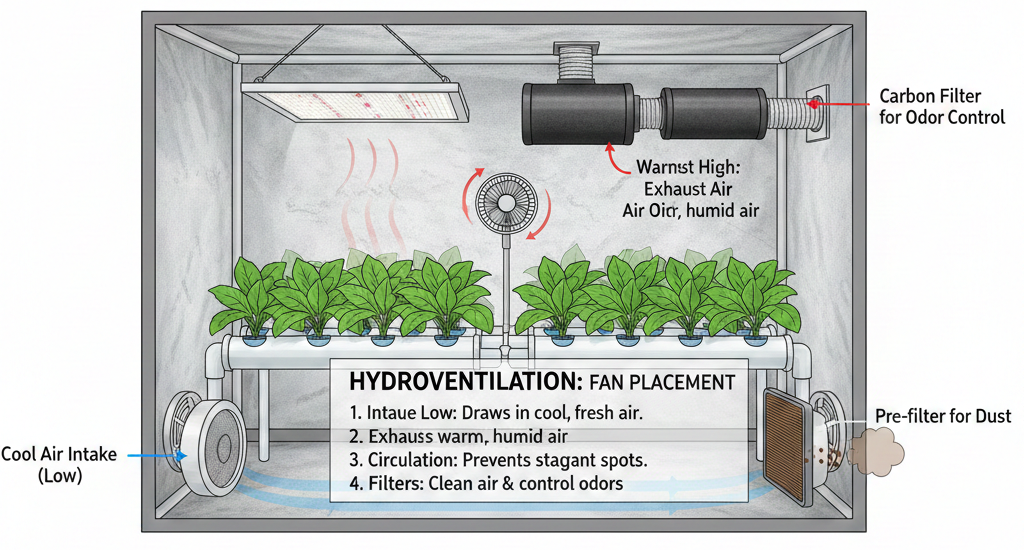
Passive/Active Intake (Place it LOW)
Active or passive air intake should be placed on opposite side of your exhaust fan, near the floor. This pulls in cooler, CO₂-rich air from the lowest point.
Grow Yukti Pro Tip
In dusty Indian environments, cover your intake with a pre-filter to keep your grow area sterile.
Exhaust Fan (Place it HIGH)
Exhaust fan should be placed at the highest point of the grow room or tent. This ensures heat from grow lights and humidity from transpiration collect at the ceiling. An exhaust fan here creates a “vacuum effect” (negative pressure) that pulls heat out efficiently.
Grow Yukti Pro Tip
Attach a Carbon Filter to your exhaust fan if you are growing aromatic crops in residential areas.
Circulation Fans (The “Internal Breeze”)
Circulation fans are used to blow air across the canopy, not directly at the stems. This prevent “micro-climates” (pockets of stagnant, humid air) under leaves where mold usually starts.
A gentle sway strengthens the plant’s cell walls, making them sturdier.
Common Ventilation Mistakes to Avoid
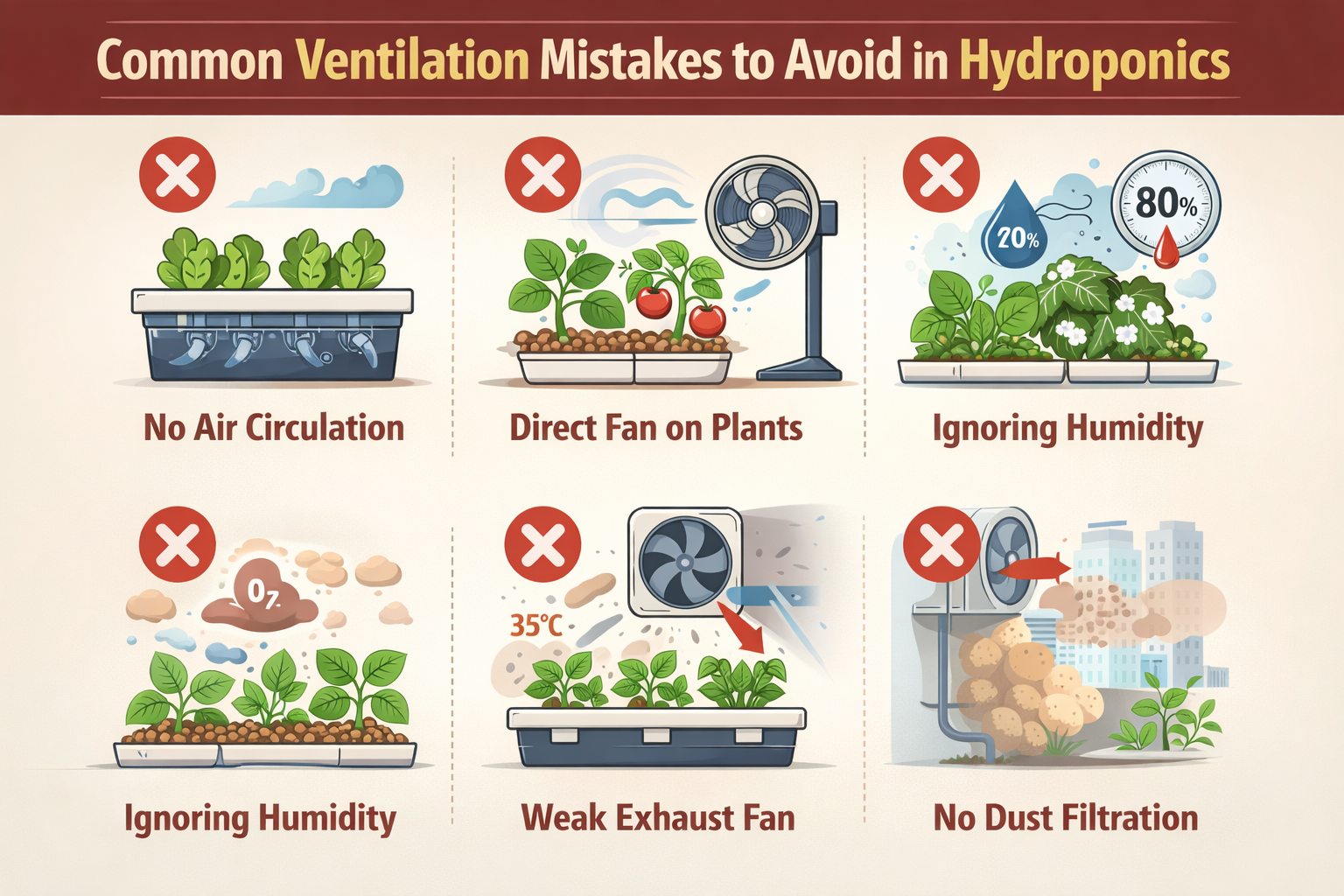
❌ No air circulation inside grow area
❌ Fans blowing directly on plants
❌ Ignoring humidity control
❌ Underpowered exhaust fans
❌ No dust filtration in urban areas
How to Calculate Ventilation Requirement (Simple Rule)
Air Exchange Rule:
Entire grow room air should be replaced once every 1–3 minutes
Example:
- Grow room size = 10 ft × 10 ft × 8 ft
- Volume = 800 cubic feet
Required fan capacity:
- 800 CFM (minimum)
- 1000–1200 CFM (ideal for Indian summers
Mastering Ventilation in Indian Climates
India’s climate presents unique challenges. Depending on your region, your ventilation strategy needs to pivot seasonally.
The Monsoon Challenge (High Humidity)
During the monsoon (especially in coastal cities like Mumbai, Chennai, or Kolkata), external humidity can exceed 90%.
The Problem: Exhausting air just brings in more wet air, tanking your VPD and risking “Bud Rot” or Mildew.
Solution: Increase internal circulation fans rather than just intake. Moving air prevents water droplets from settling on leaves. If growing indoors, this is the time to invest in a dehumidifier integrated into your smart controller.
The Summer Heatwave (High Temperature)
In North India (Delhi, Rajasthan, Punjab), summers reach 40°C+.
The Problem: Standard fans just circulate hot air, “cooking” the nutrient solution.
The Solution: Use Evaporative Cooling (Honeycombs). By pulling air through a wet pad before it enters the grow area, you can drop the intake temperature by 5–10°C.
Grow Yukti Pro Tip
Run your exhaust fans: at maximum capacity during the night to "flush" the room with cooler night air.
Urban Dust & "Loo" Winds
The Problem: Fine dust in Indian cities can clog the stomata (pores) of your plants and damage fan motors.
The Solution: Always use a Pre-filter (a simple mesh or sponge) on your intake fans. Clean these filters weekly to maintain CFM (Cubic Feet per Minute) efficiency.
Smart & Automated Ventilation (Advanced)
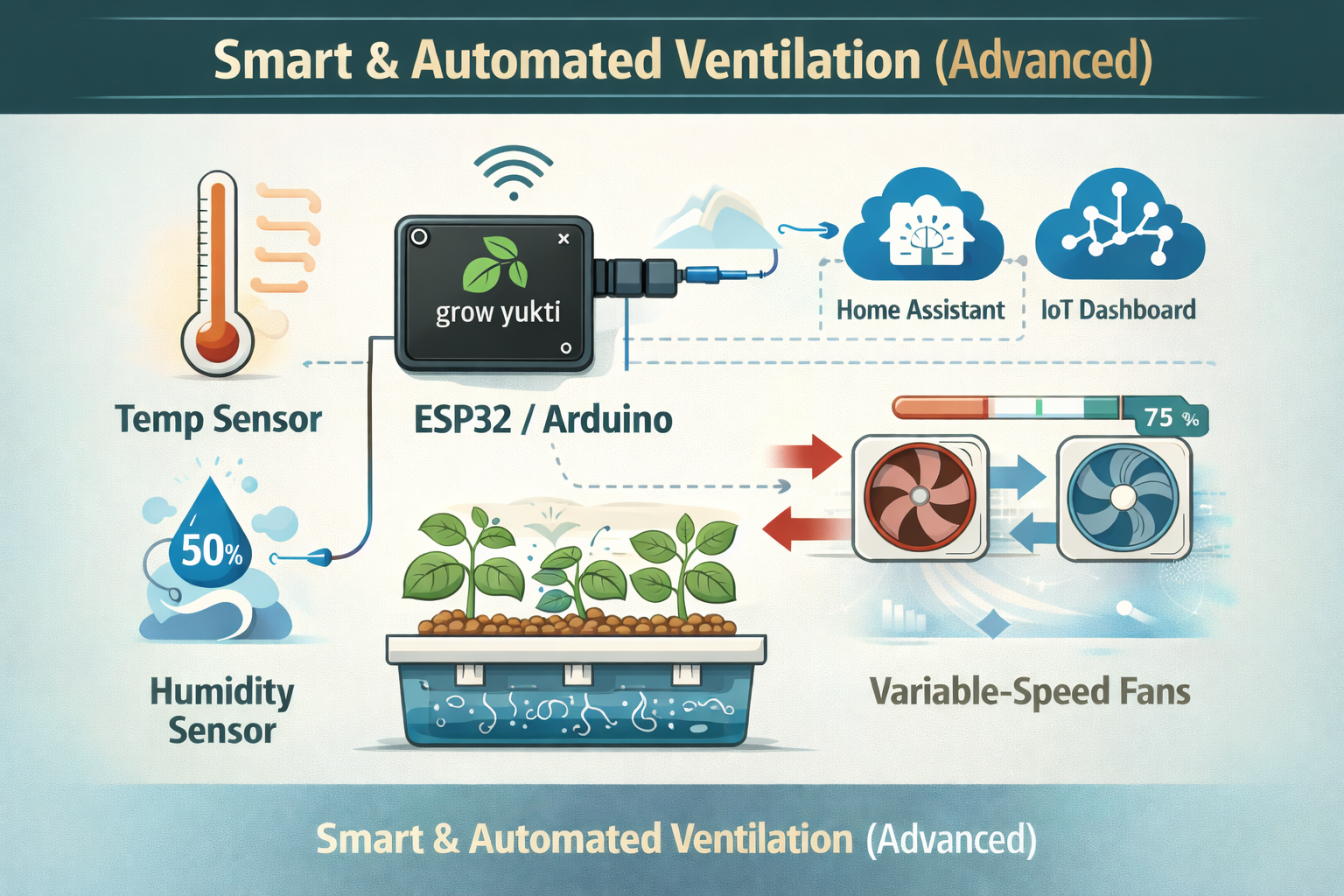
Smart & Automated Ventilation (IoT)
For those using the Grow Yukti Smart Kits, automation takes the guesswork out of the seasonal changes mentioned above.
Sensor-Driven Exhaust: Instead of a timer, use a DHT22 or BME280 sensor. The fan only kicks in when your VPD moves out of the “Green Zone.”
Variable Speed Control (PWM): During the winter, you may only need 20% fan speed to maintain CO₂. Automation saves electricity and extends fan life.
Your Hydroponic Farm Checklist for Ventilation
🛠️ DIY Ventilation Audit
Check your setup in 60 seconds
Turboshoot your hydroponic setup for Ventilation
| If you see this... | It usually means... | The Quick Fix |
|---|---|---|
| Brown/Dry leaf tips | Stagnant air (Nutrient lock) | Add a small circulation fan |
| Tall, thin "leggy" stems | Not enough wind stress | Increase fan speed & lower lights |
| Slimy or brown roots | Water is too hot (No oxygen) | Point a fan at your reservoir |
| White "fuzz" on leaves | Humidity is too high (Mold) | Increase Exhaust Fan speed |
Final Thoughts
Ventilation is not optional in hydroponics—it is a core system requirement, just like nutrients and water. A well-designed ventilation system leads to:
- Faster growth
- Higher yields
- Lower disease risk
- Better plant quality
Whether you are building a home NFT system or a commercial hydroponic farm, investing time in proper ventilation design will pay off in every harvest.
Stop Guessing, Start Growing 🚀
Manual ventilation is a full-time job. Let Grow Yukti do the heavy lifting.
Auto-Climate
Fans adjust automatically to keep you in the "Sweet Spot."
Live VPD Alerts
Get phone notifications before plants get stressed.