
Hydroponic farming is growing rapidly in India due to higher yields. However, many beginners fail not because of system design, but due to improper understanding of hydroponic nutrients. Unlike soil farming, hydroponics depends entirely on nutrient solutions for plant growth. This makes nutrient selection, mixing, and monitoring critical—especially under Indian water and climate conditions.
The best hydroponic nutrients are specialized water-soluble solutions containing essential N-P-K ratios and chelated micronutrients.
What Are Hydroponic Nutrients?
Hydroponic nutrients are water-soluble mineral fertilizers that supply all essential elements directly to plant roots. Since no soil is involved, plants rely completely on the nutrient solution for:
- Plant Growth
- Root development
- Flowering and fruiting
- Disease resistance
We classify hydroponic nutrients in two parallel ways, and they answer different questions.
A) Macro and Micro Nutrient: Classification Based on what Actually Plants need
B) Market-Based Nutrient Types: Nutrient Classification Based on Waht is Available in Market
Summary of Nutrient Classifications
| Classification Type | Purpose | Example / Values |
|---|---|---|
| Macro / Micro | What plants need for growth | N, P, K, Fe, Zn |
| Market-Based | How nutrients are supplied | Liquid, Powdered, A–B Mix |
| EC (Electrical Conductivity) | Quantity of nutrients (Strength) | Strength of solution |
| pH | Availability of nutrients | Uptake efficiency |
A) Essential Macro and Micro Nutrients
This classification answers:
What nutrients does the plant biologically need? This is based on plant physiology.
- Macronutrients: N, P, K, Ca, Mg, S
- Micronutrients: Fe, Mn, Zn, Cu, B, Mo, Cl
Plants require 17 essential elements for growth and must receive all of these regardless of system, brand, or nutrient type. This requirement never changes.
1. Primary Macros: N-P-K (Nitrogen, Phosphorus, Potassium)
Plant require primary Macro Nutrients in large quantities for leaf growth, root development and flowering.
- Nitrogen (N): Leaf growth and chlorophyll production
- Phosphorus (P): Root development and flowering
- Potassium (K): Fruit quality, stress tolerance
2. Secondary Macros: Calcium, Magnesium, Sulfur
Secondary nutrients are equally important for Photosynthesis. But often these are ignored by growers:
- Calcium (Ca): Prevents tip burn and improves cell structure
- Magnesium (Mg): Essential for photosynthesis
- Sulfur (S): Protein and enzyme formation
3. Vital Trace Minerals (Micronutrients)
Micronutrients are required in small quantities but essential for your crop growth. Iron, Zinc, Manganese, Copper, Boron, and Molybdenum are essential micto Nutrients that plant need for thier growth.
B) Market-Based Nutrient Types (Liquid, Powdered, Organic, A–B)
This classification answers: How are those nutrients supplied to the grower? This is based on product and formulation.
- Liquid nutrients
- Powdered nutrients
- Organic nutrients
- A–B part nutrients
Each of these is just a delivery format for the same macro + micro nutrients.
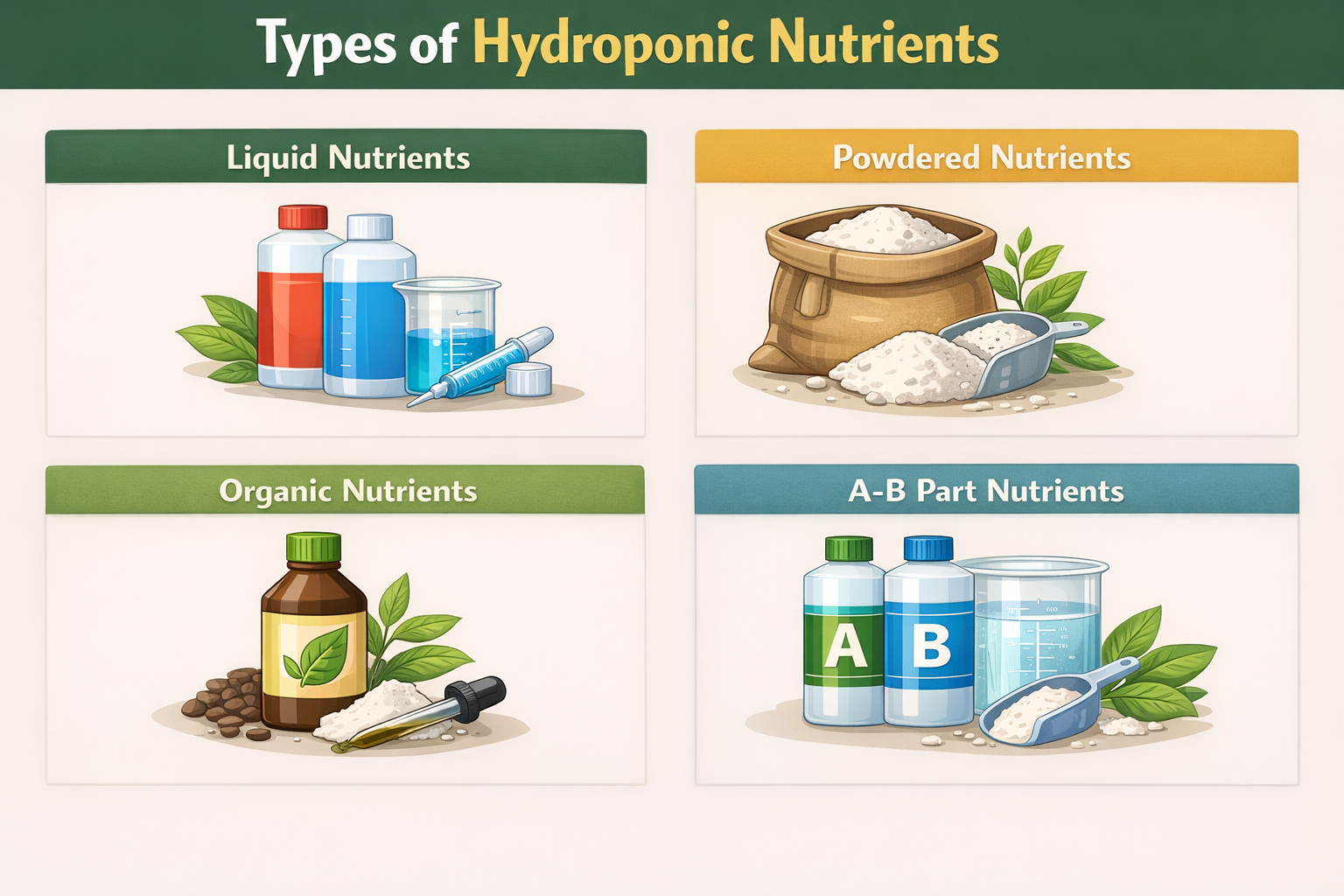
Liquid Hydroponic Nutrients
Liquid hydroponic nutrients are pre-dissolved, ready-to-use nutrient solutions designed for easy mixing and quick plant absorption. They are popular among beginners and small-scale growers in India due to their convenience and reliability.
Liquid nutrients dissolve instantly in water and provide immediate availability to plant roots. This makes them ideal for systems like NFT, DWC, and vertical hydroponics, where nutrient consistency is critical.
In Indian conditions, Liquid nutrients work best with low-TDS or RO-treated water, as high water hardness can affect nutrient balance and pH stability. Regular monitoring of EC (electrical conductivity) and pH is essential, particularly during summer when water temperature rises.
- Best suited for: Leafy greens, herbs, and short crop cycles
- Key advantage: Ease of use and fast nutrient uptake
- Limitation: Higher cost compared to powdered nutrients
Powdered Hydroponic Nutrients
Powdered hydroponic nutrients are dry, water-soluble mineral salts that are mixed with water before use. They are widely preferred by commercial and large-scale hydroponic growers in India due to their low cost and long shelf life.
These nutrients are highly concentrated, making them economical for farms running NFT, drip, or Dutch bucket systems. However, powdered nutrients require accurate weighing and proper dissolution, especially in cold or hard water conditions common in many Indian regions.
When mixed correctly, powdered nutrients offer excellent control over EC levels and consistent plant growth. Many professional growers pair them with RO or blended water to avoid precipitation and nutrient lockout.
- Best suited for: Commercial farms, long crop cycles
- Key advantage: Cost-effective and easy bulk storage
- Limitation: Requires precise measurement and mixing discipline
Organic Hydroponic Nutrients
Organic hydroponic nutrients are derived from natural sources such as plant extracts, composted materials, and biological inputs. They are mainly used by growers focused on taste, aroma, and eco-friendly production.
While organic nutrients can enhance crop flavor. They are less stable in recirculating hydroponic systems and require frequent system cleaning and close monitoring. In Indian conditions, high temperatures can accelerate microbial activity, increasing the risk of biofilm formation, clogged pipes, and pH fluctuations.
- Best suited for: Herbs, microgreens, specialty crops
- Key advantage: Improved flavor and natural sourcing
- Limitation: Difficult pH control and system maintenance issues
A-B Part Hydroponic Nutrients
A-B part nutrients are two-component nutrient systems where incompatible elements—such as calcium and phosphates—are kept separate to prevent chemical reactions. This format is considered the most reliable nutrient solution for Indian hydroponic conditions.
A-B nutrients provide maximum control over nutrient balance, making them ideal for crops with different growth stages, such as fruiting vegetables and strawberries. They are commonly used in automated hydroponic systems with EC and pH dosing.
For Indian growers dealing with hard water and seasonal changes, A-B nutrients offer greater stability and consistency compared to single-part formulations.
- Best suited for: Fruiting crops, advanced growers
- Key advantage: Precise nutrient control and scalability
- Limitation: Requires careful mixing and more storage space
Quick Comparison: Nutrient Types
| Nutrient Type | Best For | Pros | Cons |
|---|---|---|---|
| Liquid (Synthetic) | Beginners & Hobbyists | Easy to mix; immediate uptake. | Higher cost; heavy to ship. |
| Powdered (Dry) | Commercial & Large-scale | Cost-effective; long shelf life. | Needs weighing; risk of caking. |
| Organic (Liquid) | Eco-conscious | Enhances flavor & aroma. | Clogs pumps; unstable pH. |
| Multi-Part (A/B) | Advanced Growers | Control over growth stages. | Requires more storage; mixing errors. |
How to Ensure Macro & Micro Coverage Using Market-Based Nutrients?
Use “Complete” Hydroponic Nutrient Formulations
Reputed hydroponic nutrients—whether liquid, powdered, or A–B—are designed as:
- Complete nutrient solutions
- Containing all macro + micro nutrients
- In plant-available ionic form
That’s why labels usually say:
- “Complete Hydroponic Nutrient”
- “Contains all essential macro & micro elements”
Why A–B Nutrients Are So Popular
A–B nutrients don’t add more nutrients. They protect nutrient availability.
- Calcium is separated from phosphates & sulfates
- Micronutrients (like iron) remain soluble
- Less precipitation = better uptake
This is especially important in Indian hard water. That’s why A–B nutrients are often the safest way to ensure consistent macro + micro delivery.
The Role of Minerals: How Nutrients Impact Plant Growth
In a hydroponic system, the absence of soil means plants rely entirely on the nutrient solution for survival, making them highly sensitive to even minor imbalances. Monitoring visual cues is essential for early intervention, as identifying whether a deficiency appears on old growth (mobile nutrients) or new tips (immobile nutrients) allows growers to quickly correct the formula and prevent permanent crop loss.
Plant Nutrient Functions & Deficiencies
| Nutrient | Biological Function | Deficiency Symptoms |
|---|---|---|
| Nitrogen (N) | Driver of vegetative growth and leaf production. | Stunted growth; general yellowing starting from older leaves. |
| Phosphorus (P) | Energy transfer (ATP) and root development. | Dark green or purplish tint on leaves; poor root system. |
| Potassium (K) | Regulates water movement and fruit quality. | Burnt or "scorched" leaf edges; weak stems; small fruit. |
| Calcium (Ca) | Cell wall structure and transport stability. | Tip-burn in lettuce; Blossom end rot in tomatoes. |
| Magnesium (Mg) | Central atom of the chlorophyll molecule. | Yellowing between veins (interveinal chlorosis) on older leaves. |
| Iron (Fe) | Catalyst for chlorophyll production. | Sharp yellowing between veins on new, young leaves. |
| Zinc (Zn) | Regulates plant growth hormones (auxins). | Very short internodes (bunched leaves); stunted development. |
Importance of Water Quality on Nutrient Delivery
Most nutrient problems in Indian hydroponics are caused by poor water quality ofHigh TDS (300–700 ppm), Alkaline pH (7.5–8.5) and Seasonal variation due to monsoon. It is recommended to follow following Best Practices:
- Use RO water mixed with raw water
- Target base water EC: 0.2–0.4
- Adjust pH after adding nutrients
- Ideal nutrient solution pH: 5.5–6.5
For a step-by-step guide on starting your seeds before they enter the nutrient reservoir, see our guide on Seed Germination in Hydroponics.
How to Fix Common Hydroponic Nutrient Deficiencies
Identifying a deficiency is only the first step; rapid correction is vital to prevent yield loss. In hydroponics, the most effective way to fix an imbalance is to perform a reservoir flush—replacing the old solution with fresh water and a balanced nutrient dose—or by using targeted “booster” salts for specific issues.
Corrective Actions for Nutrient Deficiencies
| Deficiency | Corrective Salt | Application Tip |
|---|---|---|
| Nitrogen / Calcium | Calcium Nitrate [Ca(NO₃)₂] | Best fix for tip-burn. Ensure it is fully dissolved in Tank A. |
| Magnesium / Sulphur | Magnesium Sulphate (Epsom Salt) | Quickly restores color. Can be used as a 1% foliar spray. |
| Iron (Fe) | Chelated Iron (Fe-EDDHA / EDTA) | Use EDDHA if pH is >7.0 (common in Indian tap water). |
| Potassium (K) | Potassium Sulphate / MKP | Boosts fruit sweetness. Avoid over-application to prevent Mg lockout. |
| Trace Elements | Combi-Micronutrient Mix | A "catch-all" fix for Zinc and Boron. Best added to Tank B. |
How to Manage pH and EC Levels
In hydroponics, soil is replaced by a precision-balanced solution where pH and Electrical Conductivity (EC) levels are the primary factors for nutrient availability.
- EC Controls “How Much” : It ensures you’re giving enough total nutrients (macro-dominated)
- pH Controls “How Available” : pH ensures micronutrients (especially iron, zinc, manganese) stay available
Ideal pH, EC, and PPM Ranges by Crop
| Crop Category | pH Range | Target EC | Approx. PPM |
|---|---|---|---|
| Leafy Greens (Lettuce/Kale) | 5.5 – 6.0 | 1.2 – 1.8 | 600 – 900 |
| Microgreens | 5.5 – 6.0 | 0.8 – 1.2 | 400 – 600 |
| Culinary Herbs (Basil) | 5.8 – 6.2 | 1.0 – 1.6 | 500 – 800 |
| Tomato (Fruiting) | 6.0 – 6.5 | 2.5 – 3.5 | 1250 – 1750 |
| Cucumber | 5.5 – 6.0 | 1.8 – 2.5 | 900 – 1250 |
| Bell Pepper | 5.8 – 6.3 | 2.0 – 2.8 | 1000 – 1400 |
| Strawberry | 5.5 – 6.2 | 1.5 – 2.2 | 750 – 1100 |
Best Hydroponic Nutrients for Different Plants
Hydroponic success relies on maintaining specific N-P-K ratios in Parts Per Million (PPM), tailored to each crop’s unique growth stage to maximize yield and prevent nutrient lockout. The following table outlines the specific N-P-K ratios for common Indian hydroponic crops.
Ultimate Nutrient Ratio Guide: All Crops & Phases (PPM)
| Crop Type | Primary (PPM) | Secondary (PPM) | Phase-Specific Tip | ||||
|---|---|---|---|---|---|---|---|
| (Phases) | N | P | K | Ca | Mg | S | |
| Leafy Greens (Early Growth) | 120 | 40 | 180 | 100 | 40 | 50 | Maintain high Nitrogen for "crisp" leaves. Avoid excess K to prevent bitterness. |
| Leafy Greens (Rapid Growth) | 180 | 50 | 250 | 150 | 50 | 60 | |
| Culinary Herbs (Early Growth) | 100 | 35 | 150 | 90 | 35 | 40 | High Magnesium (Mg) is essential for essential oil and aroma production. |
| Culinary Herbs (Harvesting) | 150 | 40 | 200 | 120 | 55 | 50 | |
| Exotic Veggies (Vegetative) | 200 | 60 | 250 | 170 | 50 | 60 | Broccoli needs a Phosphorus boost during "heading" to form tight crowns. |
| Exotic Veggies (Fruiting) | 160 | 100 | 300 | 190 | 60 | 80 | |
| Microgreens (Full Cycle) | 80 | 30 | 100 | 60 | 20 | 30 | Very low EC required. Use RO water to avoid delicate root burn. |
The Approx. PPM (500 scale) column is a secondary way of measuring the concentration of your nutrient solution. While EC (Electrical Conductivity) is the most accurate scientific measurement, many digital meters in India display the reading in PPM (Parts Per Million).
Common Hydroponic Nutrient Mistakes
Common Mistakes (Don'ts)
- Overfeeding: Adding extra nutrients "just in case."
- Ignoring Water Hardness: Using high TDS tap water without checking.
- Wrong Order: Adjusting pH before adding nutrients.
- Skipping Micros: Focusing only on N-P-K.
Correct Practice (Dos)
- Measure Twice: Use a calibrated EC/TDS meter every time.
- Target pH: Adjust pH after mixing all nutrients.
- Flush Regularly: Clean your reservoir every 7-14 days.
- Check Roots: Watch for brown tips (sign of nutrient burn).
Master Your Hydroponic Journey with Grow Yukti
Hydroponic nutrients are the foundation of successful hydroponic farming in India. By understanding Crop-specific nutrient needs, Local water quality, and Seasonal climate effects Growers can achieve higher yields, better quality, and predictable results.
When nutrients are managed correctly, hydroponics becomes a reliable and scalable farming solution—not a trial-and-error experiment.
Start Your Soilless Success Today!
Don't let nutrient confusion hold you back. Let Grow Yukti provide the kits and knowledge you need for a lush, green harvest.
Join the Green Revolution