
In a soil based garden, soil provides both structural support and nutrients. Hydroponics is “soil-less farming” where growing media provides pyhsical support and nutrients provided by water. Therefore choosing the right media is one of the most critical decisions for a successful harvest. A wrong growing media can cause root rot, nutrient lockout, algae growth, or unstable plants.
This article covers what growing media actually does, best media for each hydroponic system and how to select media logically.
What is Hydroponic Media? (And Why You Can't Use Soil)
Hydroponic Media is an inert material that occupies the space around the roots. Unlike soil, true hydroponic media is chemically inactive. It doesn’t provide neutriants, it’s application is to:
- Hold plant upright.
- Maintain Air–water balance to ensure roots get oxygen and moisture.
- Protect roots during pump cycles or power cuts
- Micro-environment control
Top 7 Hydroponic Substrates for Every Budget
Here is the list of popular hydroponic media for different types of Hydroponic Systems.
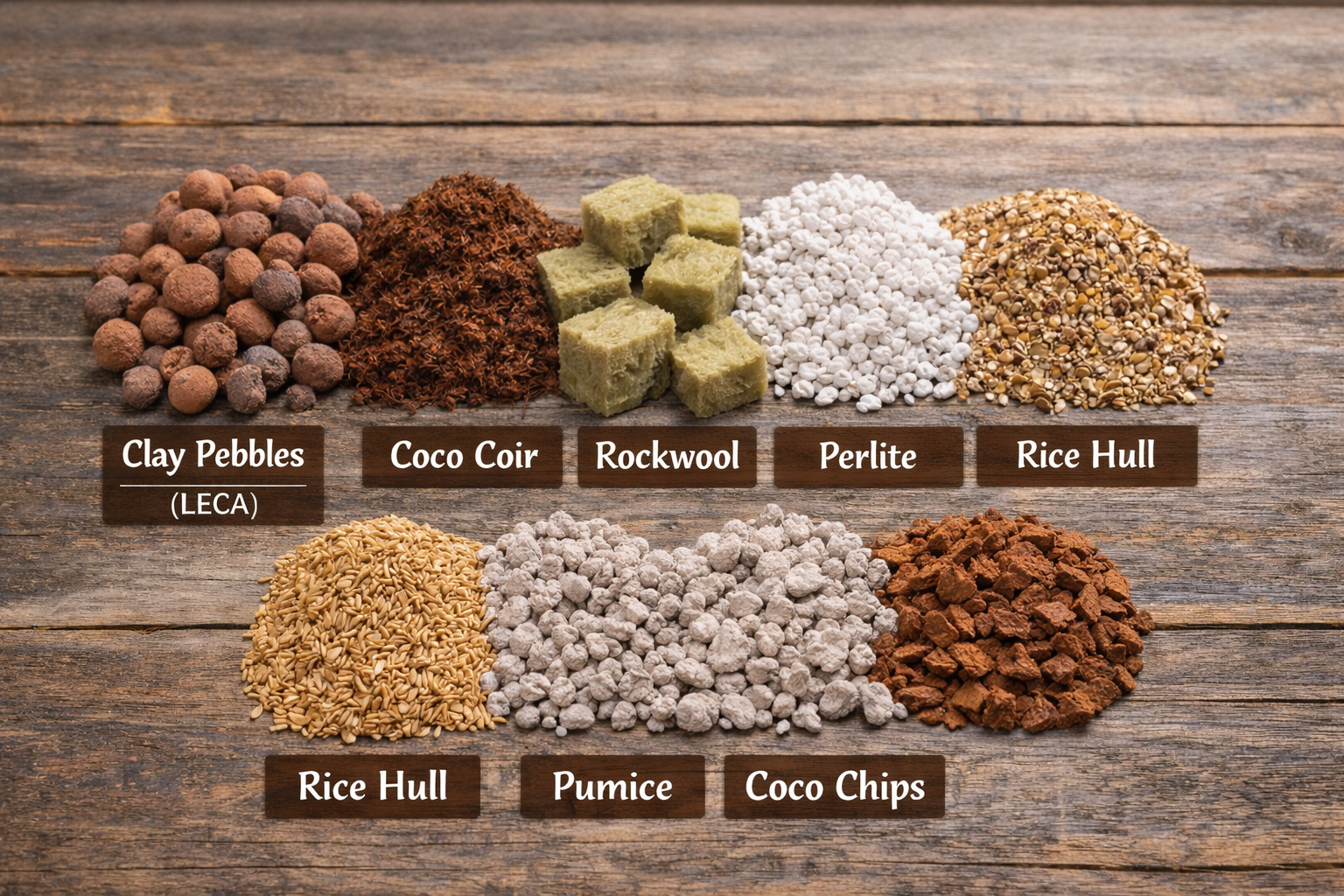
1. Clay Pebbles (LECA)
Clay pebbles also known as LECA (Lightweight Expanded Clay Aggregate) are preferred when water is more important than air.Clay pebbles are fired ceramic spheres with a hard outer shell and a porous interior. They have the following properties:
- Excellent root aeration due to large air gaps
- Fast drainage, preventing waterlogging
- High structural stability, even after years of reuse
In hydroponics, the above properties means roots stay oxygen-rich—even if watering is frequent.
Best Systems for Clay Pebbles
Clay pebbles are best choice for hydroponic systems where oxygen delivery is external or water movement is cyclic. Here is the list of hydroponic system where Clay Pebbles work:
- DWC (Deep Water Culture) because roots hang freely into aerated nutrient solution
- EBB & Flow (Flood and Drain) because fast drainage prevents anaerobic conditions
- Drip systems (Dutch buckets) when combined with frequent irrigation
Clay Pebbles are not good cgoice for NFT, where media should release water easily without lifting the plant crown.
Clay Pebbles Interaction with Water and Nutrient
Clay pebbles are chemically inert therefore they do not buffer pH & store nutrients. As a result what you feed is what the plant gets. This makes them predictable—but unforgiving. Miss a watering cycle in a drip system, and plants can wilt quickly.
In drip systems, you can mix clay pebbles with coco chips or coco coir to add minimal moisture buffering without sacrificing airflow.
Advantages of Clay Pebbles
- Reusable for 5+ years with proper cleaning.
- Resistant to rot, fungus, and decomposition.
- Easy to visually inspect roots.
- Minimal algae growth compared to organic media.
The above advantages make the Clay Pebbles a best choice for commercial or semi-commercial setups.
Common Mistakes with Clay Pebbles
- Roots dry out faster than expected if you use them alone in low-frequency drip systems.
- Clay dust can clog pumps and coat roots if you do not wash them before use.
- They don’t “hold water like soil”
When to Choose Clay Pebbles?
- Your system already provides reliable oxygenation
- You need reusable, low-maintenance media.
- Want maximum control over irrigation and nutrients
When to Avoid Clay Pebbles?
- Power cuts are frequent and irrigation pauses are long
- You need moisture buffering for young plants.
2. Coco Coir
Coco coir are considered as a best alternative to soil. In hydroponics, its real value is controlled water buffering, not nutrition. Coco coir makes a system forgiving when used correctly. Any mistake may lead to root suffocation quietly.
Coco Coir Holds water in micro-pores and releases it slowly. Unlike soil, coco does not rely on microbes to function, making it suitable for hydroponic nutrient solutions.
Coco coir is processed fiber and pith derived from coconut husks. Structurally, it behaves like a springy sponge.
Advantages of Coco coir
- Protects roots during pump off cycles.
- Smooths out irrigation timing errors.
- Reduces early-stage transplant shock
- Works well in hot climates where evaporation is high
This above advantages of coco coir media makes them extremely popular in drip systems, Dutch buckets, and grow bags.
Best Hydroponic Systems for Coco Coir
Coco coir performs best where water delivery is controlled but not continuous. Here is the list of hydroponic system where Coco Coir works:
- Drip irrigation systems
- Dutch buckets
- Grow bags / slabs
- Hybrid NFT seedling stages
It is not ideal for DWC and must be used cautiously in NFT due to its high water retention.
Coco Coir interaction with Hydroponic system
Coco coir holds water very well. But oxygen only reaches roots if:
- The coir is not compacted
- Drainage is fast and consistent
- Over-saturated coco becomes anaerobic quickly—especially in warm climates.
If coco stays wet for more than a few hours after irrigation stops, you have an oxygen problem.
Coco coir is not truly inert. It can bind calcium and magnesium.
- Poorly processed coco may cause early Ca/Mg deficiency
- pH tends to stabilize around 5.8–6.2, which is generally favorable
Always use pre-buffered coco or buffer it yourself with calcium-rich nutrient solution before planting.
Advantages of using Coco Coir
- Excellent moisture bufferLightweight and easy to handle
- Renewable and biodegradable
- Easy root penetration and fast early growth
Common Mistakes with Coco Coir
- Compressing the Coco Coir during filling kills airflow.
- Skipping buffering and washing leads to unexplained nutrient deficiencies.
- Coco is not soil; More water ≠ better growth.
Coco Coir Blends
Coco performs best when blended other hydroponics media.
- Coco coir + perlite (70:30) results in Better Drainage.
- Coco coir + clay pebbles (bottom layer) creates a oxygen zone.
- Coco chips + coco coir provides good structure and moisture balance to the plants.
When to Choose Coco Coir as Hydroponic Media?
- Your system requires moisture buffering.
- Power cuts or pump delays are common
When to Avoid Coco Coir as Hydroponic Media?
- Oxygen delivery is already marginal.
- Water temperature is consistently high
- Drainage cannot be guaranteed.
3. Rockwool
Rockwool is one of the most widely used growing media in commercial hydroponics. Rockwool does not forgive assumptions. When used properly, it delivers uniform growth and predictable results. When used casually, it creates hidden root-zone failures.
Rockwool is produced by melting basalt rock and spinning it into fine fibers, then compressing those fibers into cubes or slabs. Rockwool has the folloing properties:
- High capillary water movement
- Uniform pore distribution
- Excellent root contact
Unlike organic media, rockwool does not decompose, shrink, or change structure over time.
Advantages of using Rockwool
- Rockwool’s strength lies in uniformity. Every cube behaves almost identically
- Water distribution is predictable
- Root growth is consistent across plants
- Extremely uniform plant growth
- For controlled environments, rockwool offers repeatability, which is hard to achieve with organic media.
- Excellent for seedlings and transplants
- Clean and pathogen-resistant
The above advantages of rockwool makes it ideal for high-density, high-value crops where consistency matters more than flexibility.
Best Hydroponic Systems for Rockwool
Rockwool performs best in the following hydroponic systems with precise irrigation control:
- Drip irrigation systems
- Slab-based commercial setups
- Seed germination and cloning
- Short NFT stages (with care)
Rockwool is not a good choice for DWC and risky in low-drainage setups.
Water and Oxygen Balance with Rockwool
Rockwool holds a lot of water but that does not automatically mean poor oxygen.
- Large pores hold air
- Small pores hold water
The problem arises when rockwool is over-irrigated. Once saturated continuously, air spaces collapse, and roots suffocate.
Rockwool works best when it is allowed to partially dry between irrigation cycles.
Impact of Rockwool on water pH Behavior
Rockwool is not inert and has impact on the water pH behaviour that is the one of Most Common Failure Point.
Fresh rockwool is naturally alkaline. Untreated rockwool can push root-zone pH above 7. This causes nutrient lockout before symptoms are visible.
Rockwool must be pre-soaked in pH-adjusted water (≈5.5) before use. Skipping this step leads to unexplained growth issues that look like nutrient deficiency but are actually pH imbalance.
Mistakes to Avoid with Rockwool Hydroponic media
- pH problems start from day if you Skip the pre-conditioning.
- Keeping cubes permanently soaked will results in deficiation of oxygen to the roots.
- Rockwool does not “breathes” automatically. Roots need oxygen cycles.
- Rockwool does not compensate for bad system design. Therefore avoid using them where drainage is poor.
When to Choose Rockwool as Hydroponic Growing Medium
We should choose rockwool in one of the following conditions:
- You have precise irrigation control
- Consistency across plants is critical
- You want predictable, repeatable results
When to Choose Rockwool as Hydroponic Growing Medium
You should avoid using rockwool if:
- Drainage is unreliable
- Power cuts are frequent and long
- You prefer a forgiving system
Rockwool is not difficult to use, it is unforgiving. If you control pH, irrigation timing, and drainage, rockwool delivers professional-grade results. If you don’t, it fails quietly and early.
4. Perlite
Perlite is a low cost growing media that creates oxygen pathways in the root zone that improves root health. It is always recommended to be used along with other growing media. Perlite is volcanic glass that expands when heated, forming lightweight, white granules full of air pockets.
Structurally, perlite is extremely porous, very lightweight, chemically inert. Perlite does not break down, buffer pH, or store nutrients. Its function is almost entirely physical, not chemical.
Advantages of Perlite in Hydroponics
- Perlite’s strength is air delivery. It creates air gaps between particles and Prevents compaction. When perlite is mixed with finer media like coco coir. It ensures that roots have a path to grow through.
- It improves drainage speed.
- In systems where water is supplied frequently (such as drip system), perlite prevents the root zone from becoming anaerobic.
- Excellent root aeration
- Prevents waterlogging in dense media
- Lightweight and easy to handle
- Inexpensive and widely available
- In warm climates, perlite helps keep root zones cooler due to faster evaporation.
Best Hydroponic Systems for Perlite
Perlite performs best as a component, not a sole medium for the following hydroponic systems.
- Drip irrigation systems
- Dutch buckets
- Grow bags
- Ebb & flow (with containment)
It is rarely suitable on its own for NFT or DWC due to instability and floatation.
How Perlite impacts the Water and Root Behavior
Perlite holds a thin film of water on its surface but drains quickly. Therefore moisture must be replenished regularly because dry-down happens faster than coco or rockwool. With perlite roots receive frequent oxygen.
How Perlite interacts with pH and Nutrient Perlite is fully inert and does not:
- Affect pH
- Bind nutrients
- Provide buffering
Mistakes to Avoid with Rockwool Hydroponic media
- Roots dry out too fast, when perlite is not used along with other hydroponic media for long-cycle crops.
- It is always recommended to use mesh pots or liners to ensure perlite do not float and escape.
- Perlite dust must be washed before use.
- Avoid Overwatering, because this reduces oxygen availability.
Smart Perlite Blends
- Coco coir + perlite (70:30) → balanced air–water ratio
- Rockwool blocks on perlite beds → drainage insurance
- Perlite + vermiculite → seedling propagation
Blends allow perlite to do what it does best—add air without drying roots excessively.
When to Choose Perlite as Hydroponic Media
- Your system needs better oxygenation
- Media compaction is a problem
- You use frequent drip irrigation
When to avoid Perlite as Hydroponic Media
- Long crop cycles
- Low System stability
- Require water buffering
Perlite doesn’t grow plants, it keeps them breathing. Mostly Perlite is used as part of a well-designed mix to improve root health.
GrowYukti Tip
In regions like Rajasthan or Delhi where summer temperatures exceed 40°C, using a mix with higher Perlite helps keep the root zone oxygenated even as water oxygen levels drop due to heat.
5. Rice Hull
Rice hulls are a low-cost aeration enhancer, especially in regions where rice processing waste is easily available. They are structural helpers, not long-term standalone media.
Rice hulls are the outer protective shells of rice grains. Structurally, they are Very lightweight, Naturally porous, High in silica, Organic and slowly biodegradable. They trap air effectively but hold very little water on their own.
Why Rice Hulls are used in Hydroponics
- Rice hulls are primarily used for aeration and drainage improvement.
- Prevent compaction in coco or soil-like media
- Create air channels around roots
- Improve oxygen availability in warm conditions
- They are especially useful in low-budget or experimental setups.
Best Hydroponic Systems for Rice Hulls
Rice hulls work best as a secondary component in the following hydroponic system.
- Drip irrigation systems
- Grow bags
- Dutch buckets
- Seedling and nursery trays
They are not suitable for NFT or DWC when used alone.
How Rice Hull affect Water and Root Behavior
With rice hull as hydroponic media, wter Drain extremely fast. As a result, roots Dry quickly in hot conditions. Roots grown in rice hull mixes receive excellent oxygen but depend heavily on frequent irrigation.
Rice Hull interaction with Nutrient and pH
Rice Hull growing media is slightly alkaline to neutral, provides minimal nutrient binding. High silica content may marginally strengthen plant tissue over time.
Rice hulls do not buffer nutrients and should never be relied upon for chemical stability.
Advantages of Rice Hull Growing Media
- Very low cost and locally available
- Lightweight and easy to transport
- Improves aeration dramatically
- Useful in hot and humid climates
- For growers scaling up on a budget, rice hulls can reduce dependence on imported media.
Mistakes to avoid in Rice Hulls Growing Media
- Rice Hull can introduce pathogens or pests when you use them raw, or unprocessed.
- Roots dry out rapidly when used as a standalone medium.
- Media structure changes mid-crop if you Ignore decomposition over time.
Breakdown reduces airflow while growing long-cycle crops without monitoring.
Smart Rice Hull Blends
Rice hulls perform best in blends:
- Coco coir + rice hulls (70:30) → improved aeration
- Coco chips + rice hulls → structure + airflow
- Perlite + rice hulls → lightweight nursery mix
- Use parboiled or carbonized rice hulls when possible for better longevity.
When to Choose Rice Hulls as Hydroponic Growing Media
You should choose rice hulls in following conditions.
- Cost reduction is critical
- Media aeration is insufficient
- You operate in rice-producing regions
When to Avoid Rice Hulls as Hydroponic Growing Media
- Crop cycle is very long
- You cannot control irrigation frequency
- System hygiene is a concern
Rice hulls are not a replacement for engineered growing media, but they are a powerful supplement. When used deliberately and monitored, they can significantly improve root oxygenation at a fraction of the cost.
6. Pumice
Pumice is a natural volcanic stone that sits somewhere between clay pebbles and perlite in behavior. Pumice is formed when volcanic lava cools rapidly, trapping air inside the rock.
This creates a rigid, lightweight stone with high internal porosity, rough surface texture for root grip, and excellent structural stability.
All these properties comes with zero organic content. As a result, Pumice is completely inert and does not decompose or compact.
Why Growers Use Pumice
Pumice’s primary role is long-term root aeration. Grower choose Pumice due to following reasons:
- It maintains permanent air channels
- Prevents compaction even after years of use
- Supports heavy plants without shifting
- Handles high irrigation frequency without waterlogging
- Behaves more predictably than organic or lightweight media.
Best Hydroponic Systems for Pumice
Pumice performs best in a hydroponic systems where media stability and drainage are critical. Here is the list of hydroponic systems where Pumice is a good choice.
- Drip irrigation systems
- Dutch buckets
- EBB & Flow Systems
Pumice is generally unsuitable for NFT due to weight and slower moisture response.
How Pumice impact the Water and Root Behavior
Pumice holds a thin film of water on its surface while maintaining large air-filled pores. As a result, roots receive constant oxygen, excess water drains quickly and Media does not stay saturated. This makes pumice ideal for systems with frequent irrigation and good drainage.
How Pumice impacts Nutrient and pH
Pumice is chemically inert. As a result it does not alter pH, bind nutrients, and buffer deficiencies. All nutrition must come from the nutrient solution, making system control essential.
Advantages in Pumice in Hydroponic System
- Extremely durable and reusable.
- Does not float or shift during irrigation.
- Low algae growth.
- Ideal for high-temperature environments
- Over time, pumice often proves cheaper than media that needs frequent replacement.
Common Mistakes with Pumice
- Stone dust can clog pumps and coat roots. Therefore avoid using unwashed pumice.
- Too fine particle size reduces airflow; Whereas too coarse reduces root contact. It is recommended to choose to correct particle size as per application.
Smart Pumice Blends: Pumice works well in blends where moisture buffering is needed:
- Pumice + coco coir → stability + moisture
- Pumice + coco chips → structure + airflow
- Pumice + perlite → lightweight aeration beds
Blending improves flexibility without sacrificing pumice’s durability.
When to Choose Pumice as Growing Media: You should choose pumice in following conditions:
- Growing long-cycle or heavy plants
- Media reusability matters
- You want stable aeration with minimal maintenance
When to avoid Pumice as Growing Media
- Weight is a constraint
- You are running small NFT channels
Pumice doesn’t optimize for speed, it optimizes for consistency. If your system delivers nutrients reliably, pumice will maintain a clean, oxygen-rich root zone for years with almost no change in behavior.
7. Coco Chips
They are chunky pieces of coconut husk designed to provide structure, airflow, and moderate moisture retention without the compaction issues of fine coco. Coco chips are especially useful when you want root-zone stability without sacrificing oxygen.
Coco chips are produced by cutting coconut husks into coarse fragments and washing them thoroughly. Structurally, they offer Large particle size for air channels, rough surfaces for root attachment, Moderate water-holding capacity, slow decomposition compared to coco coir.
Why Growers Use Coco Chips
Coco chips are chosen when a balance between structural support and aeriation is required. Coco Chips has the following advantages:
- Better aeration than coco coir.
- More moisture retention than clay pebbles
- Stable root support for tall or heavy plants
- Reduced risk of compaction
- They are particularly popular in bucket-based and drip systems.
Best Hydroponic Systems for Coco Chips
Coco chips perform best in hydroponic systems with controlled irrigation. Here is the list of hydroponic system suitable for Coco Chips:
- Drip irrigation systems
- Dutch buckets
- Grow bags
- Hybrid media beds
They are not recommended for NFT channels due to particle size and water retention.
How Coco Chips interact with Water and Roots
Coco chips hold water on their surfaces while leaving large air gaps between particles. As a result, Roots stay moist without being saturated, Oxygen availability remains high. But the drainage is fast when irrigation stops. This makes coco chips more forgiving than pumice or perlite, especially during short irrigation interruptions.
How Coco Chips interact with Nutrient and pH
Like coco coir, coco chips can:
- Bind small amounts of calcium and magnesium
- Require pre-washing and buffering
- Stabilize around a slightly acidic pH (≈5.8–6.2)
- Properly processed chips minimize these effects, but buffering is still recommended.
Advantages using Coco Chips in a Hydroponic System
- Excellent balance of air and moisture
- Good structural stability for long-cycle crops
- Slower breakdown than coco coir
- Renewable and biodegradable
Coco chips are especially effective in warm climates where root oxygen demand is high.
Common Mistakes with Coco Chips in a Hydroponic System
- Salts and fines can damage young roots if you use unwashed chips
- Coco Chips dry out faster than expected. Therefore you need continuous water supply.
Coco Chip Blends
Coco chips are often used as a base layer or blend:
- Coco chips + coco coir → structure + moisture
- Coco chips + pumice → airflow + stability
- Coco chips + clay pebbles → drainage + support
These blends create a more resilient root zone.
When to Choose Coco Chips for your hydroponic system?
Choose coco chips in following scenerios:
- You need structural stability for plants
- Want better aeration than coco coir
- Operate drip or bucket-based systems
When to Avoid Coco Chips for your hydroponic system?
- Water supply is inconsistant. Longer power cuts
- Space is limited (large particle size)
- Not recommended for NFT hydroponic System
Coco chips are the structural backbone of organic hydroponic media. They don’t over-hold water, don’t collapse easily, and keep roots well-oxygenated when irrigation is designed correctly.
Which Growing Media Works Best for DWC, NFT, or Drip?
Not every growing medium works in every system. Choosing the wrong combination can lead to clogged pumps, drowning roots, or unstable plants. Use this matrix to find the best match for your setup:
| Hydroponic System | Recommended Media | Why? | Avoid |
|---|---|---|---|
| Deep Water Culture (DWC) | Clay Pebbles, Rockwool Cubes | Provides heavy support in net pots; won't fall through into the reservoir. | Perlite, Vermiculite (they float/clog pumps). |
| Ebb & Flow | Clay Pebbles, Gravel, Coco Coir | Holds enough moisture between cycles without waterlogging. | Lightweight Perlite (washes away). |
| NFT (Nutrient Film) | Rockwool, Rapid Rooters | Small amounts hold the seedling while roots hit the "film." | Gravel or Clay Pebbles (too bulky). |
| Drip System | Coco Coir, Clay Pebbles, Perlite Mix | Allows excellent drainage while maintaining a steady moisture buffer. | 100% Vermiculite (too much water). |
| Wick System | Vermiculite, Coco Coir, Perlite | Requires high "capillary action" to pull water upward. | Clay Pebbles or Gravel (no wicking). |
| Aeroponics | Neoprene Disks (or no media) | Roots need maximum exposure to air and mist. | Any loose media (clogs misting nozzles). |
Pro Tip: If you are unsure which to pick, a 70/30 mix of Coco Coir and Perlite is the "Goldilocks" of media for Indian climates—it's forgiving and works in most setups!
| Growing Media | Germination | DWC | NFT | Ebb & Flow | Drip | Wicking |
|---|---|---|---|---|---|---|
|
Clay Pebbles (LECA)
High aeration, pH neutral, reusable.
|
Not OK | ✔ OK | Not OK | ✔ OK | ✔ OK | Not OK |
|
Coco Coir (Pith)
Fine texture, high water retention.
|
✔ OK | Not OK | Not OK | ✔ OK | ✔ OK | ✔ OK |
|
Coco Chips
Chunky texture, balances air & water.
|
Not OK | Not OK | Not OK | ✔ OK | ✔ OK | Not OK |
|
Rockwool
Sterile, high capillary action.
|
✔ OK | Not OK | ✔ OK | ✔ OK | ✔ OK | Not OK |
|
Perlite
Lightweight, boosts oxygen.
|
Mainly used as a supplement to improve aeration in other media. | |||||
|
Vermiculite
Superior moisture retention.
|
✔ OK | Not OK | Not OK | Not OK | Not OK | ✔ OK |
|
Rice Hulls
Eco-friendly, adds silica.
|
Not OK | Not OK | Not OK | ✔ OK | ✔ OK | Not OK |
|
Pumice
Won't float, reusable.
|
Not OK | Not OK | Not OK | ✔ OK | ✔ OK | Not OK |
ROI of Hydroponic Growing Media: Long-Term Cost Comparison
While the initial price tag of growing media is often the first thing growers look at, the true value lies in its lifecycle cost. Some materials are inexpensive but must be discarded after every harvest, while others require a higher upfront investment but can be sterilized and reused for years.
Growing Media Cost Comparison
| Growing Medium | Initial Cost (India) | Reusability | Long-Term Value |
|---|---|---|---|
| Coco Coir / Chips | Low | Partial (1-2 times) | High (Sustainable) |
| Rice Hulls | Very Low | None (Compostable) | Excellent (Budget) |
| Clay Pebbles (LECA) | High | High (Years) | Best (One-time Buy) |
| Perlite / Vermiculite | Moderate | Difficult to clean | Moderate |
| Rockwool | Moderate-High | None | Low (Consumable) |
| Pumice | High | High (Lifetime) | Excellent (Durable) |
Rating for Hydroponic Growing Media by Aeration & Stability
Choosing a growing medium isn’t just about cost; it’s about the physical and chemical properties that keep your plants alive. Some media act like a sponge, while others act like a sieve.
Hydroponic Media Performance Ratings (Scale 1-5)
| Media Type | Aeration | Water Retention | pH Stability | Reusability |
|---|---|---|---|---|
| Clay Pebbles | ⭐⭐⭐⭐⭐ | ⭐ | ⭐⭐⭐⭐⭐ | ⭐⭐⭐⭐⭐ |
| Coco Coir | ⭐⭐⭐ | ⭐⭐⭐⭐⭐ | ⭐⭐⭐ | ⭐⭐ |
| Rockwool | ⭐⭐⭐⭐ | ⭐⭐⭐⭐ | ⭐ | ⭐ |
| Perlite | ⭐⭐⭐⭐⭐ | ⭐⭐ | ⭐⭐⭐⭐⭐ | ⭐⭐⭐ |
| Pumice | ⭐⭐⭐⭐ | ⭐⭐⭐ | ⭐⭐⭐⭐⭐ | ⭐⭐⭐⭐⭐ |
Choosing Hydroponic Growing Media Based on What You Grow
While many growing media are versatile, certain crops have a ‘natural preference’ based on their root structure and water needs. Use this guide to match your chosen crop with the growing medium that best supports its specific life cycle.
Crop & Media Matching Guide
| Crop Category | Examples | Ideal Media | Why it Works |
|---|---|---|---|
| Leafy Greens | Lettuce, Spinach, Kale | Coco Coir, Rockwool | Consistent moisture supports rapid, tender leaf growth. |
| Fruiting Crops | Tomatoes, Peppers | Clay Pebbles, Perlite Mix | High oxygen and drainage prevent root rot in long-cycle plants. |
| Aromatic Herbs | Basil, Mint, Cilantro | 70/30 Coco-Perlite Mix | The "Goldilocks" balance of air and water for delicate herbs. |
| Root Vegetables | Radish, Carrots | Vermiculite, Fine Perlite | Soft, loose media allows roots to expand without resistance. |
Grow Yukti Verdict: How to Choose?
Choosing the “best” medium is less about finding a perfect material and more about finding the perfect partner for your growing needs. At Grow Yukti, we believe in smart, sustainable farming that balances efficiency with ease of use. To make your final decision, ask yourself these three questions:
How much time do you have?
- “Set and Forget” Choice: If you want a forgiving system that won’t fail during a 2-hour power cut, go with Coco Coir or a 70/30 Coco-Perlite mix. Its high water retention gives you a safety net.
- Precision Choice: If you have automated timers and want maximum growth speed, Clay Pebbles or Rockwool offer the oxygen levels needed for high-performance farming.
What is your long-term budget?
- Lowest Initial Cost: Rice Hulls and Perlite are excellent for starting on a shoestring budget.
- Lowest Lifecycle Cost: Clay Pebbles and Pumice might cost more today, but because they can be cleaned and reused for over 5 years, they are the cheapest options over time.
What is your crop’s “Personality”?
- Speed & Water: Choose Rockwool or Coco for thirsty leafy greens like Spinach and Lettuce.
- Stability & Air: Choose Clay Pebbles or Coco Chips for heavy-fruiting plants like Tomatoes or Peppers that need strong physical support.
Frequently Asked Questions (FAQ)
Can I reuse my hydroponic growing media?
Yes, but it depends on the type.
- Clay pebbles (LECA) and Pumice are almost infinitely reusable if sterilized properly between crops.
- Coco Coir can be reused 2–3 times but eventually breaks down.
- Rockwool is typically single-use as it is difficult to clean without damaging the fibers.
Do I need to wash my media before using it?
Absolutely. Most media like Clay Pebbles, Perlite, and Pumice contain fine dust from transport that can clog your pumps and coat plant roots, suffocating them. Always rinse your media in a bucket of pH-balanced water until the water runs clear.
Why is my Rockwool or Coco Coir causing pH issues?
New Rockwool is naturally alkaline (high pH), and Coco Coir can sometimes contain excess salts. It is vital to “pre-buffer” these media. Soak Rockwool in pH 5.5 water for 24 hours, and ensure your Coco Coir is “low EC” and pre-washed to avoid nutrient lockout.
Can I mix different types of media?
Yes! In fact, we recommend it. A very popular “Goldilocks” mix is 70% Coco Coir and 30% Perlite. This combination provides the water retention of Coco with the superior aeration of Perlite, making it perfect for the Indian climate.
Is soil-less media the same as fertilizer?
No. Unlike soil, hydroponic media is inert, meaning it contains zero nutrients. It is simply a “house” for the roots. You must provide all the nutrition through a high-quality hydroponic nutrient solution added to your water.
Ready to Start Growing?
The best harvests start with the best foundation.
Digital pH & EC Meters
Precision tools to ensure your media is perfectly balanced for nutrient uptake.
Shop TestersPremium Media Blends
Pre-washed and buffered Coco-Perlite and LECA for healthy root zones.
Browse MediaSmart Hydroponic Kits
Fully automated systems designed specifically for Indian home growers.
View KitsNot sure which kit is right for you? Request a Custom Quote and our experts will help you design your dream garden.