
Indoor farming looks simple from the outside — shelves, plants, water, nutrients. But once sunlight is removed, light becomes the single most important input for plant survival and yield.
In India, where electricity cost, heat, and budget sensitivity matter a lot, choosing the right grow light is more important than choosing an expensive one. This article breaks it down in an easy way — starting from nursery needs, then spectrum, types of grow lights, and finally practical options that actually work in Indian conditions.
Why Your Hydroponic System Needs Artificial Light
Plants use light as their energy source. Outdoors, the sun provides this for free. Indoors, we must replace the sun artificially — and do it correctly.
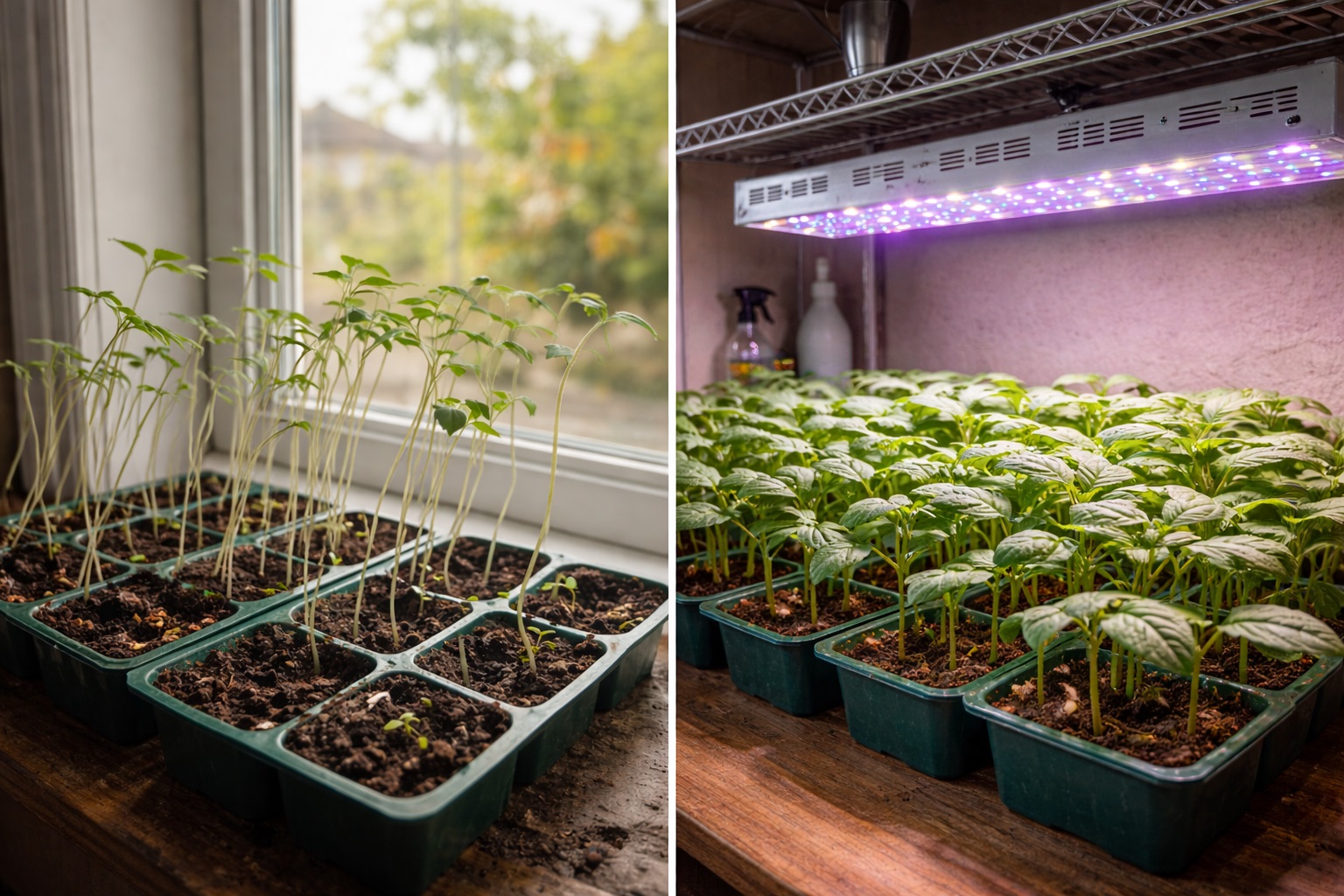
Nursery stage (seedlings & propagation)
This is the most sensitive phase in the plant growth. Without proper light:
- Seedlings stretch unnaturally (leggy plants)
- Stems remain weak
- Root growth is poor
- Survival rate drops after transplanting
Good nursery lighting produces:
- Short, sturdy plants
- Faster root establishment.
- Uniform growth across trays
For indoor farming, a strong nursery decides 50–60% of final crop success.
Vegetative and mature plant stage
As plants grow:
- Leaf area increases
- Photosynthesis demand rises
- Light intensity needs go up
Different crops (lettuce vs tomato) and stages (leaf growth vs flowering) need different light strength and color mix.
Understanding the Light Spectrum (Blue vs. Red vs. Full Spectrum)
Plants do not “see” light like humans. Brightness to our eyes does not matter much to them. They respond mainly to color (wavelength).
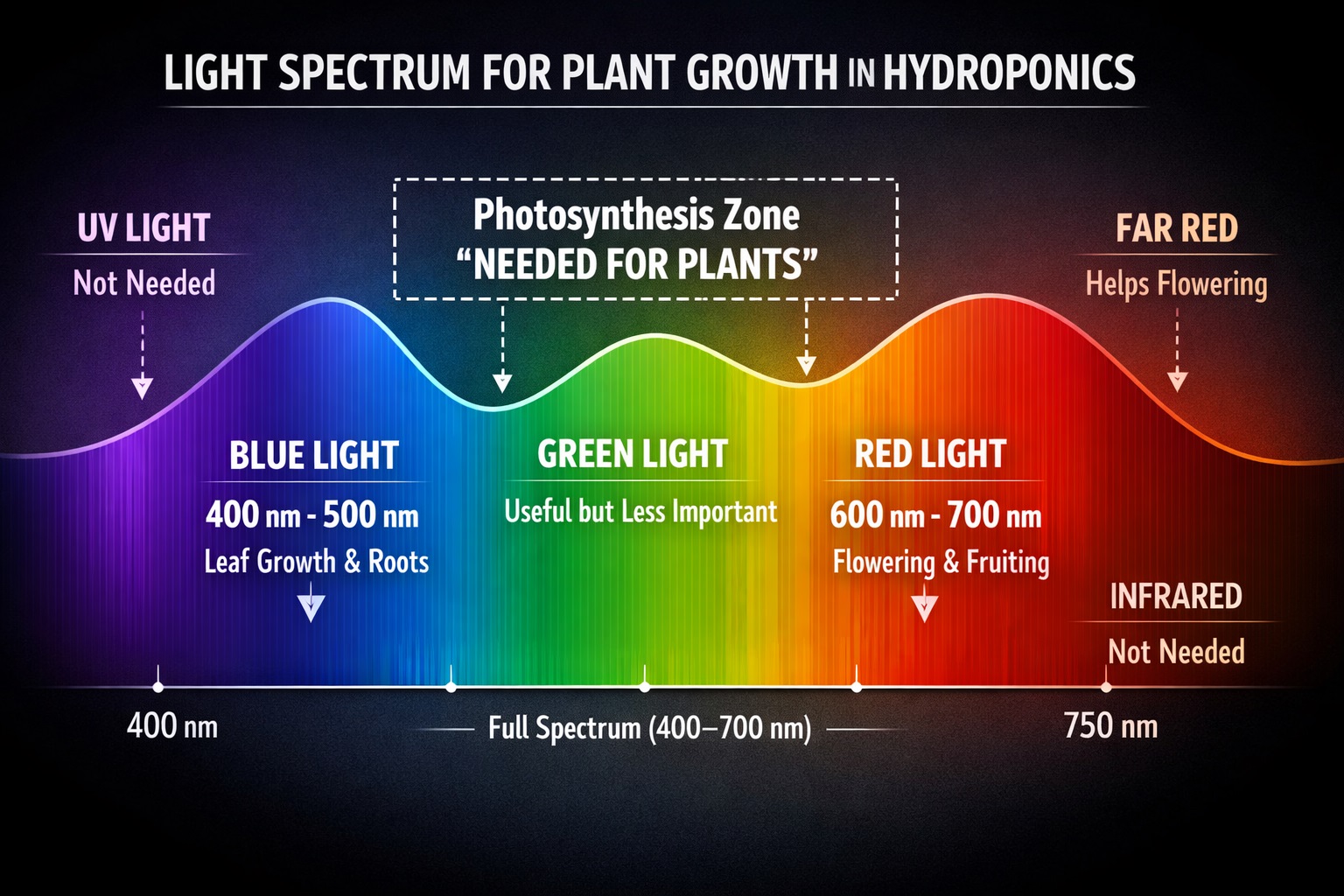
Blue light (around 450 nm)
- Encourages compact growth
- Strong stems
- Better leaf development
- Very important for nursery and leafy greens
Red light (around 660 nm)
- Drives photosynthesis
- Boosts biomass
- Essential for flowering and fruiting
White / full spectrum light
White or full spectrum light is a combination of blue, green, red that is Closest to natural sunlight.
- Easier to manage for beginners
- Works across multiple crops and stages
For most indoor farms and nurseries, full-spectrum white LED are the safest and most flexible choice.
Grow Lights Comparison & Selection Guide
The 3 Metrics That Actually Matter (PAR, PPFD, Photoperiod)
Choosing a growing light in India requires balancing crop needs with local climate challenges. Before you select a setup, you need to understand key “Smart Metrics” that will determine your ROI.
PAR
This is the light plants “eat.” In the Indian sun, PAR is abundant; indoors, we must ensure our LEDs provide the right PAR spectrum (450nm–660nm) to avoid weak crops.
PPFD
This measures the “density” of light hitting your leaves. In high-heat areas like North India, you want high PPFD LEDs that don’t require hanging the light too close to the water, which prevents your reservoir from overheating.
Photoperiod
The hours your lights are ON. In India, many commercial growers run their photoperiod during off-peak electricity hours (night time) to save on power bills and keep the grow room cooler.
Understanding Different Lighting Technologies (Types)
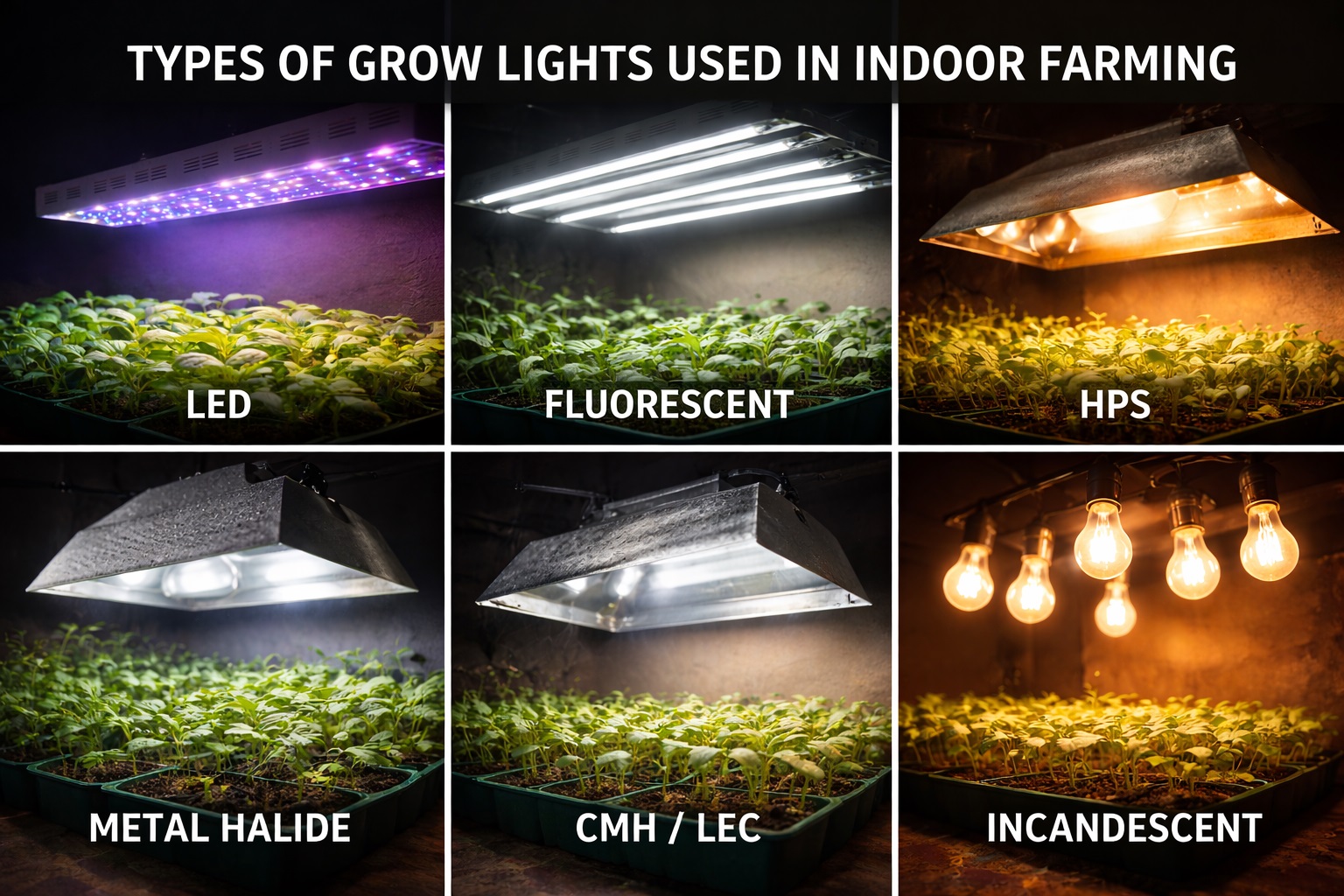
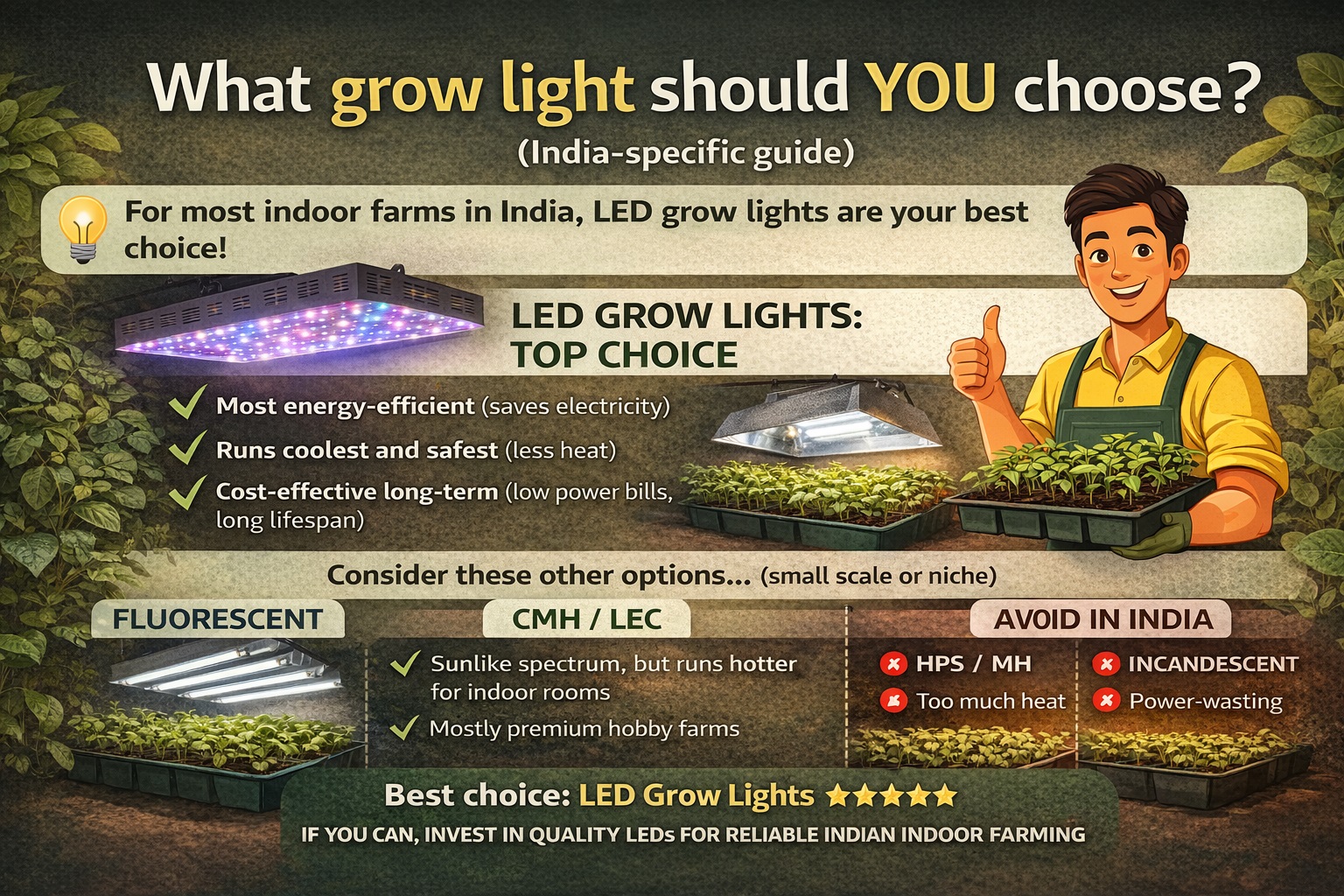
1. LED grow lights (Best overall choice)
LED (Light Emitting Diode) technology is the current gold standard for hydroponics in India. Unlike traditional bulbs, LEDs are highly efficient, converting almost all energy into usable plant light rather than wasted heat. LEDs work best in India because of following reasons:
- High energy efficiency (lower electricity bill)
- Low heat generation (critical for Indian climate)
- Long lifespan
- Available in tube, bar, and panel formats
- Suitable for vertical farming and nurseries
Best For: All stages of growth, from nursery seedlings to fruiting crops like tomatoes in a small to large commercial farms.
The India Advantage: Because they run cool, they won’t significantly raise the temperature of your grow room—saving you money on extra cooling or ventilation.
LED Grow Lights are Recommended for 90% of indoor farming setups
2. Fluorescent Lights (T5 / CFL)
- Best For: Seedling trays, clones, and low-light leafy greens like microgreens.
- The India Advantage: They are widely available and have a low initial setup cost, making them a budget-friendly entry point for home growers.
3. HPS / Metal Halide lights
- Best For: Large-scale commercial greenhouses with high ceilings where heat can be managed.
- The India Disadvantage: They are are not a good choice for indian scnerio because they generate very high heat, High power consumption, Extra cooling required, Not ideal for indoor rooms
Grow Light Efficiency: Cost per µmol (2026)
| Light Type | Efficiency (µmol/J) | Approx ₹ / µmol | Operational Verdict |
|---|---|---|---|
| LED (High-End) | 2.2 – 3.0 µmol/J | ₹10 – ₹20 | Gold Standard: Lowest heat and highest ROI over 2+ years. |
| CMH / LEC | 1.5 – 1.8 µmol/J | ₹18 – ₹25 | Balanced: Great spectrum, but bulbs need yearly replacement. |
| HPS (Double-Ended) | 1.0 – 1.4 µmol/J | ₹25 – ₹35 | Power Hungry: Cheap to buy, but adds heavy AC cooling costs. |
| Fluorescent (T5) | 0.6 – 0.9 µmol/J | ₹30 – ₹45 | Inefficient: Only suitable for clones or early seedlings. |
*Based on industrial electricity rates (approx. ₹9/kWh) and 50,000-hour operation cycle.
Note: Power, cost, and coverage values are indicative and based on commonly available fixtures in the Indian market. Actual performance depends on fixture quality, mounting height, and optics.
Professional Horticulture LEDs vs. Decorative Strips
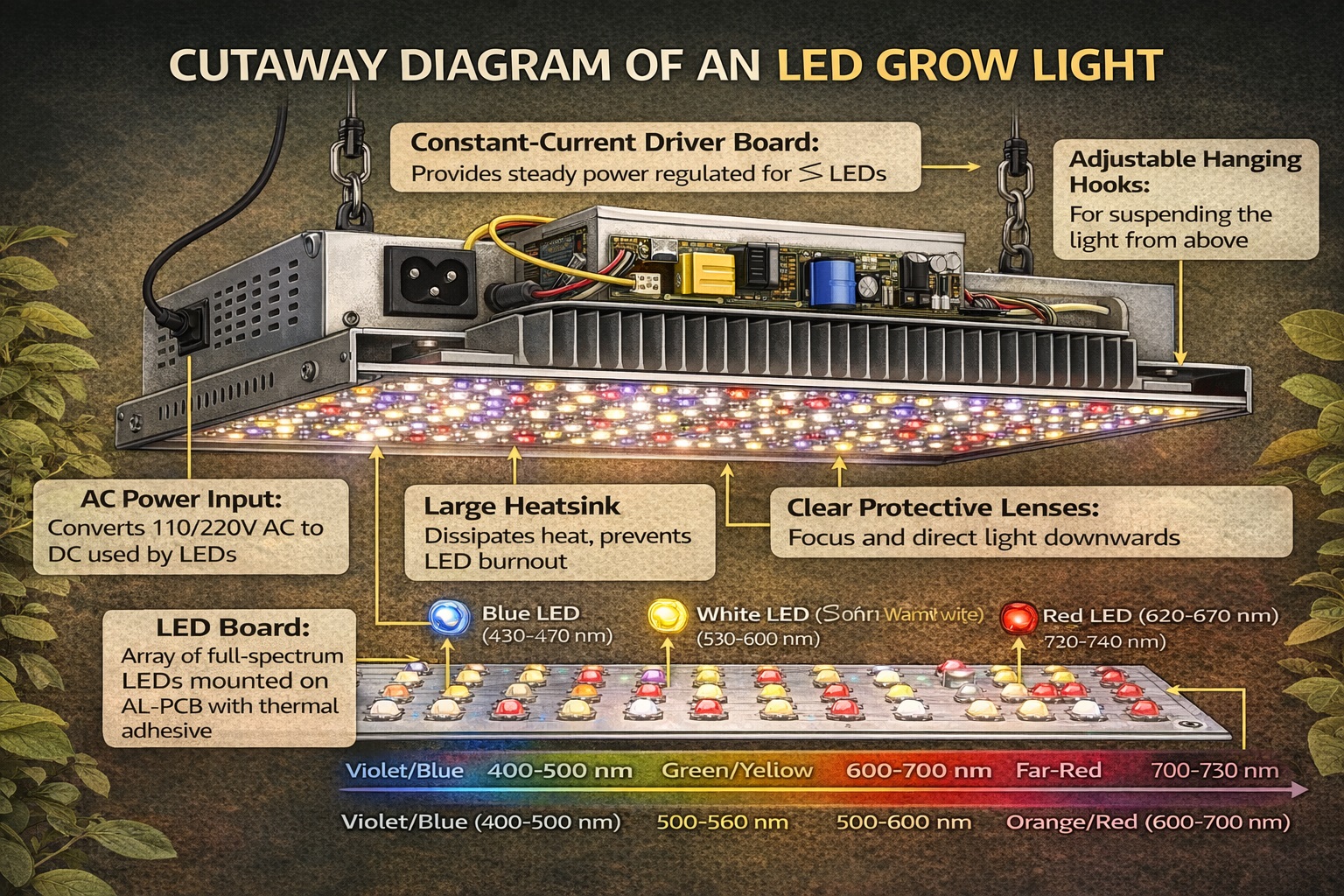
You can’t save cost by using standard RGB LED available in the market. Grow LED’s are arranged tuned to support your plant growth. They are arranged in a specific pattern with proper drivers, optics, and thermal management.
The Spectrum Gap (PAR vs. CRI)
Decorative LEDs are tuned for CRI (Color Rendering Index) to make the space look good to human eyes. Horticulture LEDs are designed for PAR (Photosynthetically Active Radiation).
The Efficiency & PPFD Problem
Standard LED strip can’t penetrate the plant canopy. Whereas, Grow Lights uses high-quality chips that are rated for 50,000+ hours for uniform and high intensity.
Heat Management
Standard strips are often encased in plastic or low-grade adhesive which traps heat. Horticulture-grade LEDs use aluminum heat sinks to dissipate heat away from the chips.
The "Heart" of the Light: High-Quality LED Drivers
In India, voltage fluctuations and power surges are common. While many sellers focus only on the LED chips, the LED Driver (power supply) is actually the heart of the system.
- Cheap Strips use unstable voltage supplies that flicker or burn out during minor power spikes.
- Professional Horticulture LED use high-quality Constant Current Drivers designed to handle Indian power conditions. A robust driver ensures a steady light output and protects your investment from the “silent killer” of indoor farming—unstable electricity.
Decorative vs. Horticulture LEDs
| Aspect | Decorative LED Strip | LED Grow Light (Professional) |
|---|---|---|
| LED Type | Low-power SMD (Generic) | High-efficiency Horticulture LEDs (Samsung/Osram) |
| Light Spectrum | Optimized for Human Eyes (CRI) | Tuned for Plants (Blue, Red, Far-Red, White) |
| Drive Method | Simple Voltage Supply (Unstable) | High-Quality Constant Current Driver |
| Heat Handling | Minimal (Traps heat in plastic) | Dedicated Aluminum Heat Sinking |
| Light Output | Low PPFD (Decorative only) | High Usable PAR (Deep penetration) |
| Lifetime | Short (Fades at high power) | Industrial Grade (50,000+ Hours) |
*Note: Standard LEDs lack the specific wavelengths (450nm and 660nm) required for vigorous photosynthesis.
Why DIY Lighting Alternatives Fail
If you choose RGB strips or household bulbs over professional grow lights, your system will likely face these five critical issues:
- Wrong Spectrum: Plants “starve” despite the room looking bright.
- Uneven Light: Creating “hot spots” and dead zones in your trays.
- Overheating: Damaging both the LED chips and your plant’s roots.
- Low PPFD: Light fails to penetrate the canopy to reach lower leaves.
- Short Lifespan: Rapid brightness loss due to poor thermal management.
Decorative lights are built to decorate a room, while professional grow lights are engineered to feed a canopy.
India-Specific Buyer’s Guide: Which Light is Right for You?
Choosing a light in India is different than in Europe or the US. You should consider following points for light selection:
1. For Home Growers & Balcony Setups
If you are growing in a small apartment or a balcony with partial shade, your goal is to supplement light without increasing your room temperature.
- Best Choice: Full-spectrum LED tubes or small 50W panels.
- Mounting: 20–30 cm above your plants.
2. For Nursery & Leafy Greens (The ROI Choice)
If you are starting a commercial nursery for lettuce, spinach, or herbs (Coriander/Mint), efficiency is your top priority.
- Best Choice: Linear LED Bars (4ft tubes) because they provide uniform coverage across multiple trays, which is critical for consistent harvests.
- Light Spectrum: Focus on blue-rich or white spectrum
India Tip: Leafy greens thrive in cooler temperatures (18°C–25°C). Since LEDs emit 80% less heat than HPS bulbs, they help you avoid the high cost of running air conditioning 24/7.
3. For Fruiting Crops (Tomatoes, Chilies, Bell Peppers / Capsicum Cucumbers)
High-value crops like cherry tomatoes or bell peppers require “intense” light to produce fruit.
- Best Choice: High-intensity LED UFOs or Quantum Boards. These crops need a strong “Red” spectrum during the flowering stage to maximize yield.
India Tip: Fruiting crops are heavy drinkers. High heat from old-school bulbs will evaporate your nutrient solution and cause root rot. Stick to high-quality LEDs to keep your reservoir temperature stable.
Common Lighting Mistakes to Avoid
Even with the best hydroponic system, how you manage your lights determines your final yield. You shoul avoid following mistakes:
- Buying by Watts, Not PAR: Don’t select the light by its power consumption (Watts). A 100W household bulb is less effective for plants than a 30W professional horticulture LED. Always look for the PPFD or PAR output.
- The “Distance” Trap: Hanging lights too far away causes plants to stretch and become weak (leggy). Conversely, hanging them too close can cause “light burn” or heat stress. Maintain a distance of 20–30 cm for seedlings and adjust as they grow.
- Ignoring the Photoperiod: Plants need a “sleep” cycle to process energy. Keeping lights on 24/7 creates stress. Stick to a consistent schedule (usually 14–16 hours for leafy greens).
- Using “Blurple” Lights Blindly: Cheap purple-spectrum lights often have poor intensity and make it impossible to spot early signs of pests or nutrient deficiencies on your leaves. Full-spectrum white light is usually the safer, more practical choice.
- Neglecting Heat Management: In India’s warmer regions, grow lights can raise the water temperature in your hydroponic system. High reservoir temperatures (above 25°C) lead to low dissolved oxygen levels and root rot. Keeping reservoir temperatures below 25°C is critical for root health, and choosing low-heat LEDs is the easiest way to achieve this.
Frequently Asked Questions about Hydroponic Lighting
1. Can I use decorative LED strips or room lights for my plants?
Decorative lights like RGB strips or cool white room lights are designed to light the room for human eyes, not the plant. They often fail because they have the wrong spectrum, low PPFD, and lack the 450nm (blue) and 660nm (red) wavelengths required for vigorous photosynthesis.
2. Why is the "Nursery Stage" so important for lighting?
The nursery stage is the most sensitive phase of growth. Without proper light, seedlings stretch unnaturally (leggy plants) and survival rates drop after transplanting. For indoor farming, a strong nursery setup decides 50–60% of final crop success.
3. How many hours should I run my grow lights?
You should run your grow ligths as per your crop lighting requirements. That is also different for the crop stage. For example, Leafy Greens requires 14–16 hours daily whereas Fruiting crops like tomatoes and cucumbers may need 16–18 hours.
4. What is the best distance to mount my lights?
For home setups and nurseries, it is generally recommended to mount your LED lights 20–30 cm above the plants. This ensures uniform coverage and prevents the plants from stretching while avoiding heat stress.
5. Why are LEDs recommended over HPS lights in India?
LEDs are the best choice for the Indian climate because of their low heat generation and high energy efficiency. HPS lights are not ideal for Indian indoor rooms because they require extra cooling and have very high power consumption.
Summary: Choosing the Best Setup for Grow Yukti Systems
Your Lighting choice is a long term investment for your plant growth. Once a decision is taken, its difficult to move back because of high capital investments. To ensure the highest ROI and healthiest yields, keep these four principles in mind:
- Prioritize Full-Spectrum LEDs: They are the most flexible and safest choice for Indian conditions, offering the best balance of growth energy and temperature control.
- Focus on Uniformity, Not Just Watts: A well-designed system uses LED bars or panels to provide even light coverage across the entire canopy, preventing “hot spots” and dead zones.
- Choose High Efficiency LED: Choosing high-efficiency growing lights, especially in warmer regions, eleminates the the hidden costs of heavy air conditioning and protects your system from root rot.
- Start Simple, Scale Smart: Begin with a setup that matches your current crop needs and upgrade as your farm grows.
A well-chosen grow light will pay for itself through better plant survival, faster growth cycles, and consistent yields. At Grow Yukti, we focus on smart, sustainable hydroponic solutions tailored for the Indian environment.