
Control pH in a hydroponics system is not optional. It’s one of the most important daily checks that ensures your plant growth. Even with perfect nutrients, lighting, and temperature, wrong pH can silently stop plant growth.
pH is easy to understand and manage once you know why it matters, why it changes, and what happens if you ignore it. In this article we will cover everything you need to know about control ph in Hydroponics.
What is pH and Why Does it Matter in Hydroponics?
pH tells you how acidic or alkaline your nutrient solution is. pH scale runs from 0 to 14. A pH value equal to 7.0 considered Neutral, below 7 is considered Acidic and above 7 is considered Alkaline.
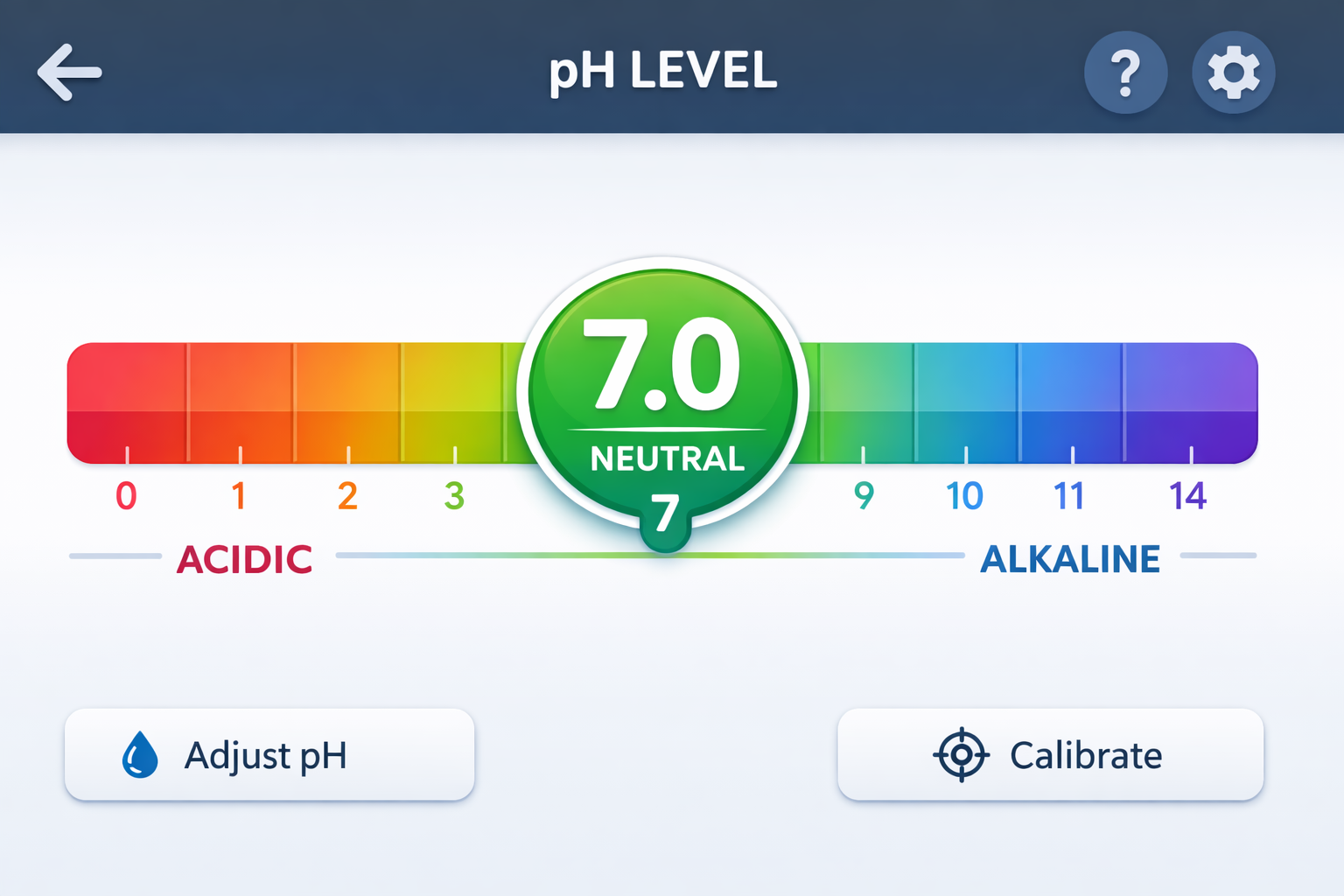
For most hydroponic crops, the ideal pH range is 5.5 to 6.5. This range allows plants to absorb all essential nutrients properly.
How pH Impacts Nutrient Absorption?
In soil, microbes and organic matter help buffer pH changes. But in hydroponics, plants depend 100% on the water solution for pH Control.
pH Control in hydroponics is important for Nutrient Absorption. Even if your water in hydroponic system has all nutrients, plants can’t absorb them if pH is wrong.
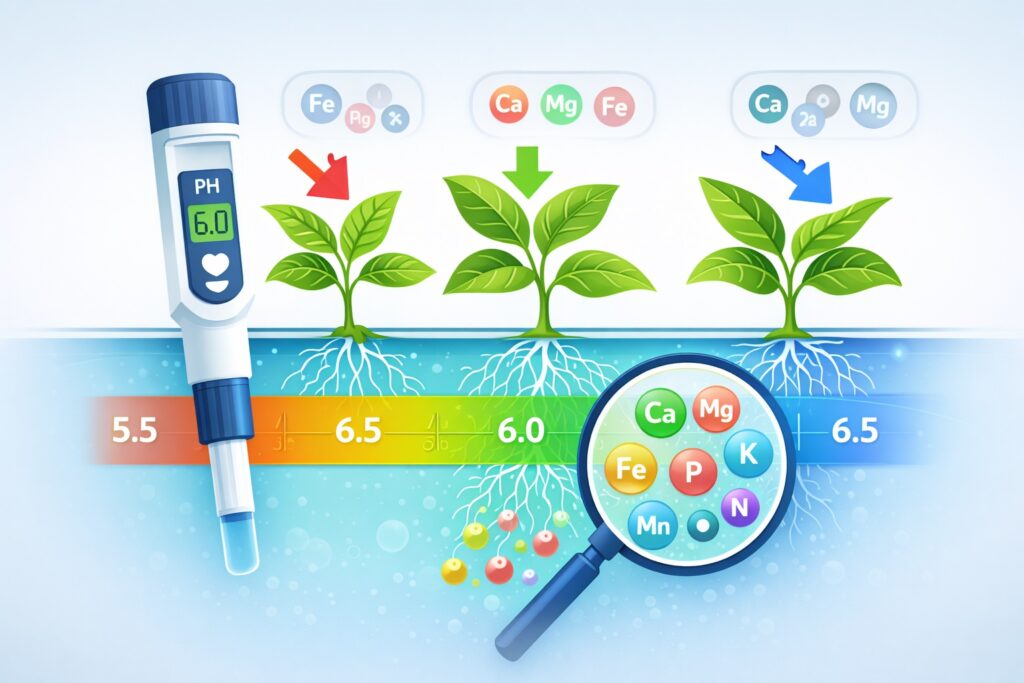
Understanding "Nutrient Lockout"
At high pH, iron, manganese, and phosphorus become unavailable. Whereas at low pH, calcium and magnesium uptake drops. This condition is called nutrient lockout.
Nutrient Lockout is a condition where nutrients exist, but plants are locked out from using them. Healthy pH will Leads to Healthy Roots
Correct pH balance in water in a hydroponic system keeps the roots white and active, Prevents nutrient stress, Supports steady growth. Whereas, Wrong pH in water of a hydroponic system Weak roots, Slow growth, More chances of disease.
Ideal pH Range for Hydroponic Crops
Most hydroponic crops grow best in a pH range of 5.8 to 6.2, where all essential nutrients remain easily available to plant roots. Staying within this range helps prevent nutrient lockout, supports healthy root function, and ensures steady, balanced growth.
pH for Hydroponic Crops
| Crop Type | pH Level |
|---|---|
| Leafy Greens | 5.5 to 6.5 |
| Herbs | 5.5 to 6.5 |
| MicroGreens | 6 to 6.5 |
| Fruiting Crops | 5.8 to 6.5 |
| Exotic Greens | 5.5 to 6.5 |
Why Does Your pH Level Keep Changing?
Water pH in a hydroponic system changes very fast and this is normal. Below are the common factors that changes the water pH in a hydroponics system.
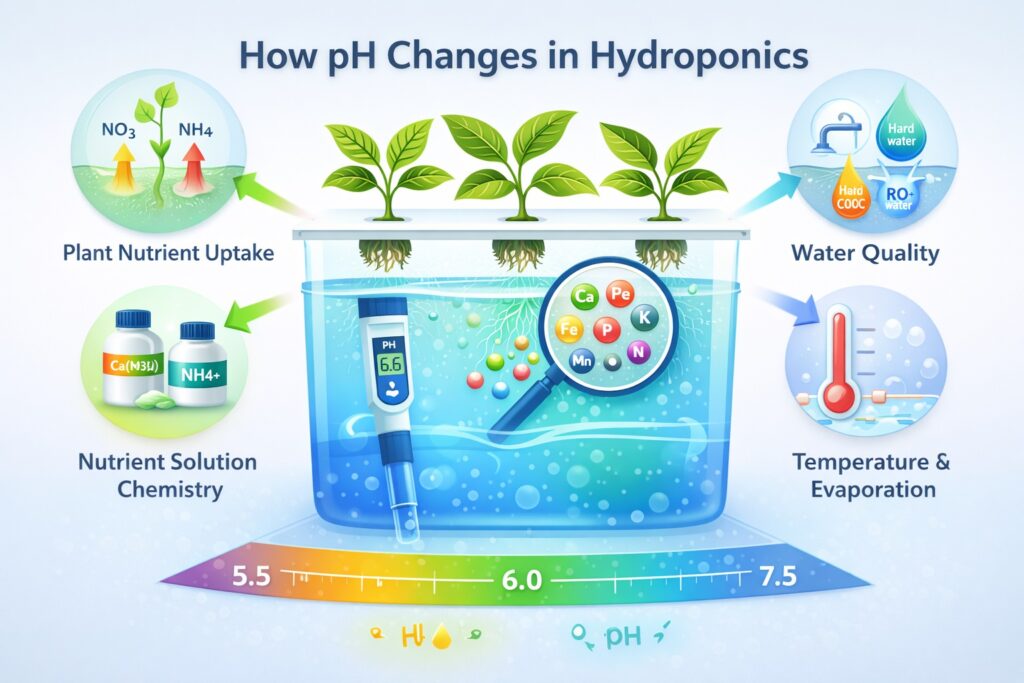
1. Plant Nutrient Uptake and Root Exudates
Plants don’t absorb nutrients equally all the time. When plants absorb more nitrate, pH rises. Whereas, when they absorb more ammonium, pH falls. As a result, when the plants grow faster, pH changes faster.
Even in hydroponics, microbes exist. Root exudates to feed microbes and Microbes release acids or bases. This release of acids or bases from Microbes slowly shifts pH. If you use organic additives, this effect multiplies.
2. Water Source: Hard Water vs. RO Water
The Source of water plays a critical role in maintaing water pH.
- Hard water (high minerals) pushes pH up.
- Whereas, Soft or RO water can cause sudden pH drops
Bicarbonates in tap water slowly increase pH over time.
3. Nutrient Solution Chemistry
Different nutrients affect pH differently:
- Calcium nitrate raises pH
- Ammonium-based nutrients lowers pH
Mixing nutrients incorrectly can cause unstable pH.
3. Environmental Factors (Temperature & Evaporation)
Warm water increases chemical activity and Evaporation concentrates salts. The Concentrated solution causes pH drift.
The Consequences of Poor pH Management
Ignoring pH doesn’t kill plants immediately, but damage builds quietly with time.
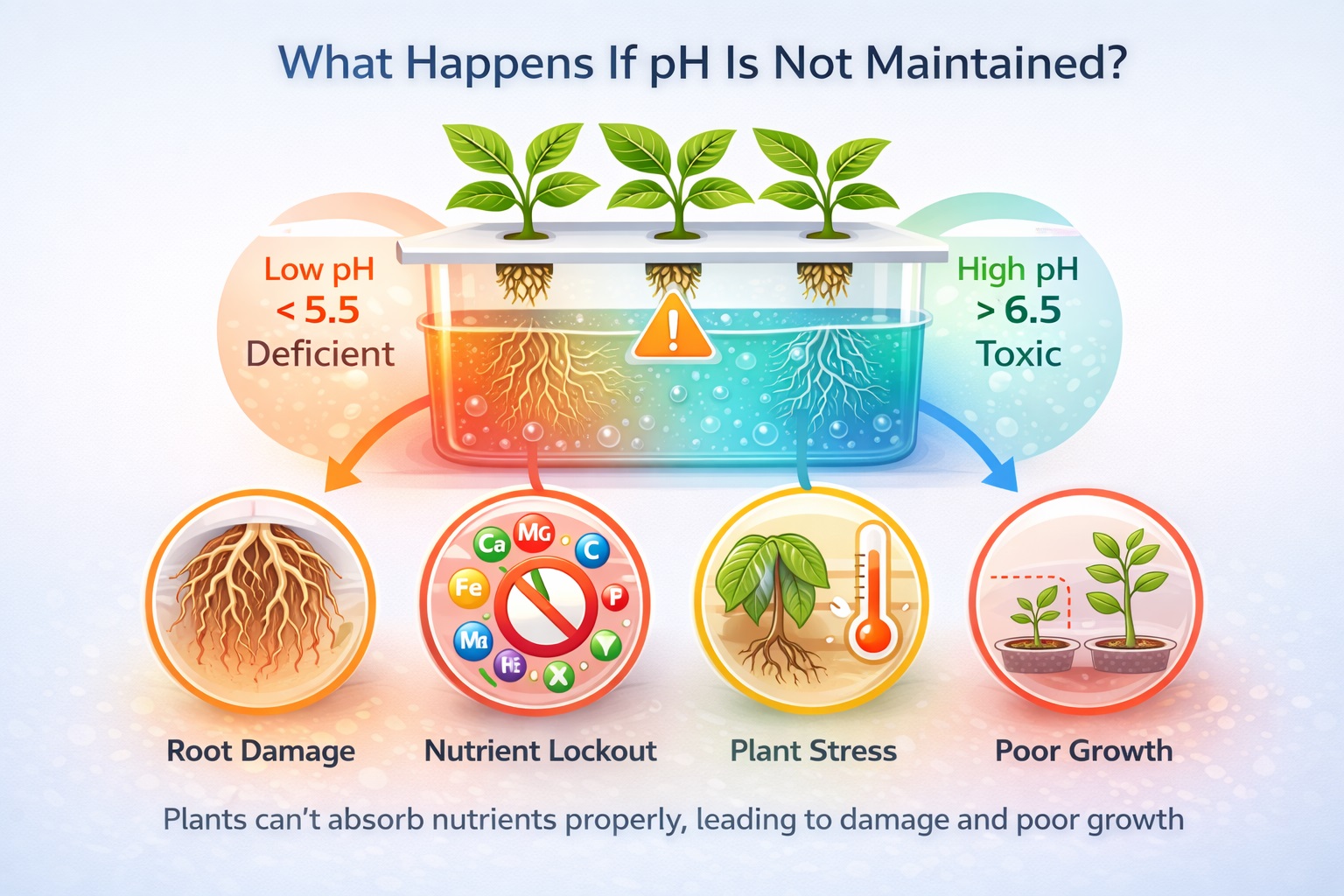
Immediate Effects: Root Stress and Browning
Wrong pH, stresses plant roots that results in Reduced oxygen uptake, Weak root tips and Higher risk of root rot. Once roots are damaged, recovery is slow.
Wrong pH stresses roots and a stressed plants are easy targets for diseases like Pythium, Fusarium, and Algae growth. Correct pH helps keep the system biologically stable.
Your hydroponic sytem water has all required nutrients. Check your water pH more regularly if you see following signs:
- Yellowing leaves (iron deficiency)
- Purple stems (phosphorus lockout)
- Leaf edge burn (calcium issues)
When new Growers see above problems they often add more nutrients, but the real problem is pH, not nutrient quantity.
Long-term Effects: Stunted Growth and Low Yield
Plants stop growing at their potential if water pH is not controlled. This results in following conditions:
- Smaller leaves
- Shorter plants
- Fewer fruits or heads
Yield can drop 20–50% just due to poor pH control.
Method 1: Manual pH Control
Essential Tools for Manual pH Testing
Manual pH testing is simple, affordable, and reliable when done correctly. Having the right tools ensures accurate readings and prevents unnecessary pH correction mistakes. Always take pH readings in a clean container to avoid contamination from nutrients or cleaning chemicals.
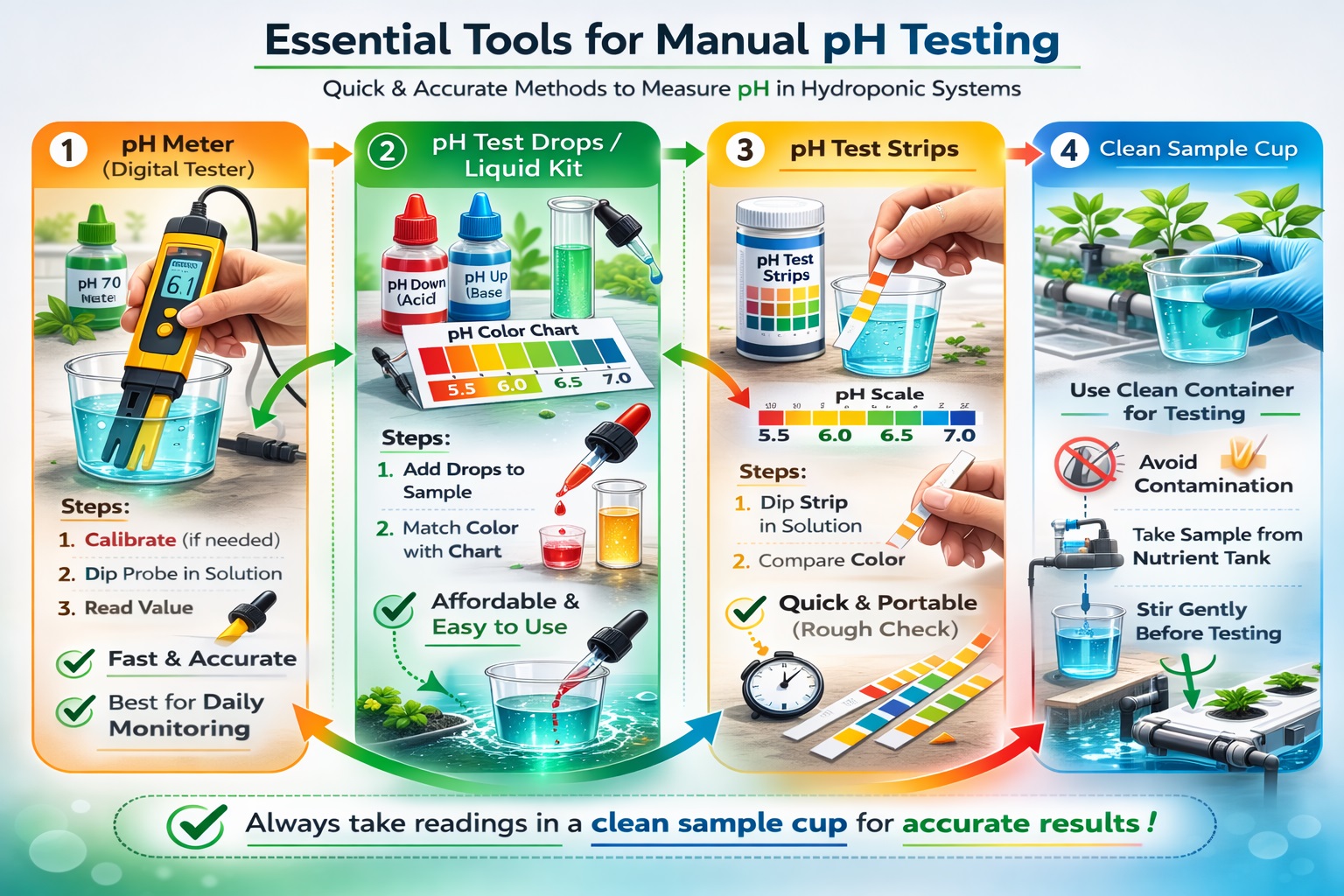
1. Digital pH Meter
A digital pH meter is the most accurate tool for hydroponic systems. It provides quick readings and is ideal for daily monitoring. Regular calibration with buffer solutions is essential to maintain accuracy.
Calibration Buffer Solutions (pH 4.0 and 7.0)
Buffer solutions are required to calibrate digital meters. Proper calibration ensures reliable readings over time.
2. pH Test Drops or Liquid Kits
These use color change to indicate pH levels. They are inexpensive and useful as a backup or for beginners, though they are less precise than digital meters.
3. pH Test Strips
Test strips offer a fast and portable way to estimate pH. While convenient, they are best suited for rough checks rather than fine pH adjustments.
NFT vs DWC for Lettuce Growth
| Feature | pH Test Strips | Liquid Test Kits | Digital pH Meters |
|---|---|---|---|
| Accuracy | Lowest (General estimation) | Good (±0.5 range) | High Precision (±0.1 or better) |
| Ease of Use | Dip and read | Requires mixing in a tube | Instant digital readout |
| Initial Cost | Lowest (₹150 - ₹400) | Low (₹300 - ₹800) | Moderate (₹1,500 - ₹8,000) |
| Maintenance | Disposable (One-time use) | None required | Needs calibration & storage solution |
| Best For | Quick spot checks | Beginners & Hobbyists | Serious Growers & Pros |
| The "Catch" | Hardest to read accurately | Hard to read in colored nutrients | Probes can fail if they dry out |
Using these tools together helps maintain consistent pH control and builds confidence in manual testing before moving to automation.
How to adjust pH Levels Safely
Check water pH daily in a active hydroponic systems. It is recommended to calibrate your meter atleast weekly.
Its always recommended to maintain ideal water temperature range for your crop. A Stable temperature results in stable pH.
Using pH Up (Bases) and pH Down (Acids)
You can use phosphoric acid for pH Down and potassium hydroxide or carbonate for pH Up. It is always recommended to adjust the pH slowly. Wait 10–15 minutes after mixing pH Up or pH Down solution , then recheck.
Why You Should Never Adjust pH "Blindly"
Avoid constant micro-adjustments for pH. Best practice is to do a change when the pH is not in between the recommended range for your crop. It’s Ok if pH swing slightly. Small swings are healthier than constant correction.
Drain and replace solution every as per recommendations (7–14 days for a small home setup). It prevents salt buildup, Resets pH stability.
The Grow Yukti Maintenance Checklists
Use this as a daily / weekly operating checklist.
Daily Monitoring Tasks
- Measure pH at the same time every day
- Make sure ph is in recommended Target range
- Note pH trend (rising or falling?)
- Check nutrient tank water level
- Ensure pH probe is clean and submerged
- If pH is in between recommended range → do nothing
- If pH < Lower Recommended Limit → prepare pH UP
- If pH > Upper Recommended Limit → prepare pH DOWN
Never adjust Hydroponic System pH blindly—measure first.
Weekly Sensor Calibration
- Calibrate pH sensor (pH 4 & 7 buffers)
- Inspect dosing tubes for clogging
- Check nutrient concentration (EC/TDS)
- Inspect roots for stress or browning
- Top up reservoir with fresh water
Bi-Weekly or Monthly System Flush
- Replace full nutrient solution (7–14 days)
- Clean tank, pump, and tubing
- Clean pH probe with probe solution
- Verify acid/alkali stock concentration
Method 2: Automated pH Control (The Smart Way)
How Automated Dosing Systems Work
An automated pH control system continuously monitors and adjusts the pH of the nutrient solution without manual intervention. It works on a simple principal:
Measure → Decide → Correct → Verify Cycle
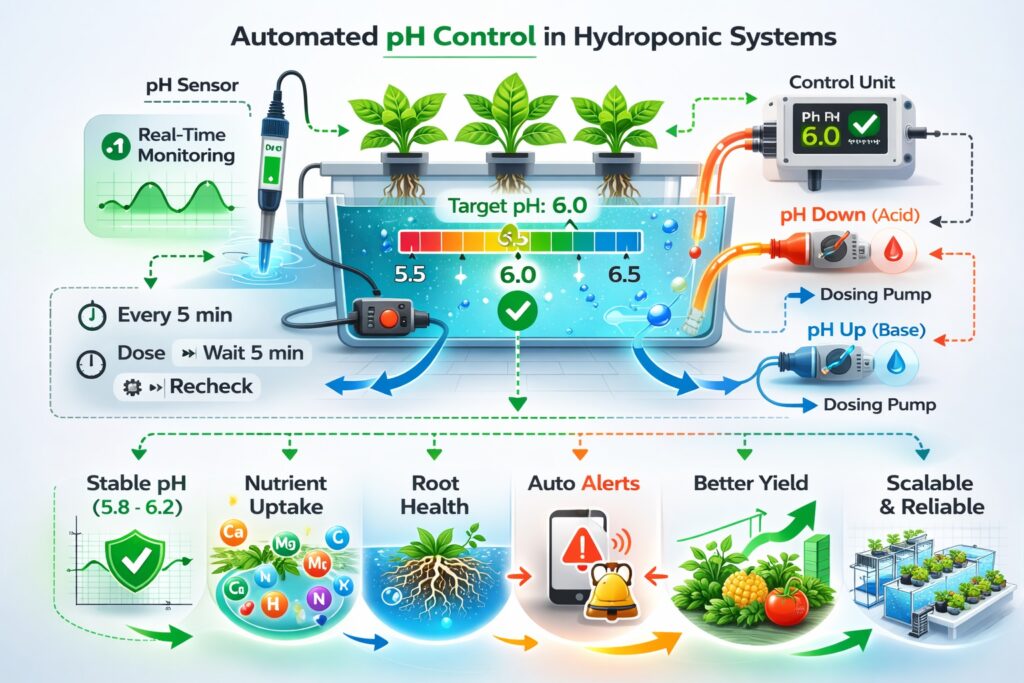
Step 1: Continuous pH Monitoring
A pH sensor placed in the nutrient tank measures the solution at regular intervals. This gives real-time data instead of one-time manual readings.
Step 2: Decision Based on Set Limits
The controller compares the measured pH with a predefined safe range.
- If pH is within range, no action is taken
- If pH drifts high or low, correction is triggered
Step 3: Take Action - Correct the pH (Controlled Dosing)
Peristaltic Dosing Pumps are used to either add either pH down (acid) or pH up (base) in very small amounts. Dosing is time-limited to avoid overcorrection.
Step 4: Verify the Cycle
After dosing, the system waits for proper mixing and stabilization before taking the next reading. This prevents pH oscillation.
If pH is still outside the range, another small correction is applied. Safety lockouts stop repeated dosing if limits are exceeded.
The complete system records all the data with time stemps. If pH goes beyond safe limits or corrections happen too often, the system sends alerts and logs data for troubleshooting.
In simple terms: automated pH control makes small, timely corrections to keep pH stable—protecting roots, improving nutrient uptake, and removing human error.
5 Key Benefits of Switching to Automation
Maintaining pH manually works—but only up to a point. As plants grow, nutrient uptake increases, pH starts drifting faster, and daily adjustments become inconsistent. This is where automated pH control makes a real difference, especially in hydroponics.
1. pH Consistency and Eliminating Human Error
Manual pH control often fails due to missed checks, overdosing, or constantly chasing exact numbers. Automated systems follow set rules, not emotions—adding only small, controlled doses, allowing time for mixing, and avoiding overcorrection. This leads to fewer mistakes and healthier plants.
Plants need consistent pH throughout the day, not just one perfect reading. Automated control measures pH regularly, corrects small drifts early, and keeps pH within a tight, safe range—resulting in smooth stability and better plant performance.
2. Prevents Nutrient Lockout Before It Happens
Most nutrient problems in hydroponics are not due to lack of nutrients, but wrong pH. Automated pH control detects early drift, adjusts pH before nutrients become unavailable, ensures continuous absorption of iron, calcium, magnesium, and phosphorus. This prevents hidden deficiencies that often confuse growers.
3. Better Yields through Stability
Sudden pH swings stress plant roots, even within acceptable limits. Automated pH systems make small, gradual corrections that prevent root shock and keep roots healthy, leading to better growth and yield.
Advanced systems also monitor for issues like pH drift, unstable sensor readings, frequent dosing, or low water levels and send alerts early. This predictive control results in faster growth, uniform plants, improved produce quality, and higher yields for both leafy greens and fruiting crops.
4. Saves Time and Effort
Checking pH once a day is manageable. Checking it multiple times a day is not. With automation pH monitoring runs in the background, Corrections happen automatically and Grower only reviews trends and alerts.
This is especially helpful for Large systems, Busy growers, and Commercial or semi-commercial setups.
5. Makes Scaling Easy
What works for 10 plants doesn’t scale well to 100 or 1000. Automation Maintains the same logic regardless of system size, Allows remote monitoring and control, Makes expansion predictable and manageable. This is critical for growers planning to scale up.
Common pH Troubleshooting & FAQs
Why is my pH rising every day?
In hydroponics, daily pH rise is normal and usually means your plants are actively growing. As roots absorb more nitrate-based nutrients, they release compounds that slowly push the pH upward. This effect becomes stronger as plant size and nutrient uptake increase.
Other common contributors include bicarbonates in tap water, evaporation concentrating salts, and warm solution temperatures. If pH rises steadily—not suddenly—it’s typically a sign of healthy uptake rather than a system problem.
Can I use household vinegar or baking soda to adjust pH?
You can use household vinegar or baking soda to adjust pH. But it’s not a good idea for hydroponic systems, especially long term.
Vinegar lowers pH, but it is a weak, organic acid. It breaks down quickly in the nutrient solution, causing pH to rebound within hours. This leads to frequent corrections and unstable pH, which stresses plant roots. It can also feed unwanted microbes in the reservoir.
Baking soda raises pH, but it adds sodium to the system. Sodium is not a plant nutrient, builds up over time, and can damage roots and reduce nutrient uptake.
Final Thoughts on Mastering Your Reservoir
In hydroponics, pH is the gatekeeper of plant health. You can have Best nutrients, Perfect lighting, and Advanced automation. But if pH is ignored, plants will still struggle.
The moment you start treating pH as a daily habit instead of an occasional fix, you’ll see:
- Faster growth
- Better color
- Higher yields
Control pH, and hydroponics becomes predictable, efficient, and deeply satisfying.
Tired of Daily pH Testing?
Experience the future of farming with Grow Yukti's Smart Hydroponic Kits. Automate your pH control, monitor your levels remotely, and spend more time harvesting instead of testing.
Explore Smart Kits →