
Seed Germination in Hydroponics: Guide to Soilless Farming

Seed Germination stage in Hydroponics is the starting point of every successful hydroponic grow. No matter what hydroponic system you use, poor germination will limit yield, uniformity, and plant health for the rest of the crop cycle. In hydroponics, germination is more controlled than soil-based growing.

A good Seed Germination in Hydroponics or soil farming ensures fast, uniform, and disease-free seedlings ready for high-performance growth.

Understanding the Hydroponic Germination Stage

What exactly is Seed Germination in Hydroponics?

Seed Germination is the biological process where a seed absorbs water, activates enzymes, and transitions from a dormant state into a living seedling. The seed first produces a radicle (root), followed by a hypocotyl and cotyledons (seed leaves).

In hydroponics, this process happens without soil, using inert media and carefully controlled moisture, oxygen, temperature, and light.

What happens during seed Germination stage?

  • Seeds absorb moisture
  • The seed coat breaks
  • A small root (radicle) emerges

How Seed Germination Is different in Hydroponics?

Unlike soil, hydroponics offers:

  • No nutrient buffering
  • No microbial safety net
  • Faster water uptake
  • Higher oxygen availability (when designed correctly)

This means seed germination in hydroponics can be faster and more uniform. But mistakes like overwatering, poor oxygen, and heat stress damage the seeds immediately.

Why Germination Success Determines Your Final Yield?

Strong seed germination in hydroponics leads to:

  • Uniform crop height
  • Predictable harvest timing
  • Lower disease pressure.
  • Higher nutrient uptake efficiency

Weak germination creates uneven plants that never fully recover, even in perfect systems.

The 5 Golden Rules for Successful Sprouting

1. Moisture: Hydration Without Drowning

Seeds need water to trigger enzyme activity, but excess water blocks oxygen. Therefore the best practice is to:

  • Media should be moist, not dripping
  • Free water should never pool around the seed
  • Gentle misting is better than soaking

Overwatering is the #1 cause of seed failure in hydroponics.

2. Oxygen: The Often-Ignored Secret to Root Health

Seeds respire even before leaves appear. Oxygen deficiency causes Slow sprouting, Weak roots, Seed rot (especially in warm climates).
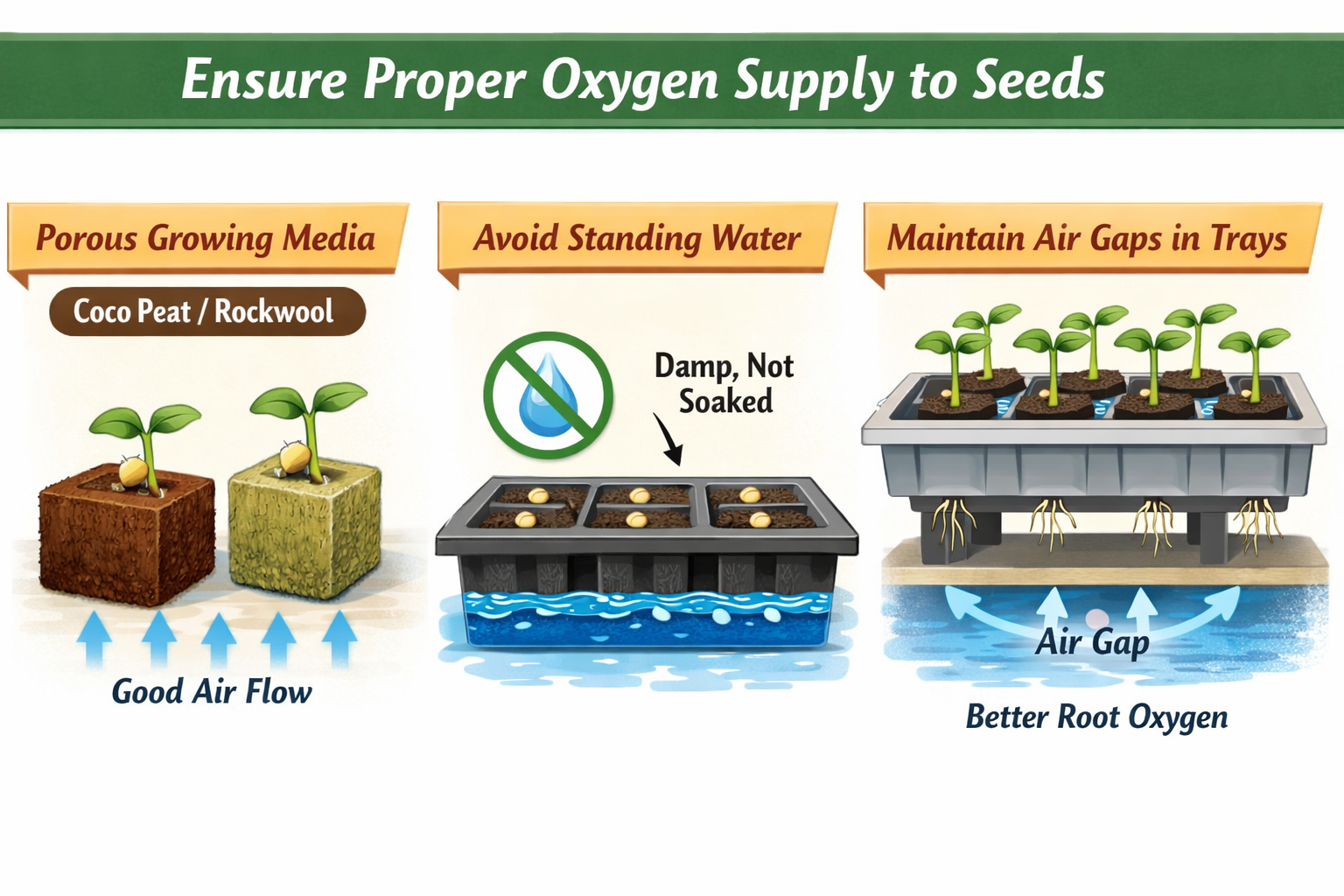
Hydroponic seed germination showing porous growing media, no standing water, and air gaps in trays to ensure proper oxygen supply.

We can ensure proper oxygen supply to seeds in the following ways:

  • Use porous Growing media (coco peat, rockwool)
  • Avoid standing water
  • Maintain air gaps in trays

3. Temperature: The Germination Trigger

Most hydroponic crops germinate best according to crop type ideal temperature. For example, Leafy greens needs 18–22 °C, Herbs 20–25 °C, and Fruiting crops needs 22–28 °C.

  • Too cold temperature will lead to delayed germination
  • Too hot temperature will lead to fungal growth and weak seedlings

4. Light: Less is More

Most seeds do not require light to germinate. In fact, strong light during germination can:

  • Dry the media
  • Increase temperature
  • Stress emerging seedlings

Best approach is to Germinate in darkness or diffused light, Introduce gentle light only after cotyledons emerge.

5. Nutrients: Why Less is More for New Seedlings

Nutrients are not required initially during germination. Seeds contain all the energy needed to sprout. Adding nutrients too early can Burn emerging roots, Increase salt stress, Encourage algae growth. Best approach is to:

  • Use plain, clean water (EC < 0.3)
  • Start light nutrients only after
    • 2 to 3 true leaves appear
    • Roots emerge from the media

Solving Indian Environmental Challenges in Hydroponics

Germination in India is fundamentally different from low temperate regions. Seed germination in hydroponics must be designed for resilience in India. Because High ambient temperatures, fluctuating humidity, inconsistent power supply, and variable water quality is very common cause of fature here.

Typical Challenges in indian Conditions

Challenge Typical Indian Condition Impact on Germination
High Temperature 30–45 °C (Summer) Can trigger seed dormancy or cause rapid fungal attacks in the media.
High Humidity 80–95% (Monsoon) Increases the risk of Damping-off disease (stems rotting at the base).
Water Quality High TDS / Hardness Excessive minerals lead to poor water uptake and pH imbalances.
Power Cuts 2–6 hours/day Causes germination trays to overheat or grow media to dry out rapidly.
Dust & Spores High airborne load Introduces pathogens leading to seedling infections and mold growth.

Your Step-by-Step Guide to Germinate Seeds in Hydroponics

Step 1: Selecting Heat-Tolerant Seed Varieties

Here is the list of points you need to consider during seed selection:

  • Select Heat tolerant varieties
  • High quality seeds can boost approximate 70 to 90% germination. Cheaper seeds might have lower germination rate.
  • Select seeds with fresh production year.
  • Prefer seeds from Indian or tropical breeders.
  • Avoid cold-climate lettuce/herb varieties.
  • Store seeds in airtight containers with silica gel.

The below table will give you a holistic idea about the seed prices in india for hydroponic crops.

Average Seed Price for Different Crops

Crop Category Avg. Price Quantity
(Seeds)
Exotic Lettuce
(Iceberg, Romaine)
₹120 – ₹190 400+
Cherry Tomatoes
(Red/Yellow F1)
₹70 – ₹150 30–50
English Cucumber
(Seedless)
₹150 – ₹250 10–20
Herbs
(Basil, Oregano, Parsley)
₹50 – ₹90 200+
Bell Peppers
(Capsicum - Red/Yellow)
₹60 – ₹120 25–30
Bok Choy / Pak Choi ₹60 – ₹110 400+
Kale
(Curly/Lacinato)
₹60 – ₹95 400+

Step 2: Choosing Your Germination Method (Tray vs. Direct vs. Pre)
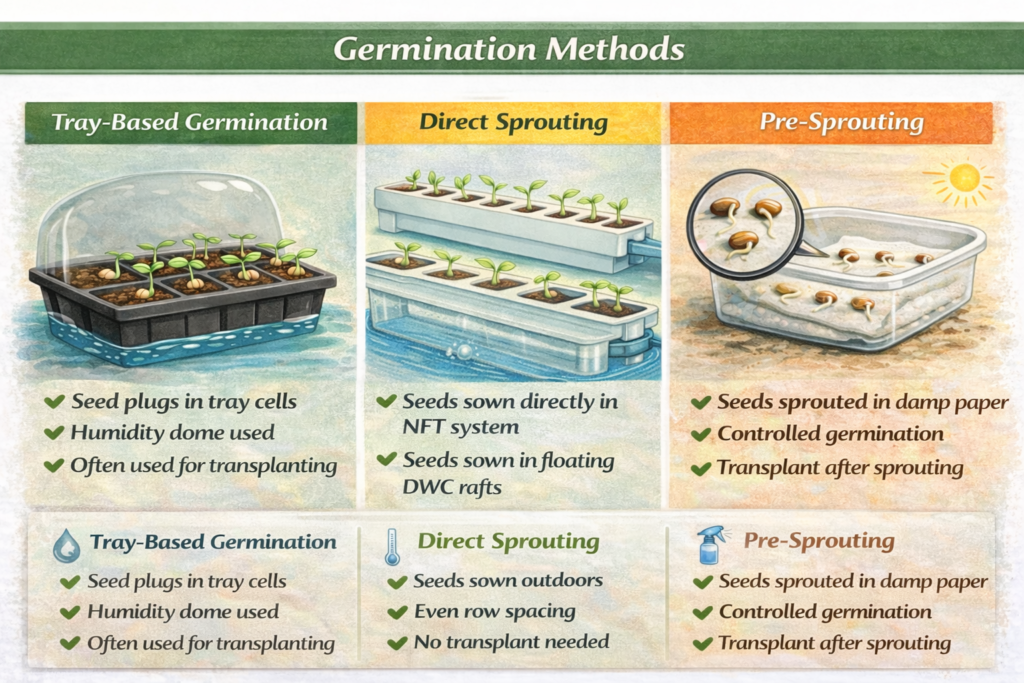
1. Tray-Based Germination (Most Common)

Tray based seed germination method in hydroponics is more common amogst new growers and a best choice for lettuce, herbs, strawberries. In this seeds are placed in plugs or cubes and kept in warm and humid environment. You can transplant after 7 to 14 days.
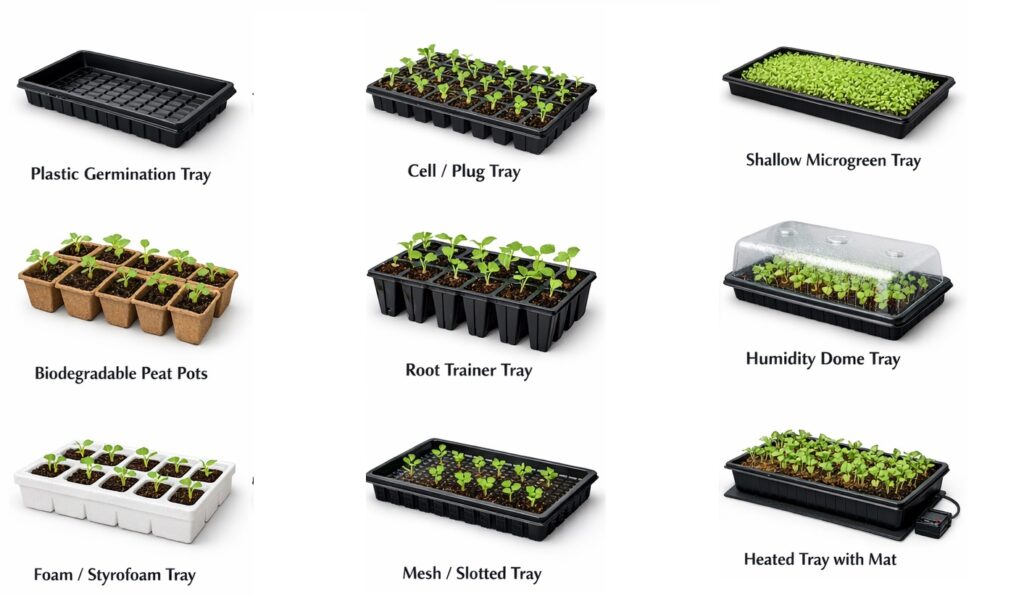
Various seed germination trays such as plug trays, microgreen trays, peat pots, heated trays, foam trays, and mesh trays.

Trays for Seed Germination

Tray Type Best For Transplant Ease Cost Eco-friendly
Standard Plastic General use Medium Low
Plug/Cell Tray Seedlings Easy Medium
Flat Trays Microgreens Hard Cheapest
Biodegradable Direct planting Easy Medium
Root Trainer Strong roots Easy Higher
With Dome Moisture control Medium Medium
Recycled Trays Commercial Medium High 👍

2. Direct-System Germination

Direct System Germination method is a best choice for fast-growing leafy greens. In this seeds are placed directly in NFT or DWC net cups. It reduces transplant shock and requires excellent moisture control.

3. Pre-Sprouting (Advanced)

Pre-Sprouting Method is more common in commercial nurseries. In this seeds are soaked or wrapped in moist cloth and then planted after radicle emerges.

Step 3: Selecting the right Growing Media (Coco Peat vs Rockwool vs Foam Plugs)

Coco peat

It is best all-round choice locally available, and forgiving. Coco Peat provides excellent water-air balance, biodegradable and ideal for Indian climates. Coco Peat must be washed to remove salts and then buffered with calcium-magnesium before use. Its better to maintain slightly loose structure to prevent heat buildup.

Rockwool

It is best choice only for controlled polyhouse environments / Commercial nurseries. Rockwool are easy to transplant into NFT and DWC Hydroponic Systems. Rockwool requires pH conditioning (pH 5.5–6.0 soak) before use.

Foam plugs

Foam plugs are Suitable for automation and vertical farms. They are reusable and root penetrain is fast.

Average Growing Media Price in INDIA

Growing
Media
Retail
Unit Price
Commercial
Price
Rockwool Cubes ₹5 – ₹12 ₹2,500 – ₹3,200
(per 1000 pcs)
Coco Peat Coins ₹2 – ₹5 ₹1,500 – ₹1,800
(per 1000 pcs)
Coco Peat Block
(5kg)
₹150 – ₹250 ₹25,000 – ₹35,000
(per Ton)
Phenolic Foam Plugs ₹3 – ₹7 ₹2,200 – ₹2,800
(per 2000+ pcs)

Step 4: Sowing Techniques for Maximum Success

Hydroponic seed germination diagram showing optimal seed depth, avoiding deep or shallow placement, and correct spacing with one seed per cell.

Deeper Seed placement traps heat and moisture whereas shallow placement dries out seeds quickly. You need to follow following points.

  • Seed depth: 2× seed size (never more)
  • One seed per cell (avoid competition stress)
  • Lightly cover during peak summer

Step 5: Watering and Moisture Control Strategies

Borewell water in india often has EC > 0.8, this also varies state to state. Municipal water varies seasonally. Therefore consider following points:

Hydroponic seed germination watering practices showing RO or rainwater, mist watering, early morning application, and avoidance of overwatering
  • Prefer RO or rainwater with EC > 0.3 for germination
  • Temperature of water shold be maintained as per crop. 20–25 °C (avoid hot water) is more common.
  • Early morning watering only.Mist is preferred instead of soaking
  • Allow partial drying between mist cycles

Step 6: Temperature and Heat Control Strategies

Seed Germination  in Hydroponics fails above 32 °C root-zone temperature, even if air temperature seems acceptable.

  • Place trays on raised stands
  • Use shade nets (50–75%)
  • Avoid metal tables
  • Never place trays on rooftops directly

Germination success in India depends more on root-zone temperature than air temperature.

Step 7: Care during Monsoon Season

Monsoon is High-risk period for seed germination. Use following approches to get the best results.

  • Maintain RH: 65–80% (not higher)
  • Ensure Daily air exchange
  • Dry leaf surfaces
  • Avoid continuous dome coverage
  • Use cinnamon/neem-based organic antifungal sprays if needed

Step 8: Light Management Under Indian Sun

Hydroponic seed germination in light vs dark conditions, showing poor germination under strong light and healthy seedlings when germinated in darkness.

Direct Indian sunlight during germination can overheat the growing media. Best approach for seed germination is to:

  • Germinate in bright shade
  • Use indirect natural light
  • Introduce sunlight only after true leaves appears.

Post-Germination: Seedling Care & Transplanting

The "True Leaf" Rule: When are they ready

Hydroponic seedling stages showing difference between cotyledons and true leaves, where cotyledons appear first and true leaves form later with complex structure.

In Indian conditions, do not rush transplanting. A hydroponic seedling is ready when:

  • Cotyledons are fully open
  • At least 1–2 true leaves are visible
  • Roots emerge from the plug
  • Stem is upright and firm at noon heat

Rushing this step causes transplant shock and uneven growth later. Use below table to build understanding on Germination and Nursery Period for various crop types. 

Typical Timelines for Leafy Greens, Herbs, and Fruiting Crops

Leafy Green Timelines

Crop
Category
Germination
(Sprout)
Nursery Period
(Total)
Key Requirement
Microgreens
(Radish, Mustard)
1 – 3 Days 7 – 12 Days No transplant needed; harvest directly.
Exotic Greens
(Kale, Arugula)
3 – 6 Days 20 – 25 Days High aeration and cool root zone.
Leafy Greens
(Lettuce, Spinach)
2 – 5 Days 14 – 21 Days Avoid temperatures above 30°C for Lettuce.
Herbs
(Basil, Mint, Parsley)
5 – 12 Days 21 – 30 Days Requires high humidity during early stage.
Fruiting
(Tomato, Peppers)
7 – 14 Days 30 – 40 Days Requires bottom heat to germinate fast.

Troubleshooting: 5 Mistakes That Kill Hydroponic Seeds

Even with the best equipment, germination can fail if the “strategy” is off. If your seeds aren’t sprouting or your seedlings look weak, you are likely hitting one of these five common Indian growing hurdles:

Mistakes and Their Impact That kills Seeds

Mistake Impact Solution
Overwatering Seed rot Light misting only
Poor airflow Fungus Ventilated trays
High EC water Root burn RO or low-EC water
Early nutrients Stunted growth Delay feeding
High temperature Weak seedlings Shade & ventilation

The Essential Germination Kit Checklist

Everything you need to start your Grow Yukti journey from seed to seedling.

Seedling Tray with Humidity Dome Critical for maintaining 80%+ humidity and protecting sprouts from Indian dust.
Low-EC Growing Media Washed Coco Peat, Rockwool, or Foam plugs for a sterile, pathogen-free start.
Fine Mist Sprayer Ensures seeds stay moist without being dislodged or drowned by heavy watering.
TDS & pH Meter The primary "Yukti" for managing Indian water hardness and nutrient balance.
Heat-Tolerant High Quality Seeds Selected varieties that thrive in tropical conditions and offer high germination rates.
Get Your Smart Hydroponics Kit →

Final Thoughts: Building Your "Yukti" for a Greener Future

Seed Germination in Hydroponics is not a passive step, it is a precision process. Controlled moisture, oxygen, temperature, and patience are more important than expensive equipment. A grower who masters germination gains control over the entire crop cycle, from seed to harvest.

If you get this stage right, everything that follows becomes easier, cheaper, and more productive 🌿

Leave a Comment

Your email address will not be published. Required fields are marked *

Scroll to Top