
Choosing the right pump for an NFT hydroponic system is critical for maintaining a consistent nutrient film. Because your pump must run continuously (24/7), selecting a high-pressure model isn’t as important as finding one built for durability and steady flow. This guide breaks down the essential calculations for flow rate, head height, and operating curves to help you pick the perfect pump.
Hydroponic NFT Pump Selection
You can select a pump fo your hydroponic NFT system in the following steps:
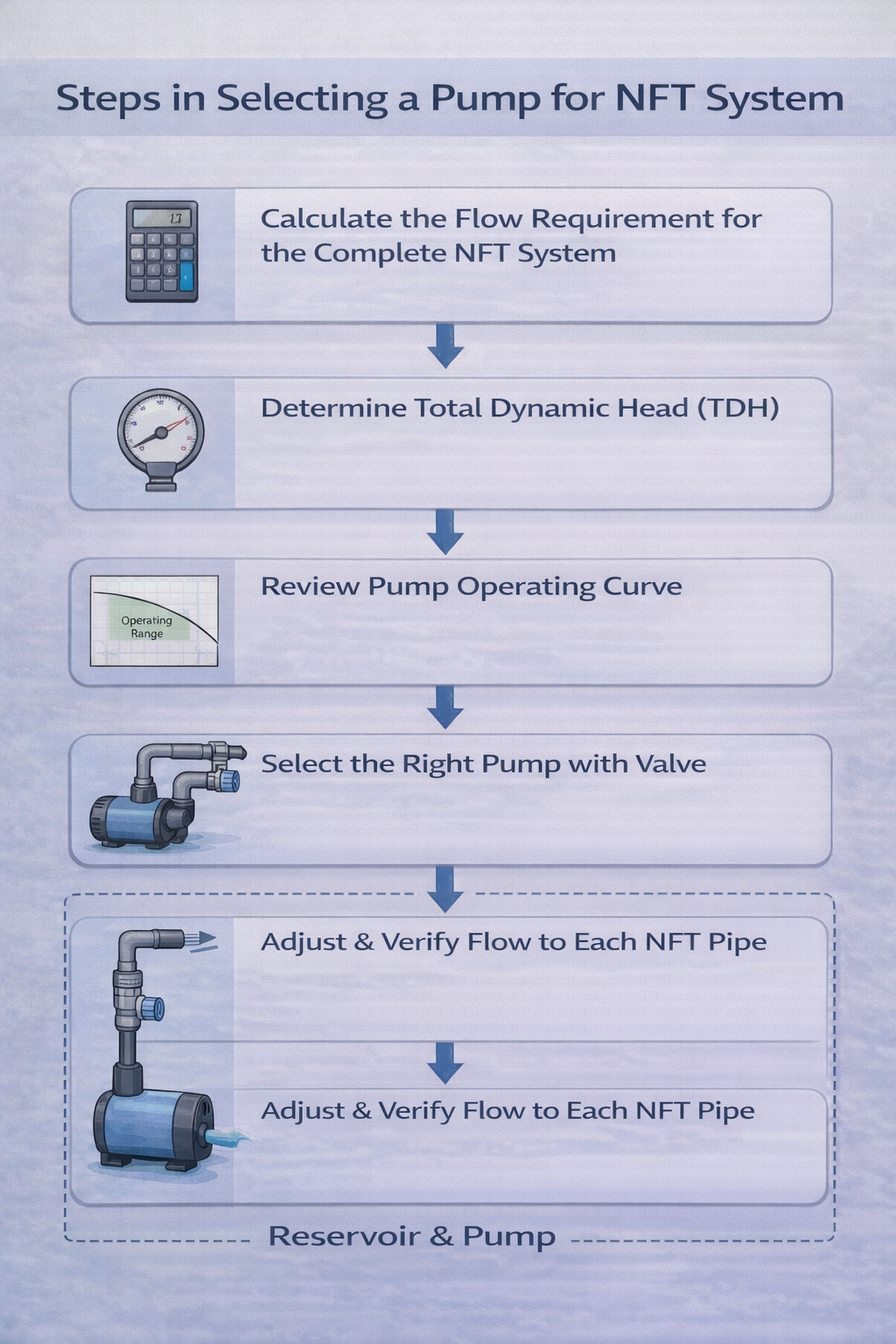
1. Calculate the Flow requirement for NFT System
NFT Pump flow rate is a critical parameter for pump design.
- Too low flow rate makes Last plants weak, reduces Dissolved Oxygen, causes Root browning & Nutrient stratification.
- Whereas Too high flow makes the Roots submerged that results in Oxygen starvation, Algae growth and Pump wasting power.
You can calculate total pump flow requirement in the following steps.
1. How much flow does ONE NFT pipe need?
Answer for the flow requirements for one NFT pipe pipe is not straight forward. Flow per pipe (Qₚ) value depends on:
- Pipe Diameter
- Flow Velocity
- Netriant flow thickness (Depends on what are you growing)
Qₚ = W * t * 𝑣
Where
Qₚ = Flow rate per pipe m³/s;
W = Effective wetted width of pipe in m;
t = Desired nutrient film thickness;
𝑣 = Average flow velocity m/s
1.1) Calculate Wetted width
For round PVC pipes, water does not wet full diameter. Wetted width is the effectived width for PVC pipe wet section.
𝑊 ≈ 0.6 × 𝐷 (internal pipe diameter.)
For a 3″ PVC pipe; ID ≈ 75 mm = 0.075 m; 𝑊 = 0.6 × 0.075 = 0.045 m
1.2) Film thickness (𝑡)
NFT ideal range for film thickness is 1–3 mm
If you are making your design for worst conditions. Consider film thickness: 3 mm = 0.003 m
1.3) Flow velocity (𝑣)
For NFT Too slow water flow causes stagnation whereas too fast water flow causes flooding roots.
It is always recommended to keep the flow velocity (𝑣) from 0.01 to 0.03m/s. For pump selection you can keep the worst case value of 0.03 m/s.
1.4) Example Calculation for the flow rate per pipe
For a 3″ PVC pipe, Film thickness: 2 mm and Velocity: 0.02 m/s
Qₚ = 0.045 × 0.002 × 0.02 = 1.8 x 10⁻⁶ m3/s
Qₚ = 1.8 x 10⁻⁶ m3/s × 60 ×1000 = 0.108 L/min
2) Apply a Safety & Fouling Factor
The above calculated value is the theoretical minimum value. In practice we apply a safety & fouling factor by multipling Qₚ with a value in between 4 to 6
Minimum Qdesign = 4 * Qₚ = 4 * 0.108 = 0.4 L/min
Maximum Qdesign = 4 * Qₚ = 4 * 0.108 = 0.7 L/min
3) Total Pump Flow Requirement
NFT Hydroponics Pump flow rate requirement Thumb Rule:
Total pump flow = Flow per pipe × Number of pipes
If you are using 3 tier 5 feet pipes for your hydroponic system and as per earlier calculation you require 0.7 L/min pump for one pipe.
Total pump flow requirement =3 * 0.7 = 2.1 L/min
2. Determine Total Dynamic Head (Vertical Lift)
Pump Head is the energy the pump needs to lift water to the highest point in your system, including losses. For NFT, head is NOT just the pipe height.
TDH is how “hard” the pump has to work to push nutrient solution up to the top NFT pipe and through the plumbing.
TDH = Hs (Static Head) + Hf (Frictional Head Loss) + Hm (Minor Head Loss)
2.1 Calculate the Static Head (Hs)
It is the vertical distance from reservoir water level to highest NFT Pipe inlet point.
- Measure static head from water surface, not pump bottom.
- Only highest NFT inlet needs to be considered
- If the Reservoir water level is at a distance of 0.75 m from top NFT inlet 𝐻𝑠 = 0.75 m
2.2) Calculate the Frictional Head Loss (Hf)
For NFT, flows are low that results in small losses but they are not zero.
- Formula for Frictional Head Loss (perfect for NFT)
- 𝐻𝑓 ≈ 0.02 × 𝐿 (total pipe length (m) that is applied to 1″ PVC at NFT flow rates)
- Example: for a total pipe length of 3 m; 𝐻𝑓 = 0.02 × 3 = 0.06 m
2.3) Calculate the Minor Head Loss due to pipe fittings such as elbows, valves, tees (Hm)
Each pipe fitting adds resistance to pipe flow.
Minor Head Loss for Pipe Fittings
| Component | Equivalent Head (m) |
|---|---|
| 90° Elbow | 0.05 m |
| Ball / Shut-off Valve | 0.1 – 0.2 m |
| Tee / Manifold | 0.05 – 0.1 m |
Example: In a NFT hydroponic system has 4 elbows are equivalent to 0.2 m and 1 valve is equivalent to 0.15 m. Therefore total minor head loss will be 0.2 + 0.15 = 0.35 m
2.4) Calculate the Total Dynamic Head (TDH)
TDH = Hs+ Hf + Hm = 0.75 + 0.06 + 0.35 = 1.16 m
2.5) Add the Safety Factor to TDH
Pump max head ≥ 1.3 × TDH ≥ 1.3 x 1.16 = 1.5 m
Your pump must deliver the required flow at TDH, not at zero head
3. Review Pump Operating Curve
The pump operating curve shows the relationship between flow rate and head (vertical lift) for a specific pump.
- As head increases → flow rate decreases
- As head increases → flow rate decreases
Pump operating curve tells you: How much water the pump actually delivers at a specific Total Dynamic Head (TDH).
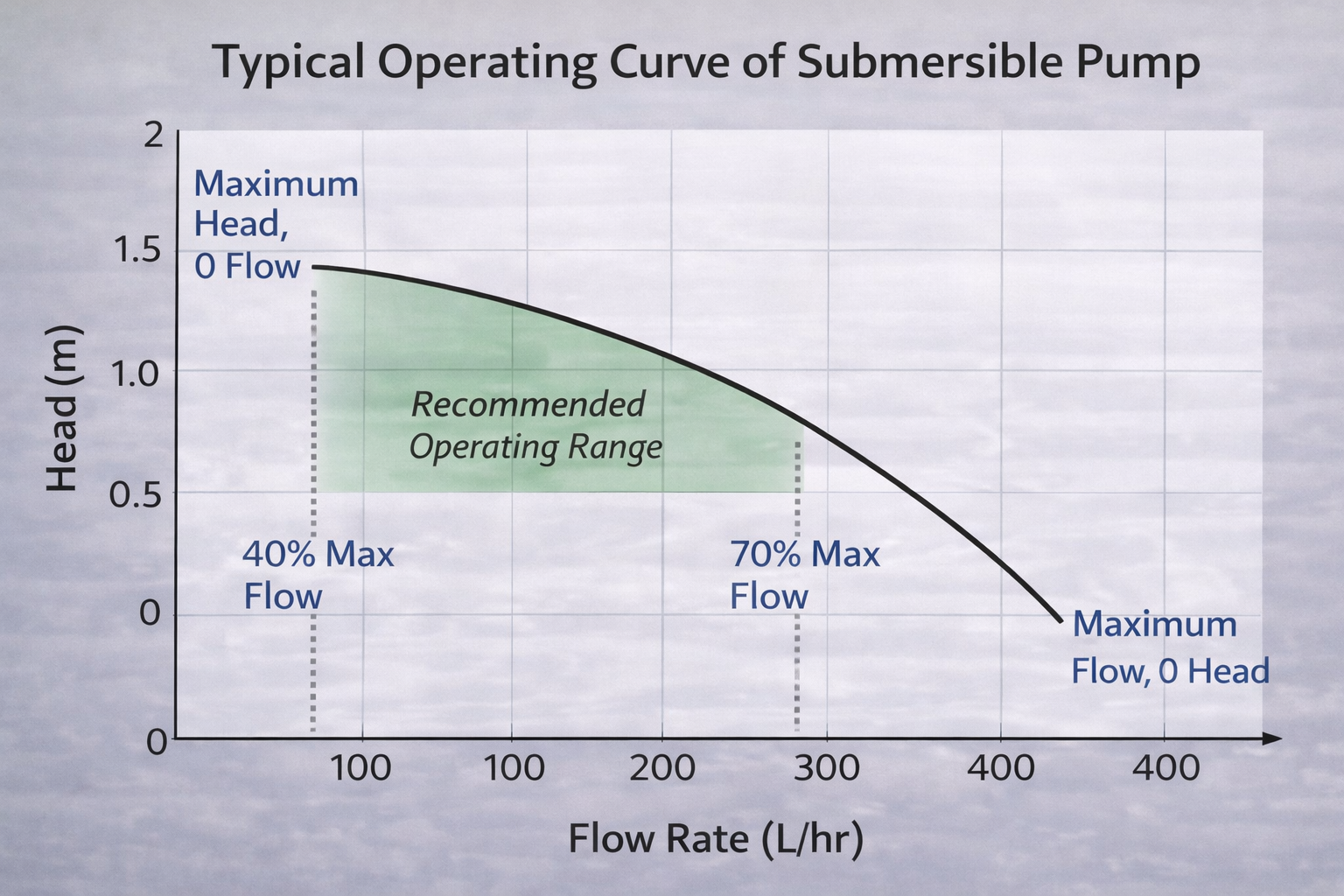
- Maximum flow occurs at 0 m head
- Maximum head occurs at 0 flow
- NFT systems operate in the middle, not at extremes
Why Operating Curve Matters in NFT
NFT systems uses a low flow, low to moderate head pump that needs to run continuously.
So the pump must operate Smoothly, Efficiently, and Away from stall or overload regions.
Choosing a pump without checking the curve leads to:
- Insufficient flow at top pipe.
- Unstable nutrient film.
- Root oxygen stress.
4. Select the Right Pump with Valve
From the above calculated parameters, you can select a best pump for your application:
Step 1: Note down the values for Total Dynamic Head (TDH) and Flow requirements for the pump
Step 2: Find TDH on Y-axis then move horizontally across the curve.
Step 3: Read Flow on X-axis, where the curve intersects TDH. This is the real flow, not the label value.
NFT Operating Sweet Spot (Very Important)
For long pump life and stable flow:
- Operate pump at 40%–70% of max flow because of following reasons:
- Below 40% → pulsation, clog sensitivity
- Above 70% → excessive flow, energy waste
NFT likes steady, boring pumps.
What Happens If You Ignore the Curve
- Pump too small Last plants starve
- Pump too large Roots flood
- No flow control Film instability
- Operating near max head Overheating
Don't Rely on Pump Operating Curve only Use Valve
Always combine slightly oversized pump with shut-off or needle valve. Valve shifts your system operating point left on the curve:
- Lower flow
- Same head
- More stability
Important Notes for NFT Pump Selection
1. Don’t use high-pressure pumps designed for fountains
High pressure pump create:
- Pulsating flow
- too much spray
- Nutrient loss
2. Avoid pressure accumulators
You want flow, not pressure. Flow control is your friend. It is recommended to use Shut-off valve or needle valve to fine-tune film depth without changing pump.
3. Energy saving
If you plan to use:
- A gravity feed from top pipe to lower pipes
- Waterfall return injection
You usually don’t need extra aeration.
Example: Submersible Pump Selection for an NFT Hydroponics System
The following example demonstrates a step-by-step pump selection process for a small-to-medium NFT hydroponics setup using engineering best practices.
System Description
- NFT channels: 3
- Length of each channel: 5 ft
- Pipe diameter: 3 inch PVC
- System layout: Gravity-fed tiers
- Highest NFT inlet height: 0.8 m above reservoir water level
Step 1: Calculate the Flow Requirement for the Complete NFT System
Total Flow = 3×0.75 = 2.25 L/min = 2.25 × 60 = 135 L/hr
Step 2: Determine Total Dynamic Head (TDH)
Static Head = 0.8 m; Friction Loss ≈ 0.02 × 3 = 0.06m; Minor Losses = 0.35 m
Total Dynamic Head (TDH) = 0.8 + 0.06 + 0.35 = 1.21 m
Step 3: Review Pump Operating Curve
The pump must deliver ≥135 L/hr at ~1.2 m head.
Step 4: Select the Right Pump with Valve
You select a Pump that delivers 300 L/hr at 1.21m head. Pump operates near the 40–70% region of its curve, that is ideal for NFT.
Step 5: Adjust & Verify Flow to Each NFT Pipe
System flow set to ~135 L/hr using valve
If your NFT channel is longer than 10 feet, add 20% to your flow calculation to account for nutrient consumption by the first few plants.
Summary: NFT Pump Selection at a Glance
- ✅ The 24/7 Rule: Use only "Continuous Duty" rated pumps. Cheap fountain pumps often fail within months.
- ✅ Check the Curve: Never buy based on "Max Flow." Ensure the pump provides your required LPH at your specific Total Dynamic Head (TDH).
- ✅ The Sweet Spot: Aim to operate your pump at 40%–70% of its maximum capacity for better efficiency and longer life.
💡 Grow Yukti Insight: Always install a ball valve after the pump. It’s better to have a slightly larger pump and throttle it down than to have an undersized pump that starves your plants.
Selecting the right pump is the difference between a struggling system and a thriving hydroponic garden. By mastering Flow Velocity and Head Height, you ensure that every plant receives the consistent nutrition it needs to thrive.
At Grow Yukti, we’ve taken the complexity out of the equation. Our Smart Kits are pre-engineered so you can skip the math and start growing immediately.
Explore Our Pre-Calculated Smart Kits →