
Among all hydroponic methods, NFT (Nutrient Film Technique) is more popular. It relies more on controlling the water flow than on volume. Instead of soaking plant roots in water as we do in DWC system, NFT feeds neutrient to plant roots them using a moving, shallow layer of nutrient solution—just enough to nourish the plant while leaving most of the root mass in open air.
How NFT Actually Works?
A NFT system has following major components
- Reservoir
- Water Channel
- Pump
- Water Return System
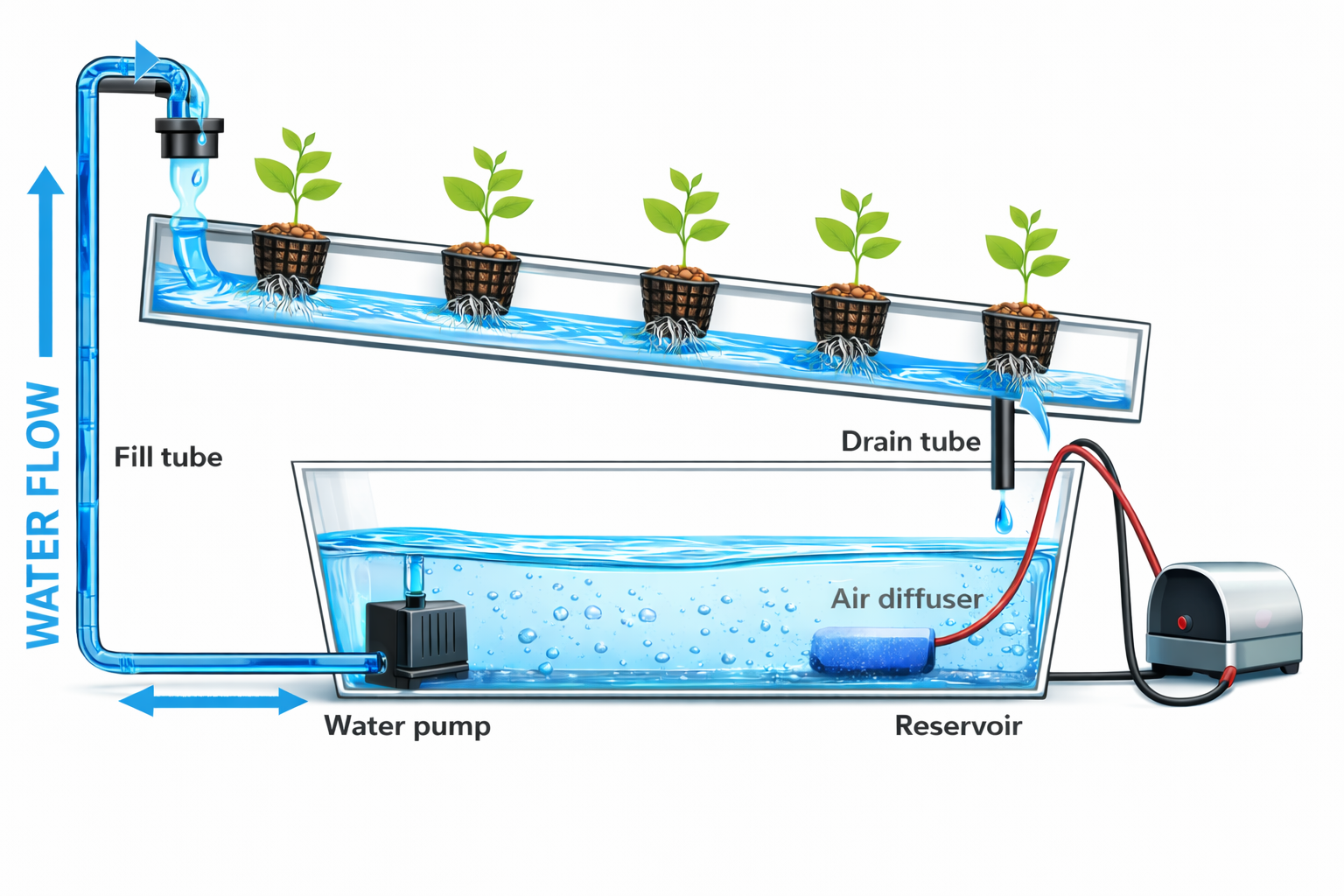
Similar to DWC, In NFT system a reservoir holds the nutriant Solution. The plant sit in the holes along the top of this channel, with their roots hanging down.
A small pump pushes water to the top of channel where it flows as 1 to 3 mm thin film inside the channel. Roots absorb the nutrients and oxygen from the thin film. At the end excess solution drains back to the reservoir using water return system.
Why a “Thin Film” Matters
NFT works only when the water layer remains shallow.
- If the film is too thin, roots dry out
- If it becomes too deep, oxygen drops and roots suffocate
The thin film ensures:
- constant nutrient refresh
- continuous oxygen access
- minimal water consumption
This balance cannot be achieved with stagnant or flooded systems.
Root Oxygenation: NFT’s Real Strength
Unlike systems that depend entirely on dissolved oxygen inside water, NFT allows roots to breathe directly from the air inside the channel.
As a result:
- Oxygen availability stays high even at moderate water temperatures
- Roots grow long, white, and fibrous instead of thick and brown
- Disease pressure is lower when flow is consistent
In warm climates, this air–water split is often more important than nutrient formulation itself.
Crops Best Suited for NFT
Lorem ipsum dolor sit amet, consectetur adipiscing elit. Ut elit tellus, luctus nec ullamcorper mattis, pulvinar dapibus leo.
| Rank | Crop | Suitability | Growth Factors | Expert Notes (India Context) |
|---|---|---|---|---|
| 1 | Lettuce | ★★★★★ | Shallow roots, fast cycles. | The industry standard; very high ROI for Indian urban markets. |
| 2 | Spinach (Palak) | ★★★★★ | Compact root zone. | Keep nutrient solution below 24°C to avoid wilting. |
| 8 | Coriander (Dhaniya) | ★★★☆☆ | Heat sensitive. | Prone to "bolting" in Indian summers; requires shade/cooling. |
| 11 | Fenugreek (Methi) | ★★★☆☆ | Dense root mat. | Harvest early as microgreens or baby greens to prevent channel clogging. |
| 13 | Cucumber | ★★☆☆☆ | Aggressive roots. | Not Recommended: Roots will block your NFT channels quickly. |
Core Design Principles for NFT System
1. Channel Slope
NFT channels must rely on gravity—not pressure.
- Too steep → water rushes, roots dry
- Too flat → pooling and oxygen loss
A gentle, uniform slope keeps the film stable.
The ideal slope for NFT system is usually 1:30 to 1:40 (1 inch of drop for every 30–40 inches of length).
2. Flow Rate
More water does not mean better nutrition.
- NFT requires movement, not volume
- A steady flow that renews nutrients is enough
The goal is to touch roots, not drown them.
3. Channel Dimensions
Bigger channels hold more water—but that defeats NFT’s oxygen advantage. Channel size must match:
- crop type
- plant spacing
- expected root mass
Oversizing often creates hidden oxygen problems.
If channels are too long (over 10-12 meters), the plants at the end may suffer from “oxygen starvation” as the upstream plants deplete the oxygen in the water.
4. Energy Use and Operational Efficiency
NFT systems consume very little power because:
- only one small pump is required
- water is recirculated
- no air pumps are mandatory
This makes NFT suitable for:
- solar-powered setups
- inverter-backed farms
- energy-conscious urban installations
However, low power does not mean low risk.
5. The Fragility Factor
NFT systems have almost no tolerance for interruption.
If flow stops:
- roots lose moisture quickly
- heat stress accelerates damage
- plants can collapse within an hour in hot conditions
This is the single biggest weakness of NFT and must be addressed through:
- pump redundancy
- alarms
- gravity-based emergency flow paths
6. Temperature Sensitivity
Because NFT uses small water volumes:
- nutrient temperature changes quickly
- hot reservoirs reduce oxygen availability
- warm channels accelerate root stress
Managing heat is as important as managing nutrients, especially in tropical or semi-arid climates.
Since the water film is so thin, it is highly sensitive to ambient temperature. In hot climates, the water can heat up quickly, which lowers oxygen levels.
DWC vs Other Hydroponic Systems (India Perspective)
| System Type | Power Dependence | Thermal Stability (Heat Resistance) | Maintenance | Indian Suitability Score |
|---|---|---|---|---|
| DWC (Deep Water Culture) | High (Needs Air Pump) | Medium-High (High water volume stays cool longer) | Medium | 7/10 |
| NFT (Nutrient Film Technique) | Very High (Continuous Pumping) | Very Low (Thin water layer heats up instantly) | High | 4/10 |
| Kratky Method | None (Passive) | Medium (Sensitive to ambient room temp) | Very Low | 9/10 |
| Media Bed / Ebb & Flow | Low (Intermittent Pumping) | High (Clay pebbles act as a thermal buffer) | Medium | 8/10 |
*Suitability scores are based on urban Indian conditions (Power stability, summer heat, and water quality).
When Should You Choose DWC?
Choose NFT system if you:
- want high efficiency per square foot
- grow leafy greens or herbs
- can monitor flow and temperature regularly
Avoid NFT system if you need:
- low-attention systems
- long power-outage tolerance
- heavy fruit production
How to Create a Small NFT Setup in India (Beginner-Friendly)
Starting small is the smartest way to learn NFT Hydroponics in Indian conditions. A compact setup helps you understand nutrients, oxygen, and temperature behavior without risking large crop losses.
This section explains how to build a small NFT system suitable for balconies,or shaded terraces.
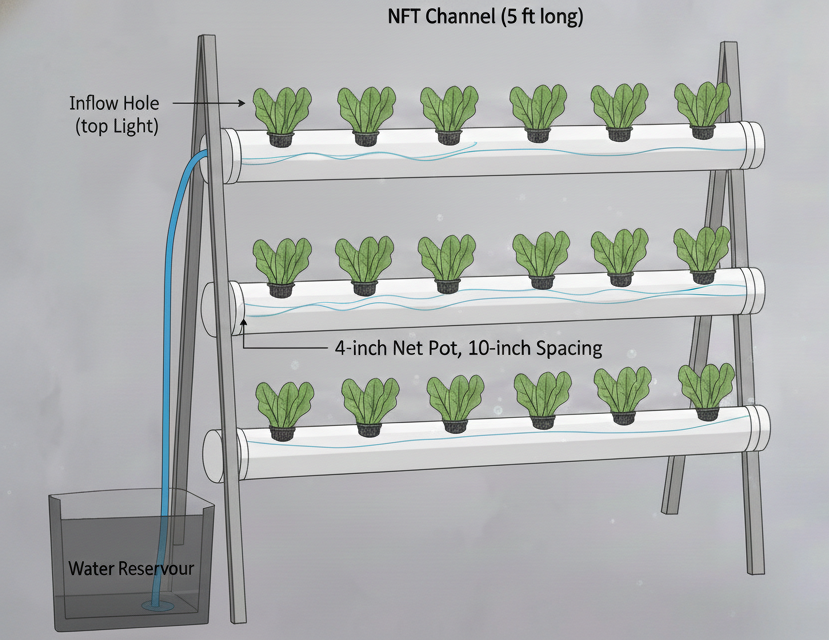
To create a NFT setup, firstly you should make a decision on NFT layout. You can take this decison by making decison on following parameters:
- Available Area
- Number of plants you want to grow
Typical BOM and CAPEX for a Small NFT Setup in India
Considering you have 6 feet area is available in your balcony and you want to use only the natural light. A basic small NFT system consists of:
- NFT Grow Structure
- Submersible Pump
- Reservoir Tank
- Net pots & Media to hold plants
- Essential Tools
| Component | Estimated Cost (₹) | Local Source |
|---|---|---|
|
NFT Grow Structure
Select Food Grade Components
|
₹5400 | Hardware / PVC Store |
|
Submersible Pump
For Water Circulation)
|
₹500 | Aquarium / Electrical Shop |
|
Reservoir
30–40 L Opaque Food Grade Plastic Tank
|
₹600 | Local Household Plastic Store |
|
Net Pots & Media
3-inch Pots, Rock Wool + 50mm Drill bit
|
~₹370 | Online / Hardware store |
|
Essential Tools
TDS Meter, ph Meter, Water Temperrature Sensor
|
₹800 to ₹1500 | Hydroponic Specialist / Online |
| Estimated Total Setup: | ₹7,000 — ₹8,000 | |
1. NFT Grow Structure
If you start researching hydroponics setups, you will find multiple NFT setup’s. Including all of these setup is not in the scope of this article.
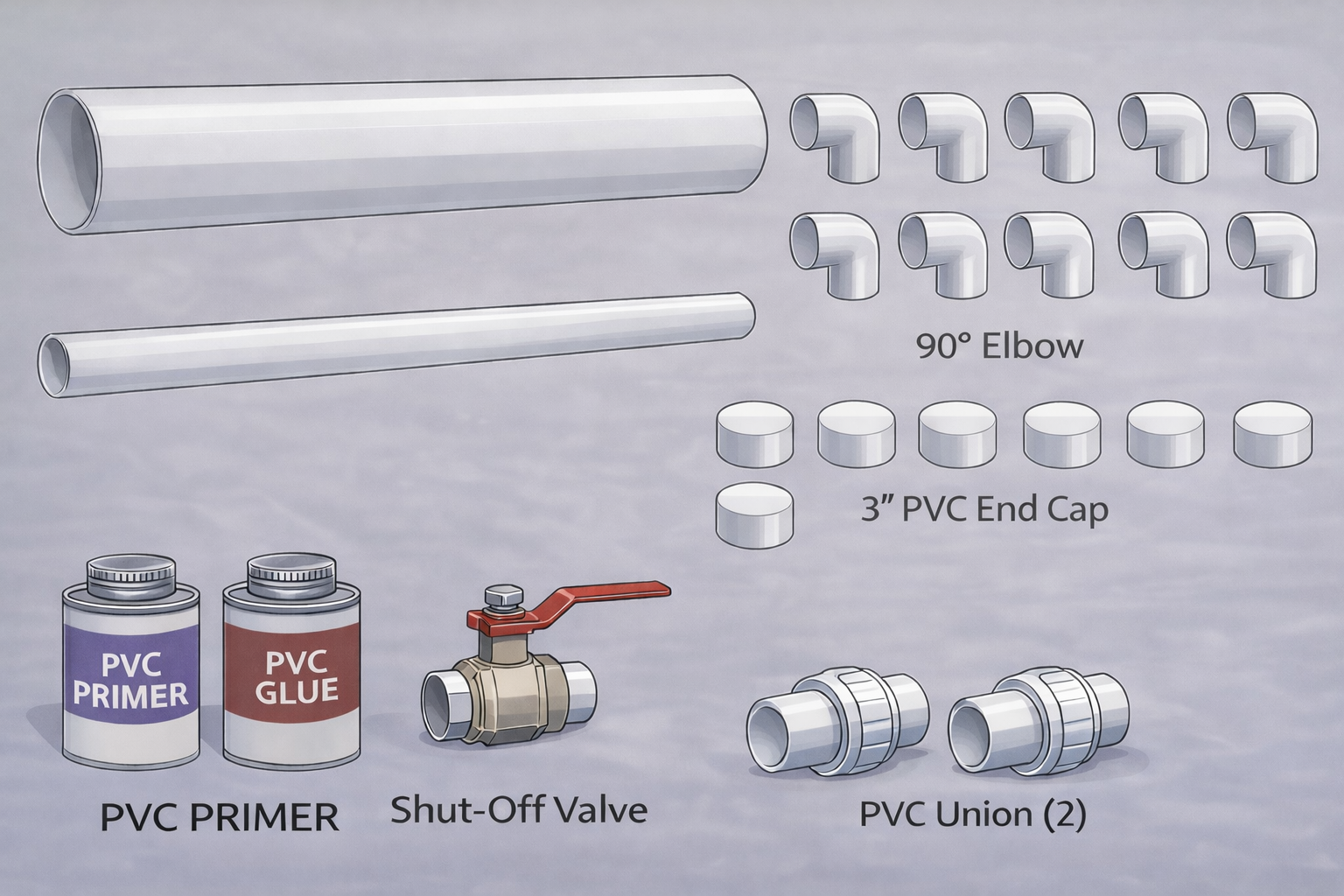
This section of the article will guide you on the list of materials you need to make NFT structure. Here is the complete list of all materials:
Bill of Materials (BOM) & Sourcing Guide
| Component | Qty | Approx. Price | Recommended Source |
|---|---|---|---|
| 3" UPVC Pipe, Length = 15' | 1 | ₹2500 | Local Hardware Store |
| 1" UPVC Pipe, Length = 10' | 1 | ₹900 | Local Hardware Store |
| 3"×1" UPVC Reducing Tee | 3 | ₹300 | Hardware / Plumbing Store |
| 3" UPVC Plug | 6 | ₹200 | Hardware Store / Plumbing |
| PVC Primer & Glue | 1 | ₹400 | Hardware Store |
| Shut-off Valve (1") | 1 | ₹200 | Amazon / Specialized Agro Store |
| PVC Union (1") | 2 | ₹500 | Amazon / Industrial Supplier |
| Total Estimated Investment | ₹5,400 | *Prices may vary by location | |
2. Submersible Pump
Pump application is to circulate water throughout the system. For NFT system, you dont need a high pressure pump, you need a pump that can work continuously and smoothly 24X7. You should consider following parameters while selection pump for NFT system.
- Flow Rate
- Head (vertical lift)
- Operating Curve
- Continuous Duty
3. Reservoir
The reservoir is the heart of an NFT system. While plants grow in the channels, system stability is decided in the reservoir. You can trace back most NFT failures to poor reservoir design.
A reservoir performs four critical functions in a NFY system:
- Stores nutrient solution
- Supplies water to NFT channels
- Buffers temperature and EC changes
- Receives and mixes returning solution
3.1) Reservoir Size
Water volume inside all NFT channels combined:
For a 90 mm round NFT pipe:
𝑉 ≈ length × width × film thickness = 1.5 × 0.035 × 0.002 ≈ 0.000105 𝑚3 ≈ 0.105 liters per pipe
Total water in 3 pipes ~=0.3 liters
Daily Water Uptake Calculation
Daily Water Uptake (Leafy Greens) ~100–150 ml per plant/day
18 plants → 1.8 to 2.7 liters/day
Evaporation + Losses =~ 1 to 2 liters/day (hot climate, open system)
Reservoir Size considering 3 to 5 days Buffer
Reservoir Size (considering 5 days buffer) = (2.7 + 2) * 5 = 25 liters
3.2) Reservoir Design Recommendation
- Reservoir Material: Choose a Food-grade plastic, or HDPE water storage tubs, or a UV-stable grow tanks.
- Color: Opaque or dark colored reservoir is mandatory. It prevents algae growth, oxygen depletion, and biofilm formation. Transparent containers almost always fail in NFT.
- Reservoir Placement: It is recommended to place the reservoir below NFT channels for gravity return design. Keep the reservoir in shade or insulated box to avoid direct sunlight while ensuring easy access for nutrient top-up, pH / EC measurement, and pump maintenance.
3.3) Common Reservoir Mistakes
Here is the list of mistakes that don’t fail the hydroponics system immediately, but they compound.
- Using small buckets
- Transparent containers
- Submerged return outlet
- No access for cleaning
- Ignoring temperature rise
4. Net Pots and Media
In Nutrient Film Technique (NFT) hydroponic system, net pots and growing media are not for nutrition. Their job is provide plant support and root guidance. When chosen incorrectly, they become a major cause of root rot, flow blockage, and unstable plants.
4.1) Net Pots
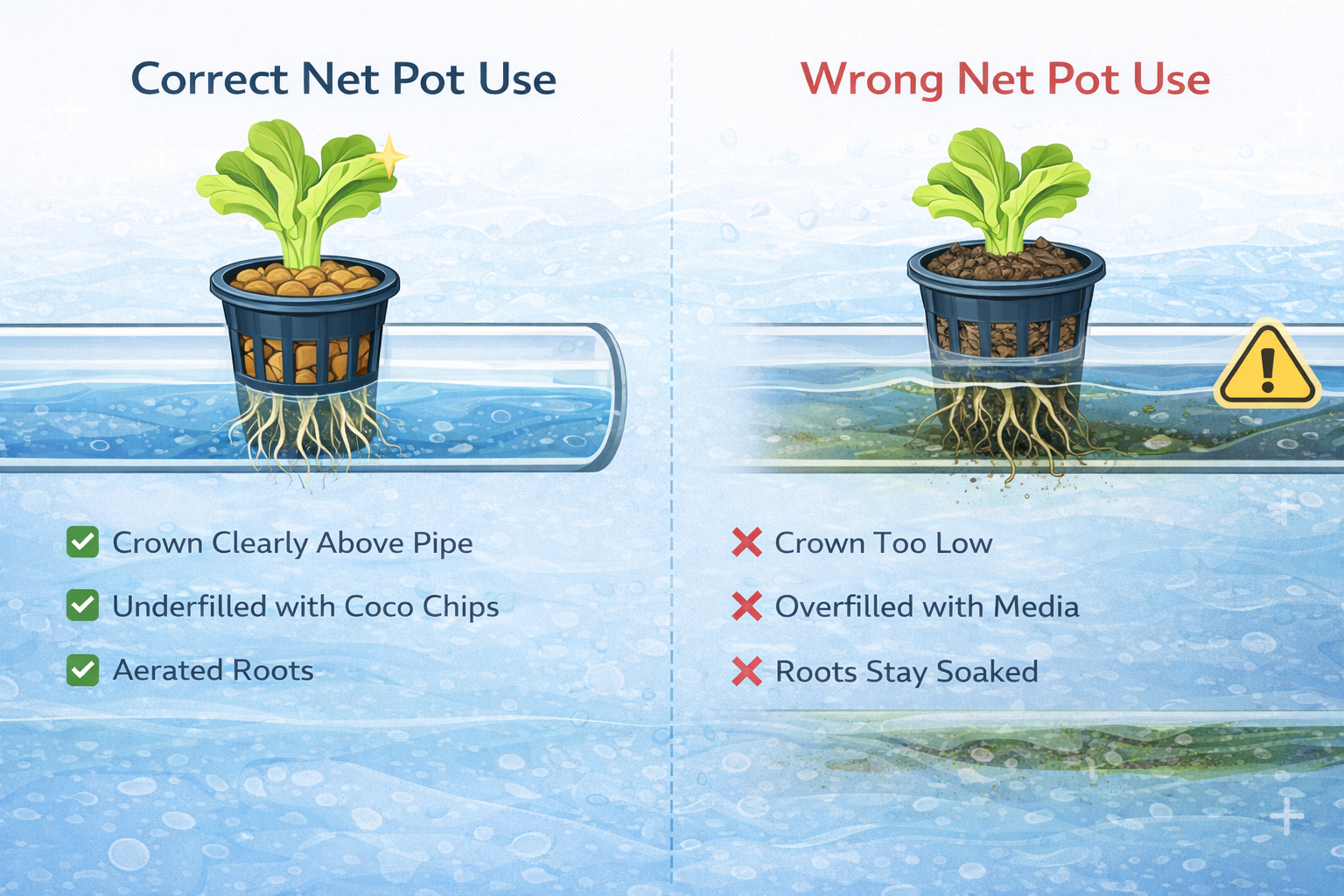
In NFT, net pots must, hold the plant crown firmly, Keep roots inside the channel, Allow maximum air exchange, and Avoid blocking the nutrient film.
Recommended Net Pot Size
- For Home / Beginner 2 inch net pots provide sufficient support, minimal root mass
- Even for Commercial leafy greens 2 inch is industry standard
- For fruits like Strawberry you need 2 to 3 inch net pot for better crown stability
Large net pots (>3 inch) cause excessive root crowding, flow disturbance, and algae growth inside channels.
Net Pot Design Features
Choose net pots with thin vertical slits (not mesh walls), Open bottom, Rigid plastic (does not deform in heat). Its better to avoid Cup-style pots with small bottom holes, soft plastic that collapses under plant weight.
4.2) Growing Media (Less Is Better in NFT)
Media should touch the roots only during the seedling stage. Once roots reach the nutrient film, the media’s role is over.
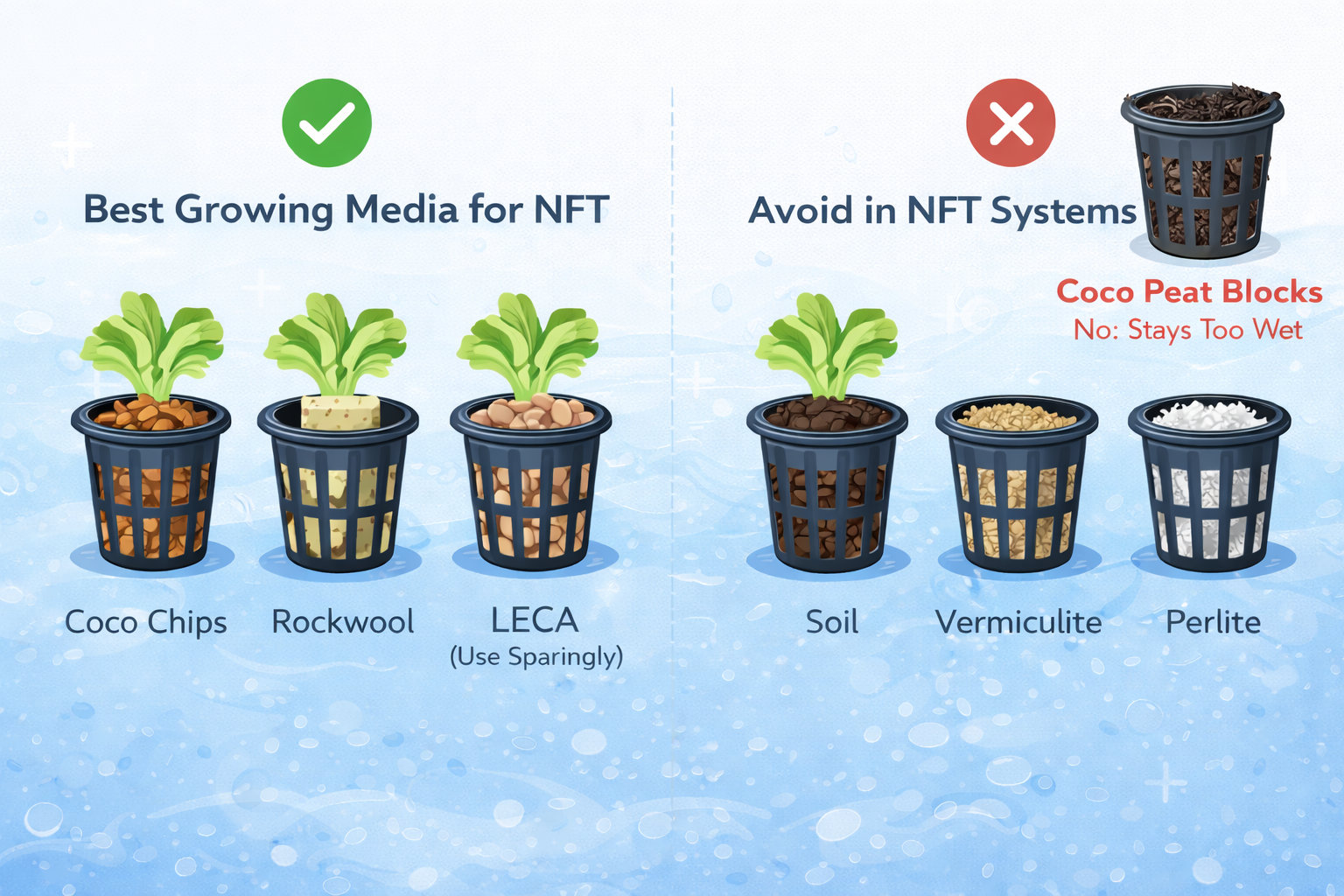
Best Media Options for NFT (India) are:
- Coco Chips / Coco Husk is a top choice because it is Lightweight, has Good air retention, Easy availability in India, and Cheap and reusable.
- Rockwool is best choice for starter. It is excellent for germination and gives a Uniform seedling growth. It is recommended to Remove excess rockwool once roots extend, Keep cube above water level to prevent stem rot
Media to Avoid in NFT
Media fails the hydroponic crop because Soil Blocks airflow and full net-pot fill causes root suffocation.
- Vermiculite Stays waterlogged
- Perlite (loose) Floats, clogs channels
- Sand Heavy, zero aeration
How Much Media to Use (Very Important)
Correct approach is to fill only the top 30–40% of the net pot and leave lower portion empty. Roots should grow freely into the channel. Overfilling is the #1 beginner mistake.
Plant Crown must stay dry and must sit above pipe surface. Never allow media to touch nutrient film. This is especially critical for lettuce, strawberry, and basil.
4.3) Common Mistakes (Seen in 70% of NFT Failures)
- Overfilling net pots
- Submerging media in water
- Using soil-like media
- Letting roots exit channel ends
- Using net pots as “mini pots”
NFT is root-air dominant, not media-dominant. In NFT Net pots support plants. Roots do the real work. Media should disappear from the system as soon as possible.
6. Essential Tools for Success (The Diagnostic Kit)
In DWC, you cannot see what is happening to the roots or the water chemistry just by looking. To prevent “silent” failures like nutrient lockout or root burn, you need three basic digital tools. In the Indian market, these are affordable and widely available online.
| Tool | Importance | Estimated Cost (₹) |
|---|---|---|
| TDS Meter | High (Prevents root burn) | 250 — 450 |
| pH Meter | Critical (Ensures food uptake) | 400 — 700 |
| Digital Thermometer | High (Prevents Root Rot) | 150 — 300 |
- TDS/PPM Meter: Measures nutrient concentration. In Indian summers, water evaporates fast, leaving behind high salts that can burn roots. Keep this between 600–900 ppm.
- pH Meter: Measures acidity. Indian tap water is often too alkaline (pH 7.5+), which blocks nutrient absorption. Always adjust your water to 5.5–6.5 pH.
- Digital Thermometer: Monitors water temperature. If the reading crosses 28°C, your oxygen levels are dropping dangerously. Use this to decide when to add more insulation.
GrowYukti Tip
Don't buy expensive laboratory-grade meters for your first setup. The basic "Yellow/White" digital meters found on Amazon or at local hydroponic shops are more than enough to get your first 5-10 successful harvests.
Final Verdict on NFT Hydroponic System
NFT is one of the fastest and most space-efficient hydroponic growing methods, but it is also highly sensitive to temperature, oxygen availability, and power stability. Under Indian climatic conditions, NFT performs best for hobby growers, urban home setups, and well-designed large-scale open systems.
When managed correctly, NFT delivers exceptional plant growth and produce quality. When neglected, it can fail rapidly—making system understanding, design discipline, and preparation far more important than the equipment itself.