
Growing your own food in an Indian apartment or rooftop comes with unique challenges—from soaring summer heat to unpredictable power cuts. If you are looking to maximize growth speed, a DWC (Deep Water Culture) hydroponic system is often the gold standard. But is it the right choice for an Indian beginner compared to simpler methods like Kratky or NFT? In this guide, we break down the DWC hydroponic system in India, including a realistic DIY setup cost, essential maintenance tips for our climate, and how to prevent common failures like root rot and nutrient lockout.
What is Deep Water Culture (DWC)?
Deep Water Culture (DWC) is one of the simplest and fastest-growing hydroponic systems. In DWC, plant roots are suspended directly in a nutrient-rich, oxygenated water solution, allowing plants to absorb water, nutrients, and oxygen continuously.
Unlike soil farming, DWC eliminates issues like poor drainage, soil-borne diseases, and uneven nutrient availability. When done right, plants grow 30–50% faster than in traditional soil methods.
In simple words: Leaves stay in the air, roots live in oxygen-rich water.
How Does a DWC Hydroponic System Work?
A basic DWC system includes the following components:
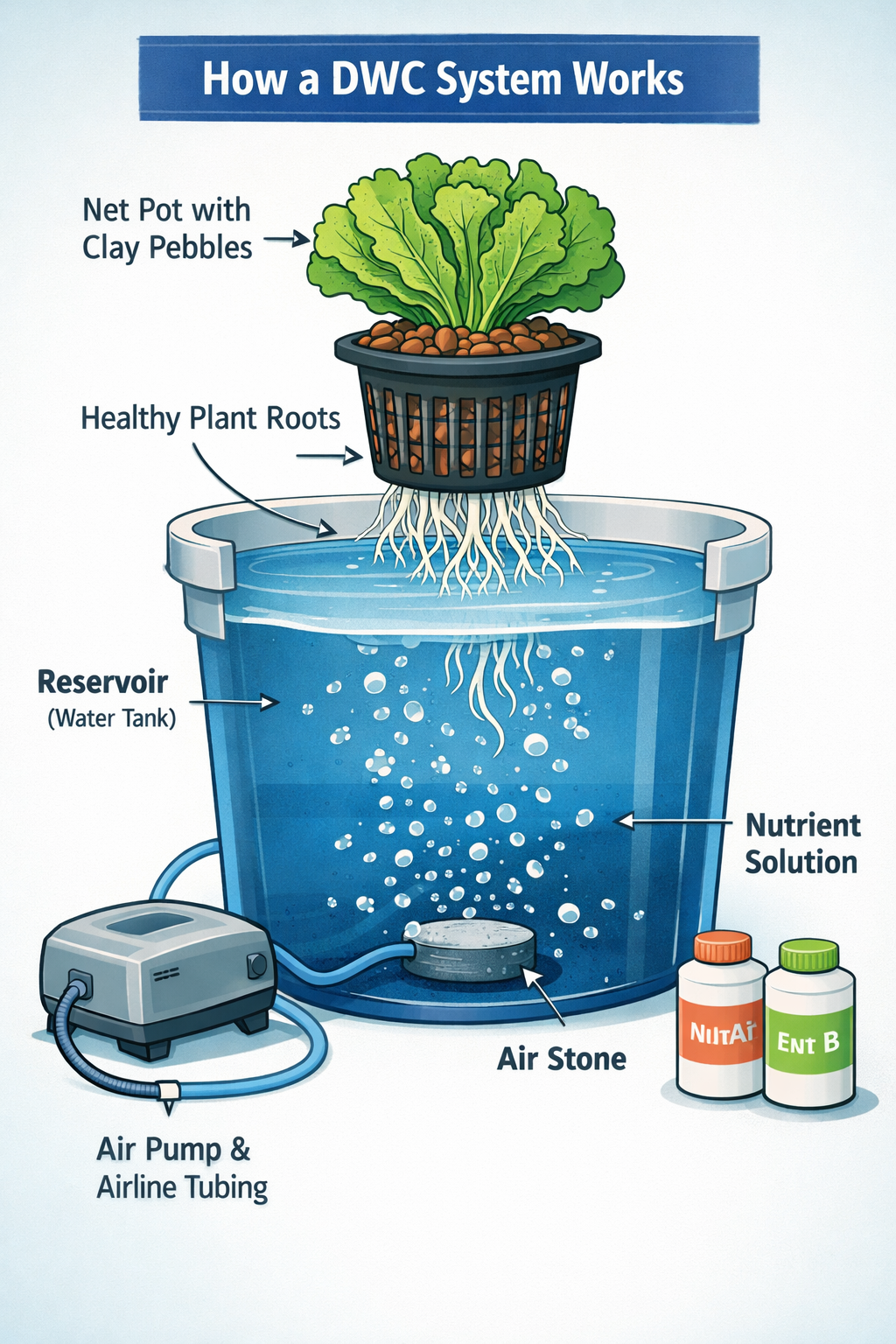
- Reservoir (Bucket or Tank): Holds the nutrient solution and supports the plant.
- Net Pots & Growing Media: Net pots hold the plant; media like clay pebbles or coco chips provide support.
- Air Pump & Air Stone:Continuously supply oxygen to the water to prevent root suffocation.
- Nutrient Solution:A balanced mix of essential macro and micro nutrients dissolved in water.
The air pump runs continuously, keeping the water oxygenated and preventing anaerobic conditions that can damage roots.
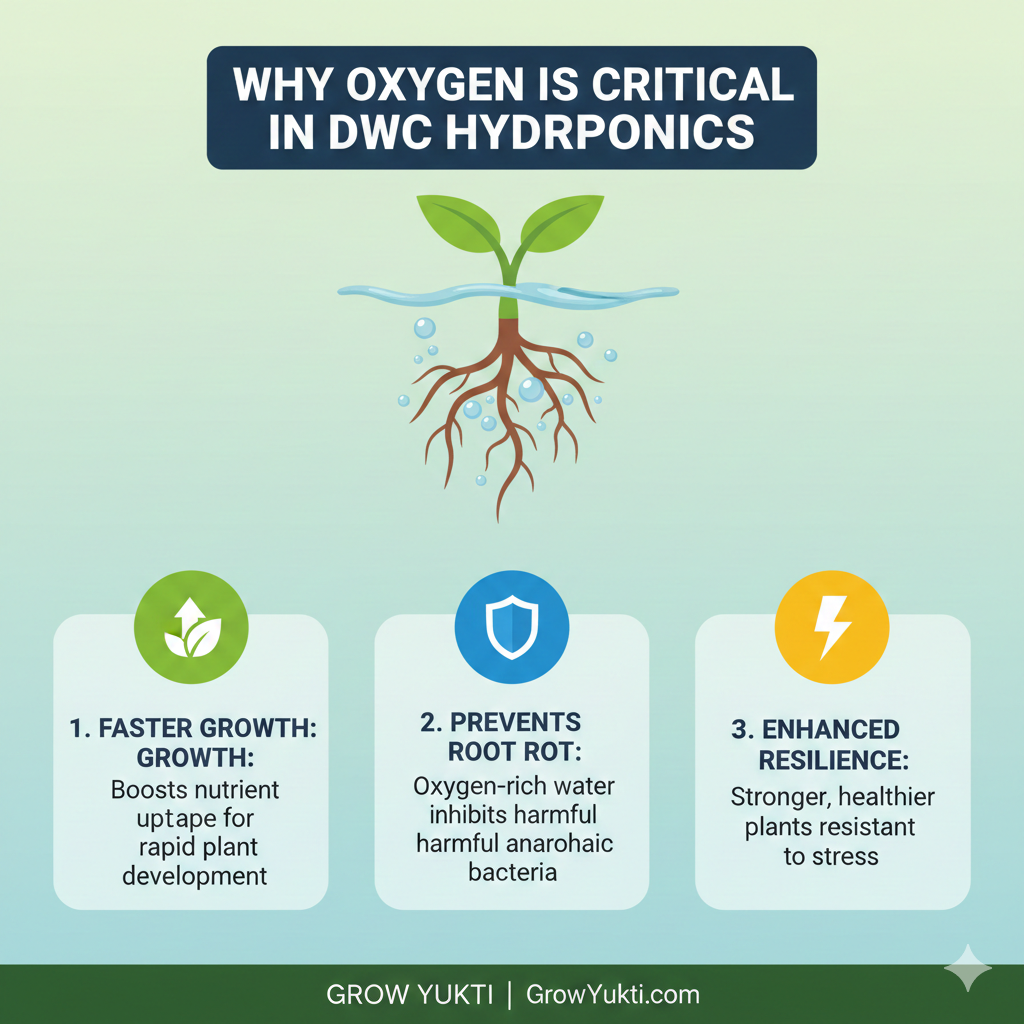
Why Oxygen is the Most Critical Factor in DWC ?
The success or failure of a DWC system depends largely on dissolved oxygen levels.
PRO TIP: Power Cuts
Power cuts are a major risk for "Deep Water Cultivation" in India. Even a few hours without aeration during hot weather can cause irreversible root damage.
Crops Best Suited for DWC
DWC works best for fast-growing, low-root-mass crops.
| Crop | Suitability |
|---|---|
| Lettuce | ⭐⭐⭐⭐⭐ |
| Spinach | ⭐⭐⭐⭐⭐ |
| Basil | ⭐⭐⭐⭐ |
| Mint | ⭐⭐⭐⭐ |
| Coriander | ⭐⭐⭐ |
| Bok Choy | ⭐⭐⭐⭐ |
| Strawberries | ⭐⭐⭐ |
❌ Tomatoes, cucumbers, capsicum (heavy feeders, large root systems) are not recommended for beginners. Read this article for more details on Hydroponics crop selection in India.
Common DWC failures in India and How to avoid them?
1. The "Boiling" Root Zone: Root Rot (Most Common Failure)
High temperature in summer can push nutrient water above 32°C. Warm water cannot hold dissolved oxygen, leading to root suffocation and the dreaded “Root Rot.
With Roots Rot, Roots turn brown/slimy, and plants wilt even if the bucket is full of water. This results in foul smell from water.
You can prevent Root Rot by:
- Keeping the reservir in a shaded area
- Never use black buckets in direct sun. Paint them reflective white or wrap them in bubble-foil insulation.
- Bury the Bucket: If you have space, burying the reservoir in the ground uses the earth’s natural “thermal mass” to keep the water cool.
2. Suffocation due to Power Failure
Deep Water Cultivation (DWC) systems depend entirely on electricity. But in India, Power outages, Voltage fluctuations and Pump failures due to high temperature is common. Without the pump, the “Deep Water” becomes stagnant, and oxygen levels drop to zero within an hour.
This results in sudden plant collapse after a power outage.
You can overcome above problems by using:
- Battery-backed air pumps
- Dual air pumps for redundancy
- Keep 2 to 3 inch air gap between the net pot and the water surface. This allows some “air roots” to breathe even if the pump stops.
3. "Hard Water" Lockout
Much of India’s tap water has high TDS (Total Dissolved Solids) from salts and minerals. You add nutrients, but the plants show yellow leaves (deficiency). This is “Nutrient Lockout”—the water is already so full of local salts that it can’t absorb the food you’re adding.
To can overcome this by using:
- RO Water
- Check pH Weekly. Indian tap water is often alkaline (pH 8.0+). You must use “pH Down” (Phosphoric acid) to bring it to the 5.5–6.5 range.
4. Algae Growth
Major cause for Algae growth in crop is light entering the reservoir that results in oxygen depletion and pH instability in plants.
You can prevent algae growth in plants by using:
- Opaque containers,
- Covering unused net pot holes
- Avoid transparent tubing.
DWC vs Other Hydroponic Systems (India Perspective)
| System Type | Power Dependence | Thermal Stability (Heat Resistance) | Maintenance | Indian Suitability Score |
|---|---|---|---|---|
| DWC (Deep Water Culture) | High (Needs Air Pump) | Medium-High (High water volume stays cool longer) | Medium | 7/10 |
| NFT (Nutrient Film Technique) | Very High (Continuous Pumping) | Very Low (Thin water layer heats up instantly) | High | 4/10 |
| Kratky Method | None (Passive) | Medium (Sensitive to ambient room temp) | Very Low | 9/10 |
| Media Bed / Ebb & Flow | Low (Intermittent Pumping) | High (Clay pebbles act as a thermal buffer) | Medium | 8/10 |
*Suitability scores are based on urban Indian conditions (Power stability, summer heat, and water quality).
When Should You Choose DWC?
Choose DWC system if You:
- Want fast growth
- Growing leafy greens
- Can manage heat and power backup
- Want a compact system
Avoid DWC system if You:
- Live in extreme heat without cooling
- Want a low-maintenance system
- Face frequent power outages
How to Create a Small DWC Setup in India (Beginner-Friendly)
Starting small is the smartest way to learn DWC in Indian conditions. A compact setup helps you understand nutrients, oxygen, and temperature behavior without risking large crop losses.
This section explains how to build a single-plant or 2–4 plant DWC system suitable for balconies, indoor rooms, or shaded terraces.
Typical BOM and CAPEX for a Small DWC Setup in India
A basic small DWC system consists of:
- Food Grade Reservoir
- Reservoir Tank Wrapper Insulation
- Air pump for oxygen supply
- Air stone & Tubing
- Net pots & Media to hold plants
- Essential Tools
| Component | Estimated Cost (₹) | Local Source |
|---|---|---|
|
Food Grade Reservoir Tank
15-20 Liters (Black/Opaque)
|
450 — 600 | Paint shop / Hardware store |
|
Reservoir Tank Wrapper
Highly Recommended for India
|
250 — 500 | Paint shop / Hardware store |
|
Air Pump
Double Outlet (2.5W - 5W)
|
600 — 1,200 | Aquarium Shop |
|
Air Stone & Tubing
Fine bubble stone + 2m pipe
|
150 | Aquarium Shop |
|
Net Pots & Media
LECA or Clay Pebbles
|
200 | Online / Garden Nursery |
|
Essential Tools
TDS Meter, pH Meter, Thermometer
|
800 — 1500 | Online (Amazon/Ugaoo) |
| Estimated Total Setup: | ₹2,200 — ₹3,500 | |
1. Choose the Right Container (Reservoir Tank)
- Material: Food-grade plastic bucket or tub
- Capacity: 10–15 litres per plant (Larger volume slows down temperature rise and stabilises nutrients.)
- Color: White or light-coloured containers (Avoid transparent or thin plastic)
 In DWC, Container Length, Width, and Depth Are More Critical Than Total Volume
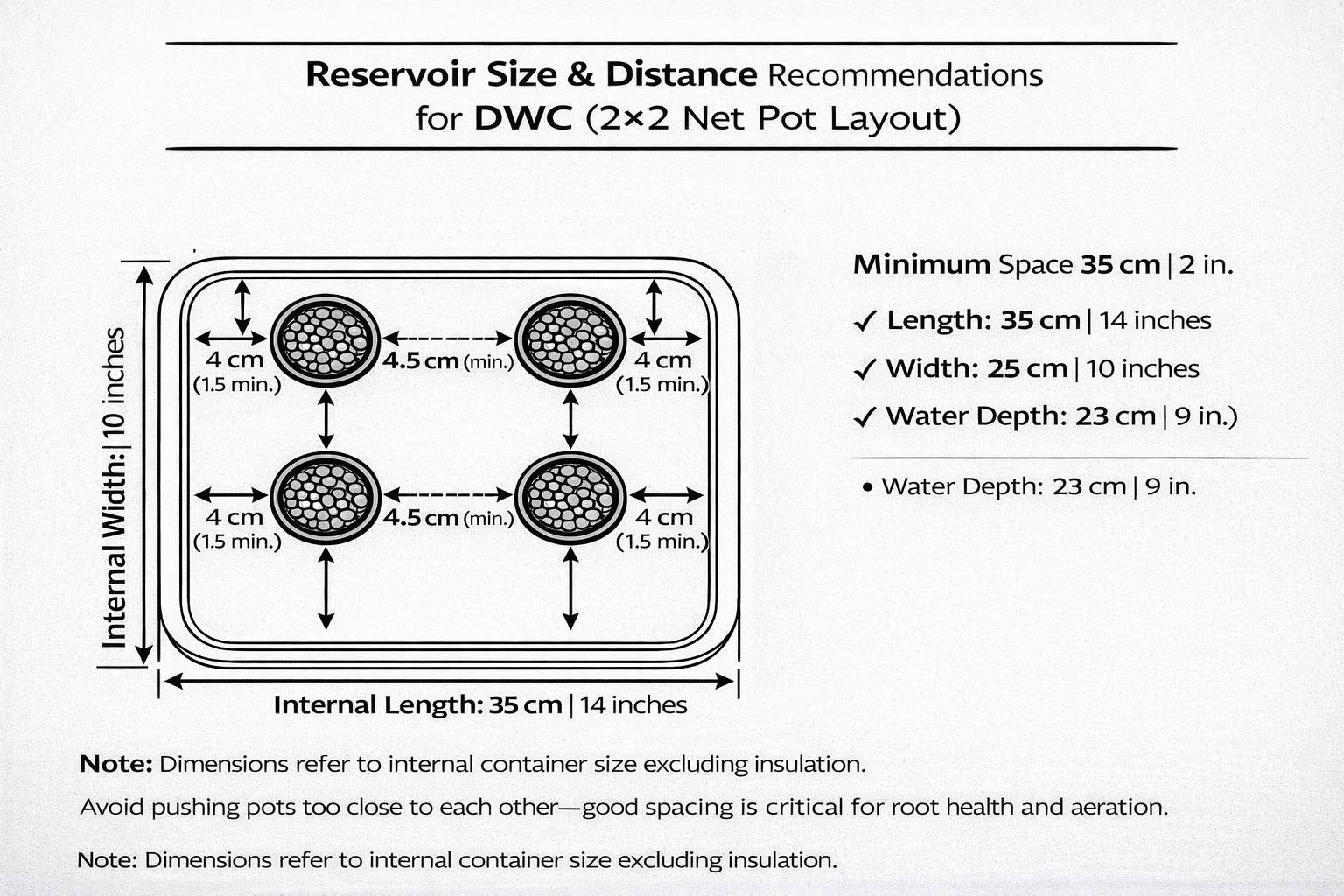
- Reservoir tank depth controls Heat absorption rate, dissolved oxygen reserve, root vertical growth. Shallow depth causes rapid temperature spikes, faster oxygen loss, higher summer failure rate.
- Minimum effective DWC water depth 200–250 mm after pot insertion.
Minimum Recommended Reservoir Tank Length and Width
- Pot diameter: ~75 mm
- Minimum Spacing between two pots: ≥ 50 mm
- Edge clearance: ≥40 mm
- Depth: ≥230 mm
How to find Correct Reservoir Size?
❌ Do not directly choose a fixed size bucket and add as many pots as possible.
✅ The correct DWC design approach is:
- Decide number of pots.
- Define required spacing (L × W) depending on crop type.
- Define minimum depth
Reservoir size calculation example for 4-Pot DWC System
Pot diameter: ~75 mm
Design Recommendation
Pot to Pot Spacing: ≥50 mm, Edge clearance: ≥40 mm, Depth: ≥230 mm
Calculated Size:
Length ≈ 350 mm, Width ≈ 250 mm
Grow Yukti Pro Tip for High heat
Rectangular insulated ice boxes or thermocol-lined tubs work better than thin buckets in summer.
2. Reservoir Wrapper (Highly Recommended)
In India, commonly available food-grade plastic containers are Transparent or semi-transparent and can not block the light. Therefore we need to cover the reservoir to make the:
- Transparent reservoir opaque
- protect the reservoir from outside heat
Comparison of Reservoir Wrapping Materials
| Material | Light Blocking | Thermal Benefit | Durability | Cost (₹) | Ease of Use | Verdict |
|---|---|---|---|---|---|---|
| Black plastic sheet (HDPE) | ⭐⭐⭐⭐⭐ | ⭐ | Medium | 30–60 | Very easy | ✅ Best budget light blocker |
| Reflective insulation sheet | ⭐⭐⭐⭐⭐ | ⭐⭐⭐⭐ | High | 150–300 | Easy | ✅ Best overall choice |
| Aluminium foil | ⭐⭐⭐⭐ | ⭐⭐⭐ | Low | 50–80 | Easy | ⚠️ Short-term only |
| Thermocol (EPS) sheets | ⭐⭐ | ⭐⭐⭐⭐⭐ | Medium | 100–200 | Medium | ✅ Best thermal insulation |
| Coconut coir mat | ⭐⭐ | ⭐⭐⭐⭐ | Medium | 120–250 | Medium | ✅ Natural + cooling |
| Black spray paint | ⭐⭐⭐⭐⭐ | ⭐ | High | 150–250 | Medium | ⚠️ Permanent, risky |
| Cloth / jute wrap | ⭐⭐ | ⭐⭐ | Low | 50–100 | Easy | ❌ Not recommended |
| Electrical tape only | ⭐⭐⭐ | ⭐ | Low | 80–150 | Easy | ❌ Incomplete solution |
PRO TIP
In Indian summers, non-insulated DWC is the #1 failure reason. Even basic insulation can reduce water temperature by 4–7°C.
3. Air Pump Selection
- Pump Type: Aquarium air pump
- Capacity: Depends on the water volume in reservoir
- Operation: Continuous (24×7). Power cuts are common in India.
Rule of thumb for pump selection:
Pump Airflow (L/min) = Effective Water Volume X 0.2
The above calculated Air pump ratings are given at ideal lab conditions. But in reality High ambient temperature, Long tubing runs, Backpressure from air stones, Voltage fluctuations reduces effective airflow by 20–40%. So a pump rated at 4 L/min may deliver only 2.5–3 L/min in real use.
Actual required Pump Airflow (with derating factor) = Pump Airflow / 0.6
Grow Yukti Pro Tip for pump selection
In DWC, air pump sizing is based on water volume, not container size or pot count.
4. Net Pots
- Recommended Net pot size: 2–3 inch
- Quantity: 1–4 per reservoir (beginner-friendly)
PRO TIP
Keep a backup battery air pump if possible.
5. Air Stone & Tubing
- It is always recommended to use one air stone per reservoir.
- Use Flexible silicone tubing preferabbly non-transparent.
- Always use Check valve to prevent backflow during power cuts.
6. Essential Tools for Success (The Diagnostic Kit)
In DWC, you cannot see what is happening to the roots or the water chemistry just by looking. To prevent “silent” failures like nutrient lockout or root burn, you need three basic digital tools. In the Indian market, these are affordable and widely available online.
| Tool | Importance | Estimated Cost (₹) |
|---|---|---|
| TDS Meter | High (Prevents root burn) | 250 — 450 |
| pH Meter | Critical (Ensures food uptake) | 400 — 700 |
| Digital Thermometer | High (Prevents Root Rot) | 150 — 300 |
- TDS/PPM Meter: Measures nutrient concentration. In Indian summers, water evaporates fast, leaving behind high salts that can burn roots. Keep this between 600–900 ppm.
- pH Meter: Measures acidity. Indian tap water is often too alkaline (pH 7.5+), which blocks nutrient absorption. Always adjust your water to 5.5–6.5 pH.
- Digital Thermometer: Monitors water temperature. If the reading crosses 28°C, your oxygen levels are dropping dangerously. Use this to decide when to add more insulation.
GrowYukti Tip
Don't buy expensive laboratory-grade meters for your first setup. The basic "Yellow/White" digital meters found on Amazon or at local hydroponic shops are more than enough to get your first 5-10 successful harvests.
Final Verdict
Deep Water Culture is one of the fastest hydroponic growing methods, but it is also highly sensitive to temperature, oxygen, and power stability. In Indian conditions, DWC works best for hobby growers, urban homes, and controlled environments, rather than large-scale open setups.
When managed correctly, DWC delivers exceptional growth and quality. When neglected, it fails quickly—making knowledge and preparation far more important than equipment.