
Whether you are managing a compact NFT setup on your balcony or a sprawling commercial greenhouse, one truth remains: Consistency is the king of yields. In hydroponics, the margin for error is slim. Manually fiddling with pumps, measuring cups, and messy spreadsheets often leads to “nutrient seesawing”, the constant fluctuation of pH and EC that stresses your plants. Automated Dosing Systems (ADS) eliminate the guesswork by replacing manual labor with surgical precision.
From saving on recurring nutrient costs to ensuring crop uniformity, here are five concrete reasons why investing in automation is the smartest move for your hydroponic farm this year.
What is an Automated Dosing System
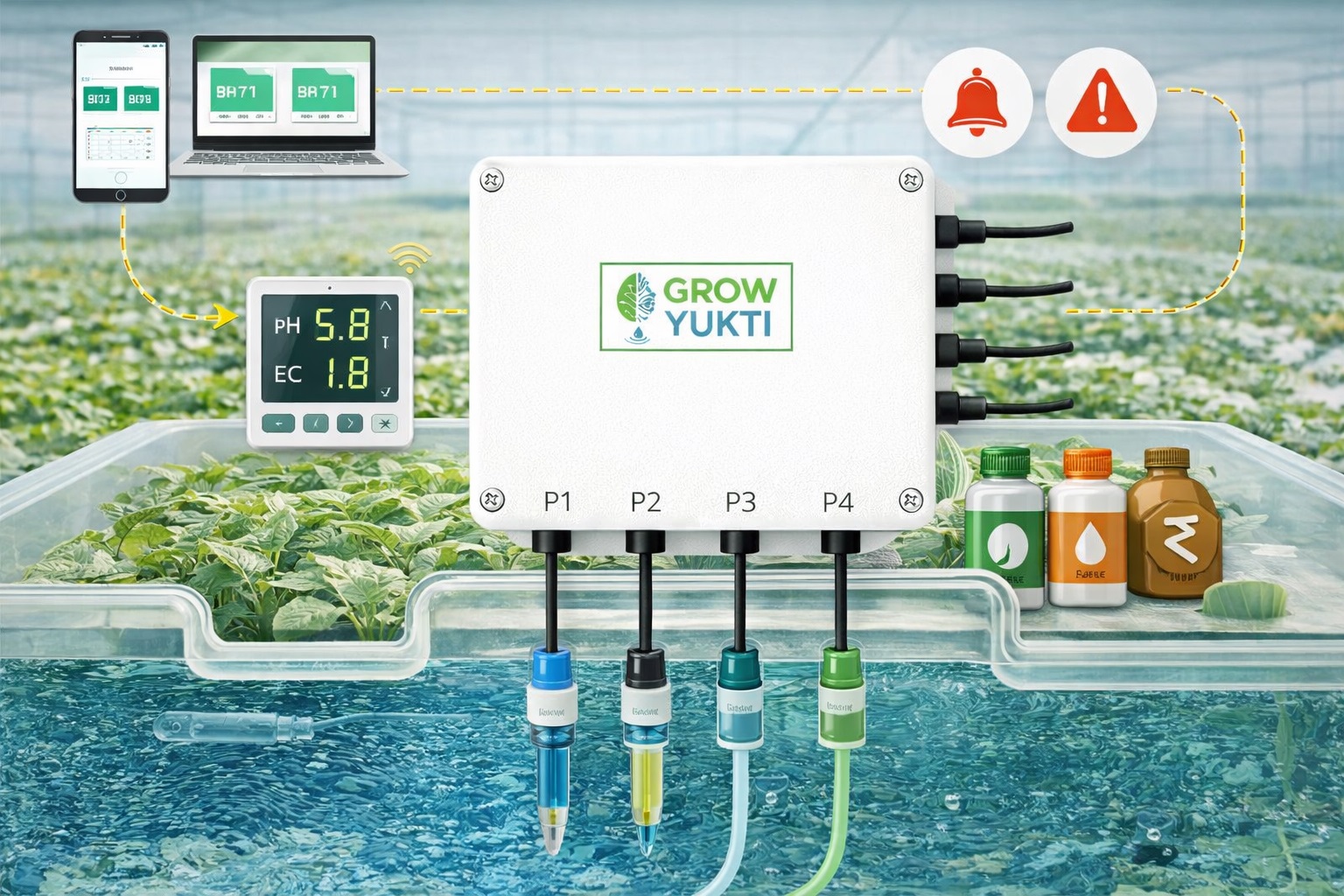
An automatic dosing system is a smart setup that continuously monitors key nutrient parameters like pH and EC in a hydroponic reservoir and automatically adds precise amounts of nutrients, acids, or bases to maintain optimal levels.
Instead of manual measuring and adjustments, the system uses sensors, controllers, and dosing pumps to make real-time corrections, ensuring plants receive a stable and consistent nutrient solution.
How Automated Dosing system are Different from Manual?
Manual dosing depends heavily on human judgment—measuring, adjusting, rechecking, and hoping conditions stay stable until the next round.
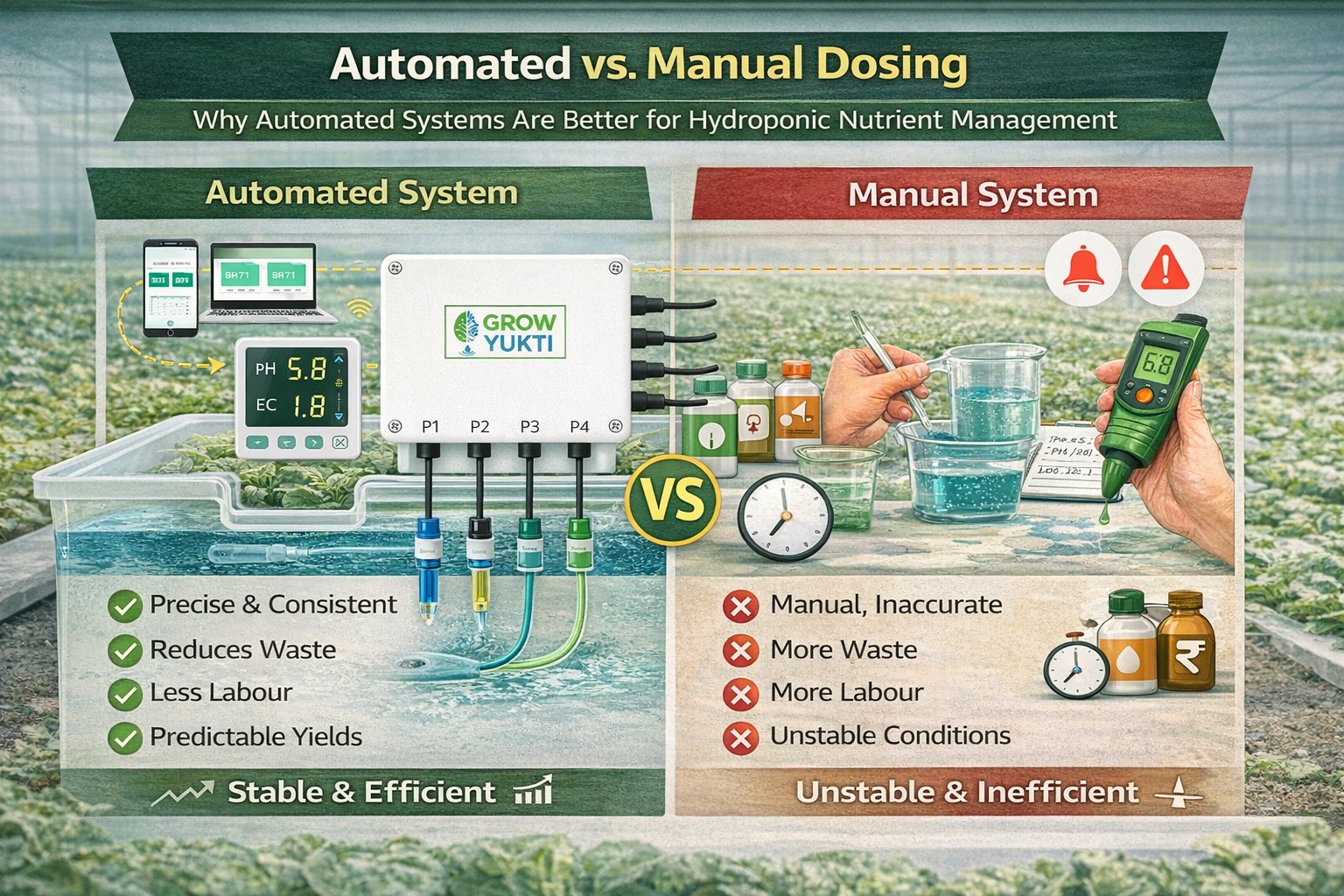
Automated dosing systems work differently: they continuously monitor parameters like pH and EC and make small, precise corrections in real time. Instead of reacting after problems appear, automation prevents fluctuations before plants are affected.
Benefits of Automated Dosing for Hydroponics
1. Automatic Dosing systems are highly Precise
Plants are sensitive to small swings in pH and electrical conductivity (EC). Automated dosing systems measure pH/EC and add acid/base or nutrient solution in tiny, repeatable amounts to keep those parameters inside narrow setpoints. The result: fewer nutrient lockouts, less stress, steadier growth rates, and more predictable harvest weights and uniformity. Read this article for details on how to control water pH in Hydroponics.
Why that matters: In hydroponics, a single missed correction or an over-dose can reduce growth or cause blossom/leaf issues across an entire channel. ADS reduces those mistakes by reacting immediately and proportionally.
Ready to Automate Your Farm?
Don't let manual dosing hold back your yields. At Grow Yukti, we help Indian growers design and implement smart automation solutions tailored to their specific needs.
2. Less nutrient waste and lower recurring costs
Manual dosing is often a game of ‘guess and fix.’ You might add too much nutrient, then have to add more water to balance it out, which wastes both chemicals and time. It’s a frustrating cycle that costs you money.
An automated system works differently. It adds tiny ‘micro-doses’ only when exactly needed. This precision means you stop wasting expensive nutrients and pH balancers. Over a few months, the savings on chemicals and water can actually help pay for the system itself.
3. Saves labour and reduces human error
Manual checks (measure pH, add chemical, re-check) take time and are prone to inconsistent technique between operators or shifts. ADS frees staff from repetitive dosing chores and reduces mistakes from fatigue or training gaps.
For small operations a few minutes saved per day adds up; for commercial farms it often means reassigning skilled labour to higher-value tasks (propagation, packing, quality control).
4. Better traceability and data for optimization
Think of a modern dosing system as a ‘black box’ recorder for your farm. It tracks every drop of nutrients and every shift in pH or EC. This information is a goldmine—it helps you understand exactly what makes your plants grow faster and alerts you to water problems before your crops get stressed.
If you enjoy using smart tech like ESP32, Arduino, or MQTT, you can easily link this data to your own dashboard. It turns your farm into a ‘smart farm,’ giving you real-time updates and phone alerts if anything goes wrong.
5. Scalability & consistency for commercial operations
As your farm grows from a few pipes to multiple greenhouses, trying to balance nutrients by hand becomes impossible.
Automated dosing allows you to control several zones from one central spot, saving you hours of work. More importantly, it ensures every crop gets the exact same nutrients every time. When you sell to shops or restaurants, they expect perfection with every delivery—automation helps you hit that mark every single harvest.
Cost comparison for Automated Hydroponic System
Below is a practical comparison of typical systems you’ll see on the market. Costs will vary by brand, region, and features (number of dosing channels, pump quality, sensors, integration). Figures are ranges to give you an idea.
Dosing Systems Price List (India 2026)
| Product & Purchase Link | Best Application | Approx. Price (INR) |
|---|---|---|
| Hydroponics Dosing System (Industrial) | Large-scale commercial farms & polyhouses | ₹2,00,000 |
| Bluelab Intellidose Controller | Premium automation for commercial greenhouses | ₹1,42,900 |
| Neptune Systems DOS | High-precision dosing for semi-pro setups | ₹34,999 - ₹37,500 |
| Enakshi Fertilizer Injector | Mid-sized systems requiring reliable injection | ₹19,345 |
| Jebao MD-4.4 Smart Doser | Budget-friendly WiFi control for home growers | ₹11,000 |
| Chihiros Dosing System | Small/Indoor hydroponic kits & hobbyist tanks | ₹10,500 |
| Automatic pH Dosing System | Simple, targeted pH-only correction | ₹7,500 |
* Prices are approximate and subject to change based on market availability and import duties.
- The higher-end controllers like Bluelab Intellidose are purpose-built for horticulture/hydroponics and offer robust pH/EC control and fertigation management, making them more reliable for commercial operations.
- Mid-range systems (₹30,000–₹40,000) often originate from aquarium or greenhouse dosing technology but can be repurposed for small hydroponic farms with customization.
- Budget dosing pumps and controllers (under ~₹20,000) are more basic, typically pumping without closed-loop EC/pH feedback — useful for small setups or as part of semi-automated systems.
- Large, fully integrated hydroponic dosing + greenhouse automation systems from Indian vendors (e.g., Emesh Farms Technik, ₹2 Lakh+) exist but are quoted via inquiry rather than fixed online pricing.
How to Choose the Right Automated Dosing System for Your Farm Size
Small / Home Systems
For hobby growers and small indoor setups, basic dosing automation is usually enough. Simple multi-channel dosing pumps combined with automatic pH control can maintain stable nutrients without adding complexity or high cost.
Medium-Scale Farms
As plant numbers grow, consistency becomes critical. Systems with accurate pH and EC monitoring, multi-head dosing, and proportional control help manage multiple trays or channels while reducing daily manual effort.
Commercial Farms & Greenhouses
Large operations need industrial-grade fertigation controllers designed for continuous use. These systems support multiple nutrient lines, precise scheduling, expansion, and integration with greenhouse automation—making them essential for scale, reliability, and uniform crop quality.
Technical Buyer Checklist for Automated Dosing Systems
1. Sensor Accuracy & Reliability
- Industrial-grade pH and EC sensors (replaceable, not disposable)
- Temperature compensation for EC
- Proven long-term stability (low drift)
- Easy calibration process with standard solutions
2. Dosing Capability
- Number of dosing channels matches your nutrient recipe (A, B, pH up/down, additives)
- Peristaltic or chemical-compatible pumps
- Adjustable dosing rate (ml/min control)
- Micro-dosing support (small, frequent corrections)
- Anti-backflow and siphon protection
3. Control Logic
- Closed-loop pH and EC control (sensor-driven, not timer-only)
- Setpoint limits and safety thresholds
- Hysteresis control to avoid rapid on/off cycling
- Dosing lockout time between corrections
- Manual override option
4. Scalability & Zoning
- Supports multiple reservoirs or crop zones
- Expandable dosing channels
- Compatible with proportional or flow-based control
- Suitable for future farm expansion
5. Data Logging & Monitoring
- Real-time pH and EC display
- Historical data logging
- Alarm and event history
- Remote monitoring (Wi-Fi / Ethernet / GSM)
- API or MQTT support for dashboards (optional but valuable)
6. Safety & Fail-Safes
- Maximum dosing limits per cycle/day
- Sensor fault detection
- Pump dry-run protection
- Power-loss recovery behavior defined
- Visual or audible alarms for critical faults
7. Build Quality & Environment
- Water-resistant enclosure (IP-rated)
- Chemical-resistant tubing and fittings
- Suitable for high-humidity environments
- Industrial connectors (not loose hobby wiring)
8. Ease of Use & Maintenance
- Intuitive interface (screen or app)
- Simple calibration and maintenance workflow
- Easy access to pumps and sensors
- Readily available consumables (tubing, probes)
9. Integration & Compatibility
- Works with your existing irrigation system
- Compatible with nutrient brands you use
- Can integrate with greenhouse controllers or farm software
- Optional cloud or local-only operation
10. Vendor & Support
- Local service and support availability
- Clear documentation and wiring diagrams
- Spare parts availability
- Warranty terms clearly defined
- Upgrade path (firmware / hardware)
Ready to Automate Your Farm?
Don't let manual dosing hold back your yields. At Grow Yukti, we help Indian growers design and implement smart automation solutions tailored to their specific needs.